
There’s nothing like the lessons that history teaches us about ourselves. I sometimes wonder how this time in our lives will be judged in even a few decades with all the venom spewing onto social media and the internet. To escape the news, I picked up Bill Bryson’s wonderful book, “One Summer…America 1927.” I know it was a bestseller when it was published, but this was the perfect time for me to read it. I had also recently read “In the Garden of Beasts” by Erik Larson, a history of Germany in 1933 as Hitler was coming into power.
The current news is disturbing, watching crowds of Americans chanting hateful words at fellow Americans. Everywhere there is the fear of people who they assume are different from them, whether they be Mexican, Middle Eastern, of different religions or sexual orientation. We seem to be confused about what kind of people belong in America.
Reading Mr. Bryson’s book, my senses sharpened as I read his description of the 1920s, noting that instead of the terms like the Jazz Age, the Roaring Twenties, etc, it could have been called the Age of Loathing. “There may never have been another time in the nation’s history when some people disliked more people from more directions and for less reason.”
He continues with descriptions of the bigotry, especially the Ku Klux Klan, which reached record numbers. It’s focus was regional with hatred of “Jews & Catholics in the Midwest, Orientals and Catholics in the Far West, Jews and sometimes Europeans in the East, and blacks everywhere.” Then there was the national interest in eugenics, the scientific cultivation of superior beings. Using eugenics, people were deported, groups were restricted in the places they could live, civil liberties were suspended and thousands of innocent people were involuntarily sterilized, including people who scored low on the newly developed IQ test, used not to determine who was the smartest, but who was the least intelligent so they could be weeded out. In the way that these things tend to move, the people chosen to make these decisions had their own prejudices and interests projected onto the results of testing. Those with epilepsy and other mental or physical disabilities which made them inferior stock, so to speak, were victims also. Europeans were tiered with lighter skins being preferred to the darker skins of the more southern regions.
You can read both of these books to see the similarities of what is going on in our country today – and you should!
I had already been trying to process the anger and fear I see daily. It’s hard to understand where it comes from when I look around me. For one thing, what exactly qualifies a person to be considered white? Since the beginning of our country, immigrants have flooded in, assimilating into the country while still retaining some of their heritage. You can drive across the Kansas plains and see tiny towns on the flat horizon with the steeples of large churches built by the European settlers who came there standing out as the places the farmers came together to worship in this new land. I was just in Okarche, OK, which was settled by Germans who conducted all their education and worship services in German until just before World War I.
Since I was born in 1945, I have seen the acceptance of so many different kinds of people in my own little corner of the world. As a child, I only knew African American people in service areas but, through the years, I became friends with bi-racial couples and worked with professional people of all races. Being Native American was not embraced even in Oklahoma, the land of the red people with more than 70 tribes today. Now it is a source of pride with people searching for traces of Indian bloodlines.
The recent surge of interest in genealogy has opened up the realities of our country’s growth with DNA tests available to reveal our roots. My family seems to have moved from the east to the west in the traditional ways with my father’s family moving from the British Isles to Maryland and on to Kentucky, with some spurs in Louisiana, before my ancestors ending up in Oklahoma. My mother’s family took the southern route from the east coast, farming through the southern states into Texas and, eventually, southern Oklahoma. No telling what other family tree branches hold as far as mixed breeding along the way.
We’ve welcomed refugees even if it took awhile for them to be totally assimilated. I remember enrolling Vietnamese children after they were sponsored by local churches. They were so sweet as they came to a new country, a new state and city and started school when they couldn’t even speak the language. They were model students, hard working and thankful to be there.
Today, our wonderful diversity is all around me in ways that were shocking mere decades ago. Children with disabilities are not hidden or shuffled off to institutions as we mainstream them in schools when possible and celebrate them with Special Olympics. They are beloved children who teach us as much as we teach them. Medical advances have made so many lives more livable and children learn to accept rather than ridicule those with differences. One of my grandsons has grown up with a friend with disabilities and doesn’t seem to even notice.
Both of our presidential candidates have children who have married into the Jewish faith, which would have been hard to do in past generations, both from the Jewish and protestant sides. My grandmother was raised Catholic but had to leave the church to marry my grandfather who was Episcopal. True love ruled out back at the turn of the 20th century and they were married over 55 years. I can remember the fears around the candidacy of John F. Kennedy as to whether the Pope would try to run America if Kennedy were elected.
I was fortunate to grow up in a community where Jews and Catholics were community leaders and friends, so I didn’t see the kind of ugliness as much as in other places. When I worked for the American Red Cross, I took classes such as water safety, disaster planning, and even diversity to many rural schools. For our fundraising records, I was supposed to bring back the racial breakdown of the classes where I made presentations. This was almost a joke as I answered that I could barely tell the girls from the boys. In rural Oklahoma, there were so many kids who were of mixed heritage – African American, Native American, Hispanic and white. Fortunately, the teachers had the statistics for me from enrollment numbers. We all keep those kind of records these days, I guess. It was eye-opening for me to look out at a sea of 2nd or 3rd graders and try to figure out who they were. They were all kids to me and it was amusing to try to decipher the different colors of skin and facial features that could be from anywhere. Such is the melting pot we live in.
One of my grandsons asked me years ago to explain the differences in religions, especially protestants. After pondering that for a minute, I explained some of the differences in structure of the governing bodies and of the basic beliefs. I also explained that churches vary by community depending on the people who are members. You might want to join the Presbyterian church in one town, the Methodist church in another or some other religion. It was about finding which one felt right with your beliefs and where you felt you belonged as far as the membership. It gets confusing in today’s world because each religion is also subject to interpretation by the leadership. This is world wide and we all know that the worst things mankind has done to fellow human beings throughout history is usually done in the name of God. Not the God I believe in who is about love and acceptance, but the God they describe to meet their own desires.
Today, I have friends who have had to hide their sexual orientation for most of their lives and are now able to lead very happy lives, loved and accepted by their families and friends. It’s not always easy for them but they can at least know there are places and people who are working to make it easier for them to live and work as they please. My boss at Oklahoma State University is from Malaysia. Last week, I sat with three friends and thought about where we all are. One of them has a gay son, one has a daughter who is married to a Muslim and raising her grandchildren in that religion and one has a son who is married to a German girl. A friend from long ago was able to see his son married to his partner and accepted at last. As parents and grandparents, we accept and love, even if we know there are still those who will make it more difficult for them along the way.
As two of my grandchildren graduated from high school this year, my own high school, I took pride in watching the cheers from the students as classmates of various racial backgrounds crossed the stage. They are so much more accepting than we were because they are exposed to the differences in their everyday lives. They play sports with them, go to class with them, and get to know them as people. Sure, there are still those who snicker and make tacky jokes or mean comments, but it is infinitely better. In their world, where everything can change in a minute with social media, I still see things as better.
I worry today with the hatred I see spewing because it’s hard for me to understand the fear. The more people with differences of race, religion, sexual orientation or physical limitations you meet, the more you relate to them as fellow human beings. Basically, we all want the same things in life – to love our families and provide homes and ways to contribute to our societies. Sure, there are aberrations with people who have distorted visions and sick needs and ugly aspirations for power and control, but people are basically good.
What is a white person, this ideal that people want to bring back, anyway? There are so many shades of skin that I don’t know what that term even means. How can you be a white supremacist if your own heritage may be of a nationality that was once the focus of the hate you are now spewing? Do you have Italian or Irish blood? You were once hated and feared too. Scandinavians were also suspect as were any people who spoke another language. Where do your people come from anyway? Who are you to think you are superior to anyone? Really?!
What were those good times that people talk about? Do you want to go back to a time when people were discriminated against because of their heritage, their skin color or even because they were women? How good were those times? I can look back fondly at the past and loved growing up in the 50s and 60s, but there were some things that weren’t so great. Adults didn’t talk about anything with kids and I’m always finding out family secrets that were hidden in those days. Finding them out makes understanding easier. There was alcoholism and abuse and no telling what other ugliness hidden in those perfect families of the day. There was discrimination in the workplace and in daily life, all hidden in pleasant seeming communities and churches. It wasn’t quite as peaceful as it looks like in the nostalgic pictures we see.
People will always be people, with all the good and bad things that implies. In our country, in our time, I hope that we will always try to be the best of the best. Let’s be the place where people feel free to believe and live and love because when those things happen, our whole world gets better. Today and every day, let’s look at our own prejudices, which we all have, and try to understand why we have them. Take each prejudice one by one and find someone who makes that prejudice just wrong. If you can find one person, you can find many and, maybe, just maybe, one person at a time, we can put people in perspective and not judge them as a whole but as individuals who enrich our lives. Together, we can recognize the ones who are making it difficult for others and make changes. Together, we can do lots of wonderful things.
We have to keep trying to stop hatred and the ugliness it spreads and encourages. We have to keep trying!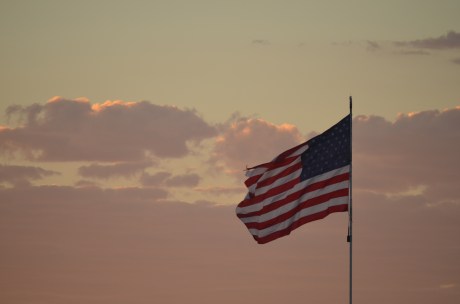
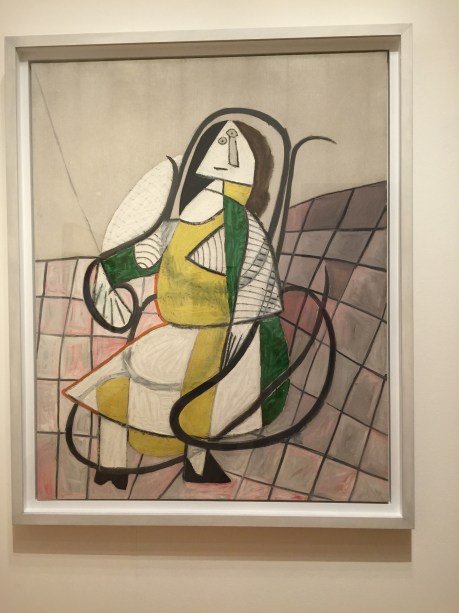
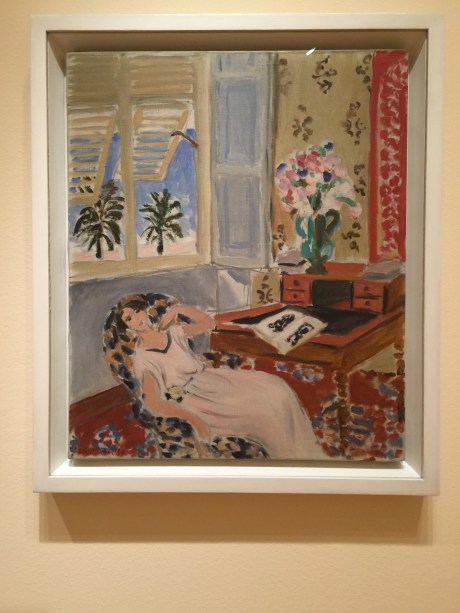 It wasn’t a large painting at all. When I saw this Picasso, I felt a big smile. Oh you, Picasso, you! “Rocking Chair” was one of my favorites I kept returning to. Maybe I saw my future!
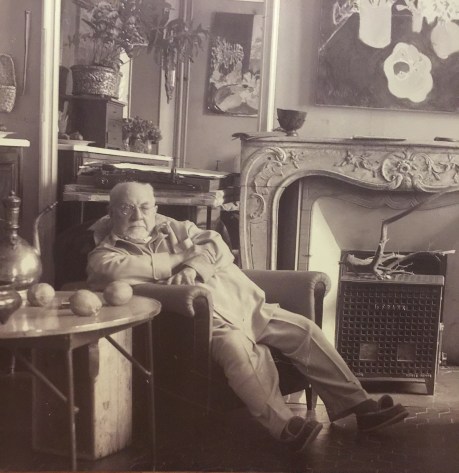
 I won’t spoil the show for you, but it was pretty spectacular for art lovers. To think he spent his last years cutting designs and creating fanciful treats for us to enjoy all these years later. Thank you, Matisse!
 I went downstairs to see the permanent Chihuly exhibition and the rest of the museum, going back through the Matisse show before I finally left. Chihuly brightens my day and brings joy to my heart. Having tried glass blowing, I can only say it takes not only creative talent but an enormous amount of strength to master the manipulation of the hot, heavy glass. His work always makes me go Wow!
 Since I was by myself, I thought I would do some things I’d been wanting to do. Next was the Oklahoma City National Memorial, just blocks away. Did I mention I was born in Oklahoma City and lived there until my family moved to Tulsa when I was 2 1/2, back in 1948. I spent much of my life traveling back to see my grandparents, aunts, uncles and cousins and even spent work time here later on. It is a part of me.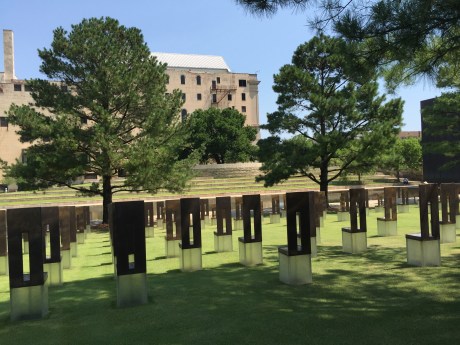
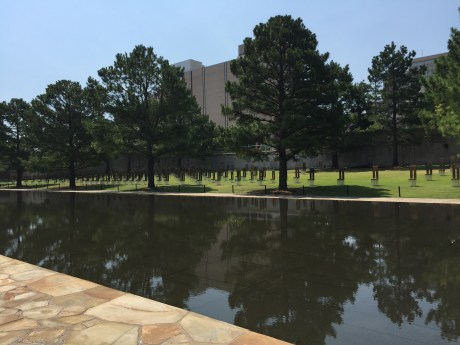 A couple of years ago, I toured the JFK Memorial in Dallas and I felt the same way about this one. I lived through it and it is so painful to walk through each detail again. Both are wonderful walks through our history with details that take you right into the moment if you were here at that time. For those who are younger, these are important ways to understand and learn what happened, bringing it to life. In the OKC memorial, you walk into an exhibit that shows what a normal day it was and then you wait to enter a room that is a copy of the ordinary meeting room where the Water Resources Board was meeting that fateful meeting. They had recorded the meeting and you sit in a closed room listening to a woman start the meeting, giving instructions, greeting the visitors, knowing that you are going to hear an actual recording of the bomb exploding. I was lulled into listening to her as she routinely did her job and then jolted by the sounds of bomb, screams, hysteria and confusion. You then enter the rest of the story. I didn’t spend too much time there as the photos and sounds were so very familiar to me. I stood in the memorial room, looking at the portraits of the victims, hearing their names as they were called as each person’s picture was lit. Powerful stuff to see the miniature memorials of stuffed animals, tokens of memory placed by families. Powerful. I was ready to race back into the 100 degree heat and rest in the memorial outside, standing in the shade of the huge tree that showed us we can make it, even through such atrocities.
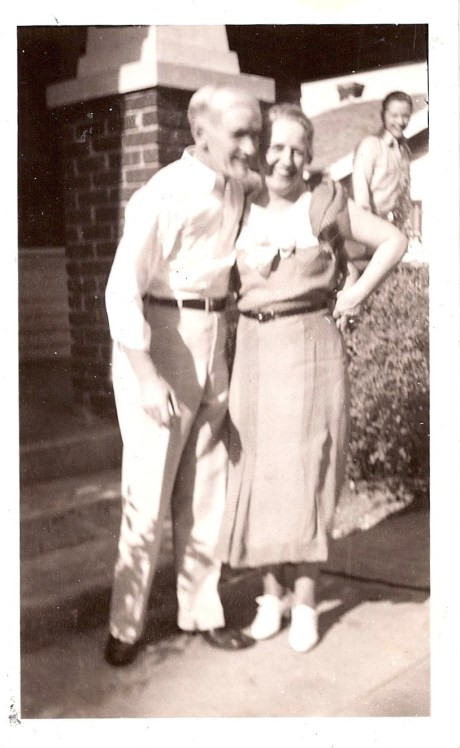 Here they are, relaxing in that wonderful home, much smaller than I remember it when we gathered for dinners and holidays. My grandad had his workshop in the garage in back and the big kids got to eat at the big table in the room behind the kitchen at the back of the house. The smaller children ate at the kid’s table in the kitchen. The beds were so tall that we could crawl under them easily and had endless games of hide ‘n seek. We played on that porch and walked that street for hours.
 Driving around the corner, I saw the movie theatre we used to walk to, now an antiques mall…
 …and parked across the street for a fried chicken lunch. It seemed like the right thing to do and the right area to be in.
 After drinking as much liquid and eating fried chicken and fried okra, I headed further north with the goal of visiting my grandparents’ grave, very far north in a city that sprawls forever. Driving past the more affluent areas where my grandparents and cousins lived later, I finally arrived at the cemetery. I have to tell you that my family isn’t much for visiting graves and I hadn’t been here since my grandmother died in 1977. My parents were both cremated, which I agree with, so here we are. I’ve visited all my grandparents’ graves now along with my great-grandparents, so I’m up to date. There are mixed feelings about graves for me. They are interesting, but I’m obviously not out there all the time. I don’t know if we are losing some history, but I’m about dust to dust too. I’m being cremated myself.
 Wiley Post, the great aviator from Oklahoma who died in the Alaskan plane crash with his friend, Will Rogers.
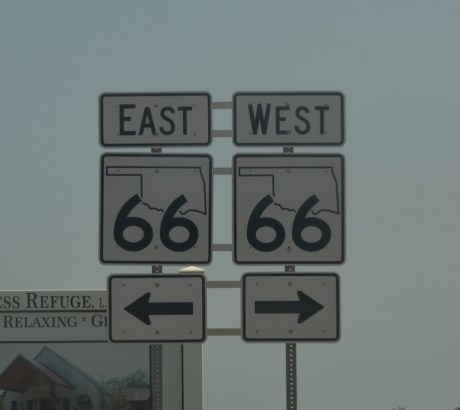 I hadn’t been on this stretch in a few years, so it was a new adventure. There are places with stories like this.
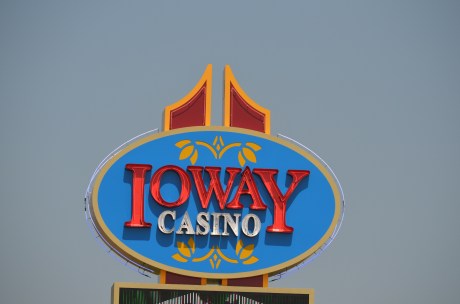
 And then you turn a corner and then modern times hit you as you meet the new Iowa tribe.
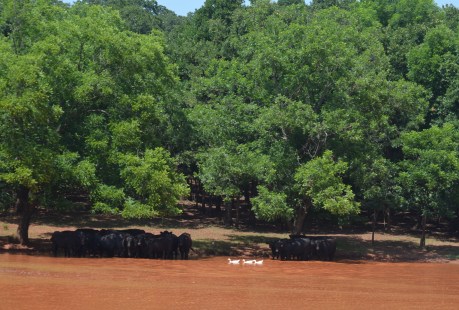
 In the eastern side of Oklahoma, we have brown dirt, regular dirt. About halfway between Tulsa and OKC, you begin to see the red dirt, clay colored dirt. Growing up, we would play in this bright stuff, staining our summer clothes. I guess my mother knew how to get it out because I’m picturing white shorts and tennis shoes with globs of red mud on them. Anyway, that memory came back as I saw this scene with cows and ducks cooling off in the red muddy waters.
 Across the road, there was a farm with green plants pushing up through the red earth.
 I kept turning around and going back to see these things. On the last pass by this field, where I had stopped to take pictures, I had to stop at this sign, conditioned by my mother who never saw a road-side stand she didn’t love.
 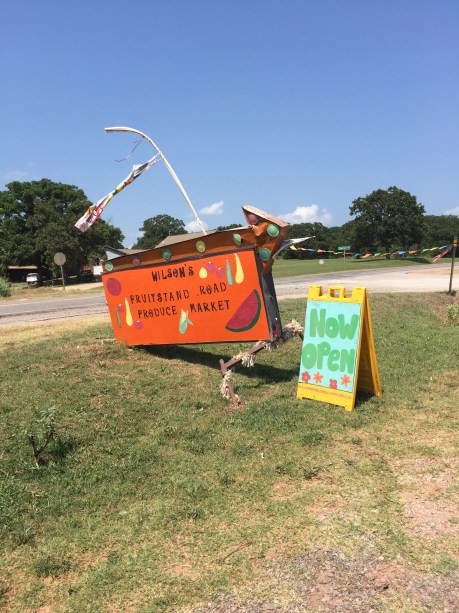 I mean, you have to stop, don’t you? Especially when you can meet Mr. Wilson himself.
 I know he thinks I’m the most ignorant city girl he’s ever seen as I asked him questions about how hard it is to grow crops in that red soil. Of course, he smiled his missing tooth smile and told me it’s no problem if you have water. Of course. And I purchased potatoes and peaches and tomatoes from him, even though I asked and he told me that these weren’t his crops as his aren’t ripe yet. Duh. Of course they aren’t. I know when Oklahoma crops come in. But I wanted to keep his stand going, chickens running around with its cute painted things and all sorts of quirky items on the ground.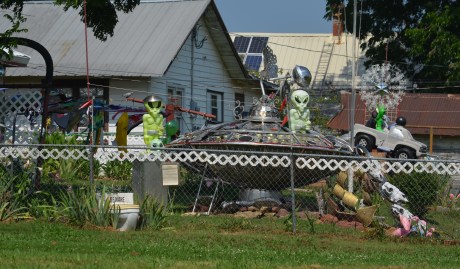
 Following along, I approached Depew and took the truck route through the mostly deserted town. It had its own charm as I drove the main street, thinking of the people who came from all over the country to travel this road.
 Leaving Depew, I crossed the old railroad tracks leading east.
 Now I was passing through other towns that had jumped on the Route 66 bandwagon and restored their main streets with antique shops and restaurants and museums for those who are hitting the off roads again. Occasionally, I saw one of these signs and jumped off the current Route 66 onto the old one.
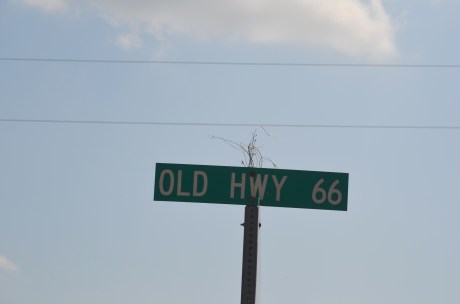 Driving for just a stretch, I would imagine how it must have been with new fangled cars heading across the country on great adventures – without the air conditioning I was enjoying so much! Whew! These old stretches have wildflowers still alive before our stretch of summer heat wilts them all.
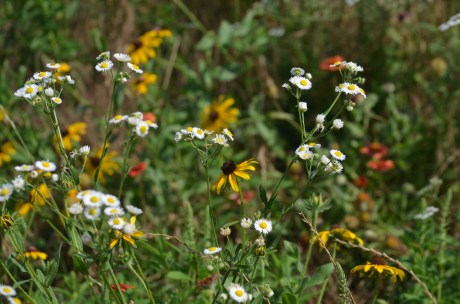 At a house on the old road, I saw this basketball goal where someone had made Old Hwy 66 into a private court.
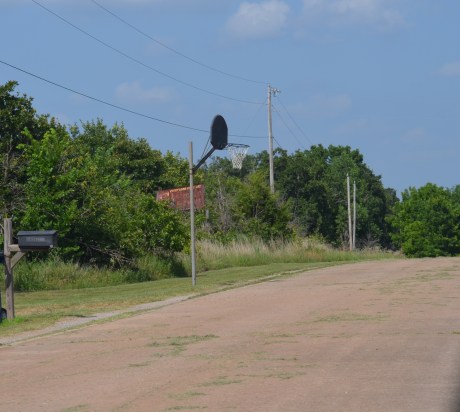 Here’s the old sign you see in the background.
 Turning back from this little touch of the old Mother Road…
 I kept going, stopping and turning around for things like this that caught my eye as I made my way home.
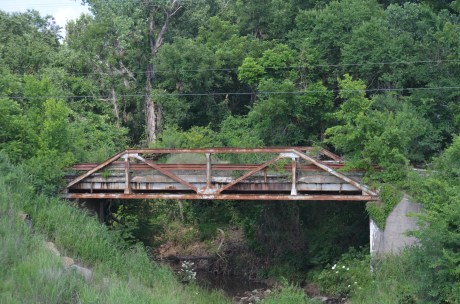 And this. I saw the sign from the road and then turned onto the next street with another one of those Old Hwy 66 signs.
 It was deserted, but must have been a lot of fun at one time.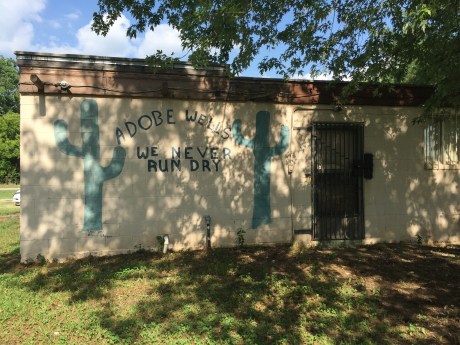
 That was my day on the road alone, not rushing anywhere and stopping to see whatever. Adventures and people I wasn’t expecting made me arrive home hot and happy. I should do this every week, this getting in the car and going somewhere. There’s so much to see out there in ordinary places and I’m old enough to enjoy it and young enough to do it. Thanks for coming with me…
 Confetti Thoughts