Archives for category: Uncategorized

Forgive my eye roll as I listen to discussions in the news on how women are most fulfilled by staying home and raising babies. Everyone knows how much I love my children and how I enjoyed being home with them, but…here’s my story.

When I went to college in 1963, women were beginning to be expected to work really hard through high school to get into college and then…well, the options we were given were ok but really an excuse to stay in school and find a college educated husband. If you had to work after college until you found one, that was ok, but you were still kind of expected to start a family as soon as possible.

I’m not sure I really had a goal of any kind. I was smart, observant, in love, and thought my life would mirror my parents’, which was pretty nice I thought. I was very naive about how the world was going to work for me and my friends. I got married right after I turned 21, finished school, started grad school so I could teach while my husband finished up, and had my first child. Our life progressed as we thought it would and I stayed home and had three more kids before I turned 30. My husband worked with my father, I loved the babies (which I had never even thought about before I had them), and we were happy.

But, there was the fact that I got bored when the kids were asleep or at day care, preschool, school. Housework and playing bridge weren’t really doing it for me. I started doing volunteer work, as was expected of those of us who had it so seemingly easy, and found an unpaid career that filled my time, brought me new friends and taught me more than I ever imagined. I learned new skills and attained new leadership positions. My thought was that I couldn’t be out saving the world, but I could save my own little world, one day at a time, while still doing all the mom things, which I loved.

By the 1980s, I had edited a cookbook, a magazine, planned for city growth, worked with the arts, helped educate people on Historic Preservation, served on Boards of Directors and was feeling pretty good. It was the 80s and women were speaking up more and more. I had heard Gloria Steinem speak when I was in college and read all the women’s and new magazines and current books and was up on Women’s Lib, as it was called, sometimes not in a nice way. I understood and empathized, but I was busy driving a billion carpools and leading committee meetings and selling popcorn after school – all things that were needed. I wasn’t out marching for Women’s Rights. I didn’t have time.

The Equal Rights Amendment was in the news and states were ratifying it and dismissing it. Would it ever get passed? Nope. Women were slowly gaining more rights but were still not considered equal under the law in the United States. That’s the truth and still is to this day. It doesn’t mean that we can’t get more rights, but it means that they can more easily be taken away. Eventually, it was out of the news and women were content with small victories along the way. NOTE: we never should have stopped fighting for it.

I thought of myself as a person who was good at bringing people together to make decisions and finish projects and get things done. I was aware of inequities for women, but I wasn’t much of an advocate – yet. The Junior League of Tulsa was a bastion of educated women who spent their time trying to make the city a better place. It was the epitome of what women, even women who were proud homemakers and mothers, could do to make change. In 1983, two projects were proposed for the coming year. One was to work with domestic violence advocates and organizations to increase awareness. This was a new movement at the time.

The second project was to collaborate with The University of Tulsa to open a resource center for women who needed help as their lives changed due to numerous upheavals and changes of direction. This included women who needed to go to work, women who were widowed or divorced and left to fend for themselves and would help women who didn’t have the opportunities and contacts my friends had at the time. I first heard the term “displaced homemakers.” For some reason, the Catholic community decided that this project would be doing abortion counseling and there was a big uproar with even the Bishop becoming involved, articles in the paper about it all causing much division in the Junior League membership. After all of this, when it came time to vote for new projects to give our time and money to, I wasn’t sure if we should do something that was causing so much friction. I’m not sure how I voted, but both projects passed and were ready to go. Then it was time to choose chairmen for the projects. I was more than shocked when I got a call to chair the women’s resource center project. My first inclination was to say no, because why did I need to have stress like this, but a good friend convinced me that I was the right person precisely because I didn’t have a side in it and could work to bring everyone together. Flattery and a new challenge were appealing and I took off on a year that would be life changing in so many ways.

Our joint committee of volunteers and representatives from TU worked for nine months to set up the policies and hire a professional Director for The Women’s Center, as we decided to call it. We had a converted house donated by the university to furnish and set up, materials to collect, and publicity to generate. By the time we opened in January, 1984, women were pretty much lined up for the services. I’m proud to say that the center, under a different organization, still exists in Tulsa today. I met women who were desperate for job counseling, looking for places to live, needing just anyone to talk to. Nobody was asking about an abortion, by the way.

A couple of years after this project, I was asked to chair the domestic violence project as the new shelter was opened and new programs being developed. After that year, I continued to serve on the Board of Directors for six more years, including a year as Board President. In all those years, I never spoke to a community group without a woman or women coming up to me afterwards to tell me their story. They were beginning to break free with education about the issue.

This was becoming personal because I was the mother of three girls and I felt like I needed to be a role model in the fight for other women. I needed to expose them to the things that happen to women. And, I was the mother of a son who needed to be a man who respected women. My son was the one who worked for women’s rights while he was in college. Hopefully, they all absorbed some of what I was doing.

Another reason this was becoming more personal was because at the same time, my friends were also going through major life shifts. In my parents’ time, there were few divorces, mainly because the women had no recourse. They had no education or skills, no money except through their husbands, and no support from churches, society or even family. You were expected to stay in a marriage, no matter how bad it got. Cheating and abuse and addiction and gambling and men who couldn’t provide for their families are nothing new, but nobody talked about it. It was the age of secrets. By the time I was in my thirties, more marriages were falling apart. We had married young for so many reasons. Birth control was new and only available if you were married. Girls had to either have abortions in secret places, give their babies up for adoption or get married. Guys could get exemptions from Viet Nam if they were married or couples married because the guy was drafted. You were expected to have your children young for health reasons. But now, maybe some of those reasons weren’t good enough for a sustained marriage. Guys who cheated felt free to leave their families for their new love, husbands died, husbands were cruel. I also had friends who realized that they were gay, which was fine with me. They really weren’t any different, just happier. When I wasn’t out saving the world for others, I was on the phone with friends who were facing new realities.

Those who suddenly had to find work learned that those degrees we got were pretty useless if you hadn’t been in the work force building up your resume. Many sucked it up and called people they had worked with as volunteers to see if there was a paid job they could do. Networking was key to survival. Whatever job was found was mostly at entry level and many still had children at home to take care of. Divorces were messy and many a friend became a fierce advocate for their children and themselves in courtrooms where men still had an advantage. Once you were out there, it was just becoming a thing for women to get their own credit and bank accounts. There were those who suggested that women should stay married no matter what and were no support at all.

Through the 80s and into the 90s, I did a lot of writing, speaking and advocating for these women, these “displaced homemakers.” In that time, my own children went to college. The three girls married and had their first babies and my son was in college. I had gone to work part-time, then full time and had my own business. Then, suddenly, I was one of the displaced. My husband died of cancer very quickly and, after almost a year of being immersed in the world of medicine, I was out there on my own. After putting four children through college and having three weddings, selling our family business and watching my husband have to reinvent himself, our resources were at a low. I was a widow at 52. Life happens.

In the 25+ years since, I have reinvented myself so many times, used every skill I ever had, laughed and cried with friends and watched the world changing all the time. There are so many new developments in medicine and technology for my children and grandchildren. My friends are still going through transitions and reinventing ourselves for our later years. I survived because of the experiences I had through the years, the friends and family who gave me love and support, and because of the strength of the women in my family whose stories I tell with such pride. My daughters, and daughter-in-law, mother and grandmothers and all the women I have known have made me stronger and happier than I ever expected. I ride on all their shoulders.

Looking back, I smile at the dream of the “Happy Homemaker” that we believed in so blindly. It is a great part of life, but it is only part of who we will be as women. “Children are the best thing in your life” is an easy thing to say, but they can be a challenge. Some are born with physical or mental disabilities, some become addicted, some just seem to defy everything we give them, some make bad decisions. And some die. Some women cannot have children by birth and may struggle through fertility issues and adoptions. And, some women just don’t want to have children. Children cannot be the only way to happiness.

I am a lucky girl. My children were healthy and sweet and fun and came out ok. I am a lucky, lucky girl. I will always be grateful for my wonderful children. I will also say that I also had wonderful men in my life, including a supportive husband. I will always be grateful for the loving, kind men I have known and been friends with throughout my life. Because I have been so lucky, I will aways fight for the women who haven’t been. I will write and talk and post and march and vote for the homemakers and the “displaced homemakers” and those who chose another direction.

The thing is that we cannot make decisions for other people. We cannot force them to believe as we think they should or live as we think they should. We cannot judge them for their beliefs and decisions. None of us know what is going on in other people’s lives. We need to support and love and listen. We need to live the Golden Rule. Life isn’t always easy and we don’t need to make it harder for anyone. We need to be kind.

Politics has become a way to beat other people down instead of lifting their lives up. We need to be better.

Going to the theatre has always been special and you cannot recreate the total experience of being at a live concert or play or musical at home. The same goes for movies. With new technology and streaming services and the internet, you can now watch movies at home, on your computer or even on your phone. You can’t beat the convenience of watching from home, but it’s just not the same.

Recently, I’ve been back to the movie theatre several times. We all got out of the habit with the Pandemic and some people think it’s just fine. I’m remembering my lifetime of theatre going and hoping those days aren’t going away.

The first movie I remember seeing was a Disney film, “So Dear to My Heart,” an adorable combination of live people mixed with animation. I still have a warm spot in my heart for that one.

It was all so magical in those days. We saw a lot of movies without our parents as they could drop up off on Saturday morning and we could watch cartoons, serial dramas, and a feature. Sometimes there would be a live show with someone like a yo-yo man showing us how to do all the tricks.

Movies for many years started with a newsreel, a cartoon, coming attractions and then the feature. We didn’t get our news as instantly as we do today, so I learned a lot about what was going on in the world from the wonderful voice of Lowell Thomas.

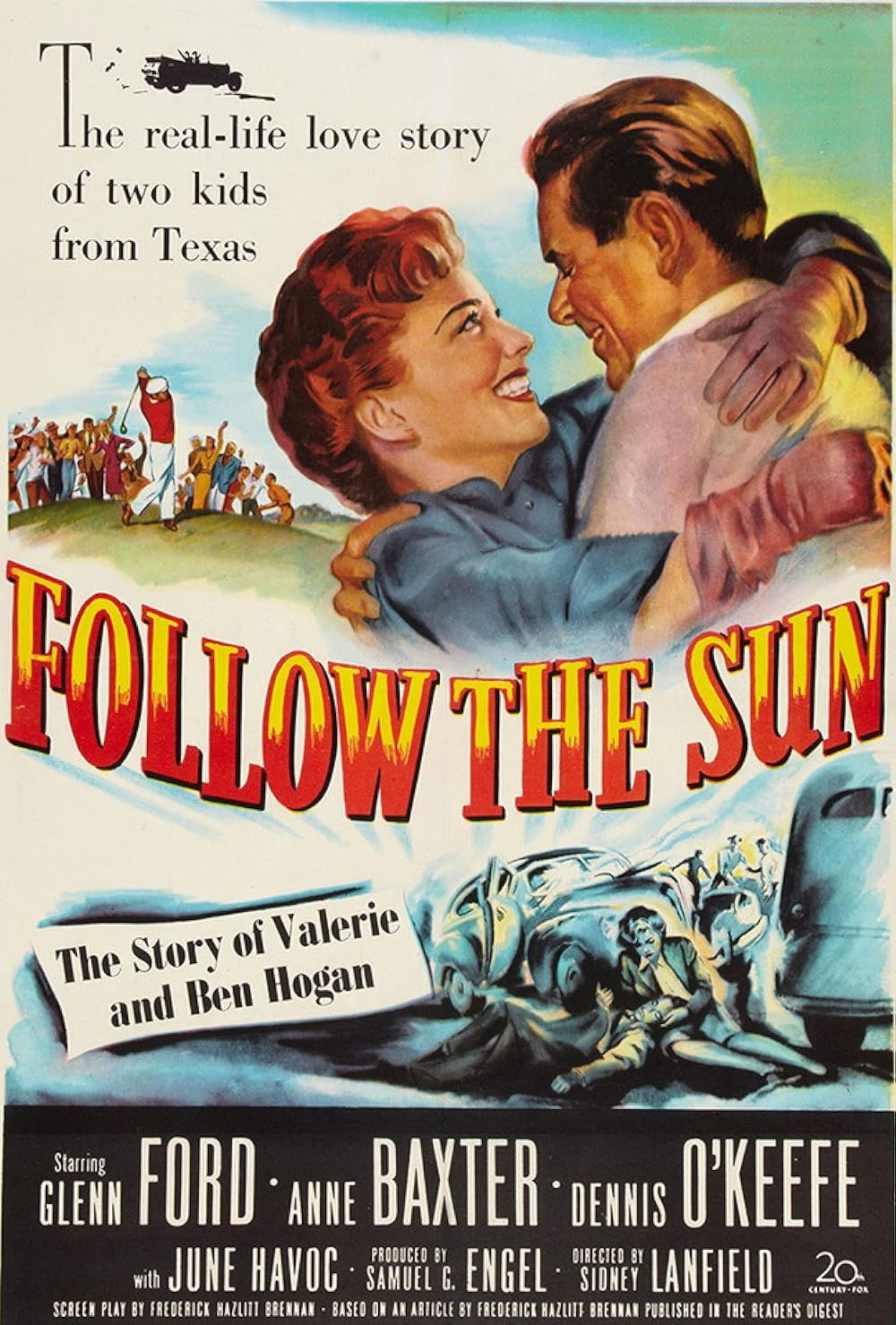
We went to local theaters, beautiful downtown movie palaces, and the drive-in movies. I don’t remember my father going to the movies very often, but I have a vivid memory of going to the drive-in to see a golf movie with my whole family (Daddy was a championship level golfer). It was the story of Ben Hogan.

I’ve never been one to go to scary movies, although I’ve seen my share. The first one I remember seeing was “The House of Wax,” which we saw in 3D and I had to watch from the back of the theatre so I could duck at the very scary parts. I’m still scared thinking about it.

Another scary one was “The Tingler,” which I saw at a theatre that had buzzers on some of the seats to give a jolt to some in the audience at scary parts. When I saw “The Birds,” they released parakeets into the balcony where I was sitting. I still think that movie was scary even when I rewatch it and see how hokey some of the effects were. It did its job on me when I’ve had birds get into my house through the years.

As we got older, going to the movies was a fun thing to do with your friends. For my 11th birthday, we took all my friends to see “Giant,” still one of my favorites. That’s one I can watch every time I see it, which is a good thing about having it so readily available (a tip to modern times).

For one of my birthdays, my little brother took me to see “Ben Hur,” which I still think was so cute of him.

In Junior High and High School in the 1950s and 1960s, the movies were one of the places we could go on a date, either meeting a guy there or being dropped off by parents or, finally, driving ourselves. We went to everything from comedies to heavy dramas like “On the Beach,” a frightening look at the future that still lingers with me. As with many movies, I also read the book it was based on.

I grew up in an era of wonderful musicals and saw them all. I think my favorite is “South Pacific,” although there are so many great ones. My husband loved the movies and we saw everything we could. It was our night out and we saw westerns, war movies, comedies, dramas. Our children grew up with movies like “Grease” and the Star Wars movies and all the teen movies of their time.

A couple of months ago, my youngest granddaughter had just read “To Kill a Mockingbird,” and the local art theatre happened to be showing the movie in conjunction with the play being in town. I took her to the movie, which I hadn’t seen on a big screen since it came out. Wow! I couldn’t help but think that the experience was so much better for her than if we had just found it on one of our many screening services. I felt the same after seeing “Killers of the Flower Moon,” which showed the horrors of events that took place less than an hour away from us. Then I saw a comedy with some friends and we laughed and enjoyed it together.

It began to dawn on me that I was missing the experience of going to the theatre to see movies. There are some that just need to be seen on a big screen with a group of people and the sounds and excitement and a box of popcorn and a drink. When I watch at home, I get up and move around and pause the action and tend to do other things while I’m watching (puzzles, looking at my phone, flipping through magazines). My concentration is not the same, no matter how hard I try to get absorbed. My dogs need out or I need to answer the phone or take the laundry out of the dryer or fix a snack. There are so many distractions.

I applaud movie makers for trying to adapt to the audience’s new viewing styles and I do think some things are very good. When I drive by the theaters, and there are just a few left, I check the parking lots to make sure people are going in person and I do seem to see more cars, although it’s not as packed as it used to be. Time changes so many things, but I hope that going to the movies doesn’t go away. There are just so many fun memories to be made, so many great stories to be thrilled by, and so many times that being with other people to experience something is still the best.

As they used to say, “Let’s go to the movies.”

Driving down a familiar street on a hot summer day, I was hit with a wave of memories of summers past. Once they started, it was hard to stop them.

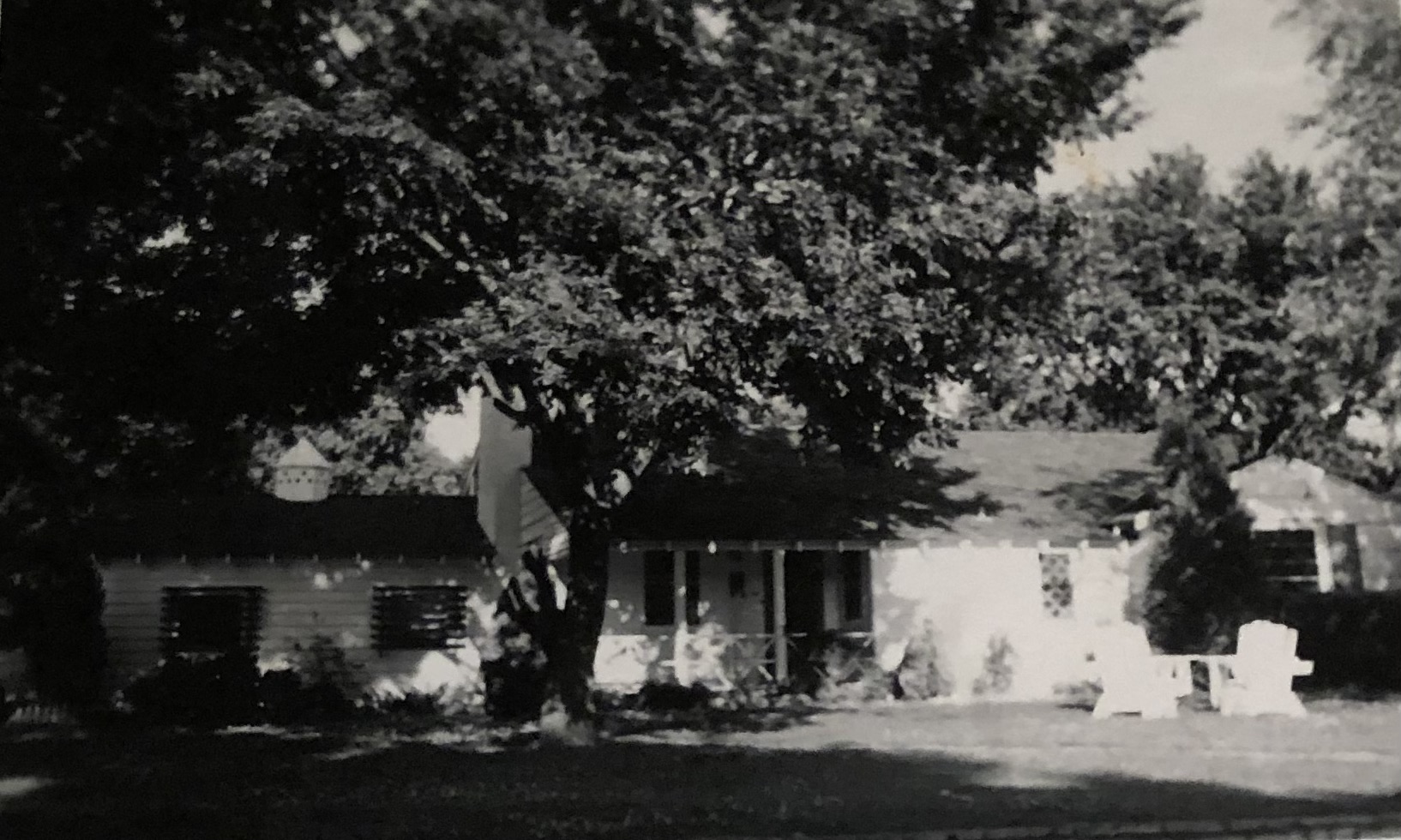
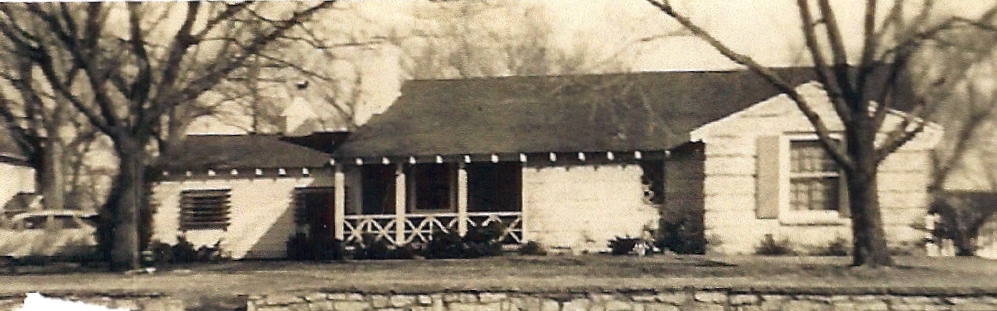
We moved to Tulsa sometime in 1948. I was about 2 1/2 years old and my brother was a baby. We lived in this house until late summer 1955 when we moved to a new custom home where I lived until I was married. But those 7 years in that first house, when I was ages 2 1/2 to 9 1/2, packed in a lot of memories.

In the summer, we played outside before there was air conditioning. We played in the sprinklers, went high on the swings until we pulled the poles from the ground, played work-up and Red Rover in our big side yard. We looked for fossils in the gravel on the street until they paved it. I learned to ride my bike on that street and attempted to roller skate with the skates that you hooked onto your shoes and tightened with the skate key.

In the evenings, we looked at the sky for constellations before there were so many lights to make the skies not so bright. We caught lightning bugs, June bugs, lady bugs, roly polys and put them in jars with a few leaves and holes we punched in the top. Sometimes there were locust shells to collect and crunch. We walked down the street to the school where I went to play in the creek. There was trumpet vine on the back fence to use for cups for my dolls and honeysuckle to drink the nectar from.

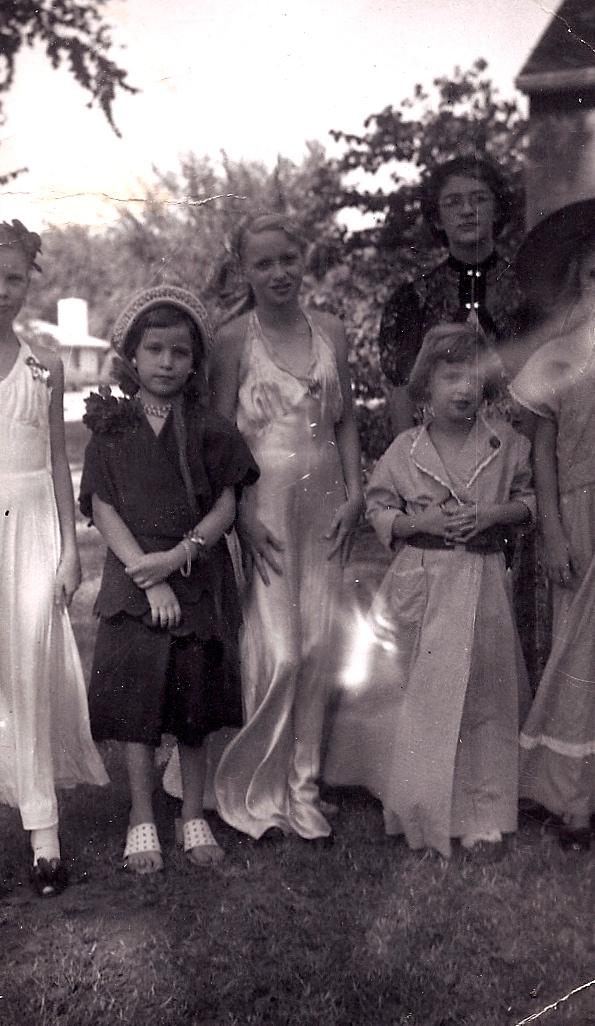
i played with my dolls and cut out paper dolls. I loved Betsy McCall in my mother’s monthly McCall’s magazine and kept all the clothes in a box in my room. I played dress up with the other girls in the neighborhood, raiding our mothers’ closets.

My mother worked in the garden, washed the clothes and hung them on the clothesline in the back yard. I loved the clothespins in their little bag that hung on the line.

In this house, my brother and I shared a bedroom with green chenille Hopalong Cassidy bedspreads and welcomed our little sister home. I think we listened to Hoppy on the radio as we didn’t have a television yet. I loved seeing him in person one year at the Tulsa Horse Show.

When I got bigger, I had my own bedroom at the back of the house with a door to the screened in porch. On hot summer nights, I laid spread eagle on top of my covers in my seersucker babydoll pajamas, hoping for a breeze from the fan and the open windows. We drank Kool-Aid (made with lots of sugar) and waited for Jack the Milkman to come so we could run to his truck for ice chips. Sometimes he would let us get in and ride around the corner with him. And the ice cream truck would bring us popsicles and ice cream bars to cool us off.

We had a patio in the back for picnics and Daddy got a grill to cook hamburgers and hot dogs. It was the 50s as you imagine.

In the summers we went to the library and I brought home stacks of books that I read quickly. There were biographies with orange covers, fairy tales, the Oz books, Nancy Drew mysteries. I read anything I could. One time I wrote a play sitting under the big elm in the front yard. It was about kings and princesses, I believe. I still have it somewhere in a spiral notebook, written in my careful printing. We played cards, spending hours with Old Maid, Crazy Eight, Go Fish. We collected comic books and read them, loving Lulu, Donald Duck, Superman and Batman and all the superheroes.

Time went on and my parents converted our garage into a “family room.” There were big couches and my mother had an artist paint a scene of cute barnyard animals on the concrete wall. And, we had a television there and an air conditioner. It was a new world. We watched tv when it came on at 5:00 with the news. If we stayed up late (10:00), you could watch the newscaster sign off and the screen turn to the overnight screen picture. On Saturday mornings, we watched all the shows. Winky Dink was an interactive show where you placed a piece of heavy plastic over the screen and then used the special crayons to finish pictures or images that were part of the show. We watched Sky King, Lassie, Rin Tin Tin, The Lone Ranger, Hopalong Cassidy, and cartoons like Popeye.

I learned to cook in this house, making little cakes in tiny pans, first in a toy oven and then in my mother’s big oven. I cooked my first dinner from my first cookbook, proudly serving it to my Daddy, who was always amused by my attempts to be a big girl. That kitchen had a corner booth where we had breakfast and my grandmother would bring us homemade french fries with little cups of ketchup when she visited. We got our first dishwasher, which was pushed across the room where the hoses were connected to the kitchen sink.

School started in the fall and we walked down the street to our school. My parents sent me there because my birthday was past the cutoff for the public schools and, besides, it was down the street.

When the leaves turned, we raked them into piles to jump in and burn in the incinerator in the corner of the back yard. We loved the smell of the burning leaves and watching the embers that escaped and flew into the sky. For obvious reasons, this was banned in the city at a later date. In the fall, Daddy brought his hunting dog home where he lived in his pen in the yard unless Daddy was training him or we were playing with him. Early in the mornings, they would head out in search of quail which Daddy would bring home to eat later.

When school started, so did our Brownie troop meetings. My mother was one of the leaders so we often met at our house where we learned to give tea parties for our mothers, how to sew on a button, how to sell cookies and took fun field trips.

For Halloween, we donned cheap costumes purchased at the dime store or dressed as hoboes or ghosts and grabbed a pillow case and went for blocks and blocks, trick or treating. When our bags were full of caramel apples, popcorn balls, and full size candy bars, tootsie roll pops and bubble gum, we headed home to dump the load and head out again. We kept our piles of candy under our beds where we would bring them out to count or trade or eat.

In the colder weather, we lit the floor furnace, which we quickly learned to step over so we didn’t burn our feet. The bathrooms were heated with little gas furnaces on the walls to keep us warm after our baths.

In the cold weather, we had fires in the fireplace in the living room where we listened to 78 records on the big record player and toasted marshmallows and drank hot chocolate. For Christmas, we hung our stockings and waited for Santa. My favorite gifts, maybe ever, were the Madame Alexander Alice in Wonderland doll in her blue trunk with other clothes and my first puppy, a red dachshund named Mr. Schmidt. We also got sleds for the small hills in our neighborhood and made snowmen in the front yard and had snowball fights with the neighbors behind the forts we built.

With spring, we planted zinnias in the back yard and dyed Easter eggs. We found baby chicks and ducks in our Easter baskets along with eggs to hide and hunt. One baby duck used to follow me everywhere until he died even though I tried to keep him warm and well. I’m sure our back yard had many graves of turtles, parakeets, chameleons and other little creatures we brought home from the dime store or the fair. We didn’t mean to be rough with them.

I had many parties for my friends at this house. There were birthday parties and slumber parties. This must have been my last one there and everyone seems to be happy with our comic book collection. I remember the noise and the giggles and the patience of my parents.

This was the house where I lost my first teeth and the Tooth Fairy left a dime under my pillow. This was where I had chicken pox, the measles and mumps. Those diseases were no fun and I can remember days in bed, the calamine lotion all over me with chicken pox and not scratching so we wouldn’t have scars (I only have one) and staying in the dark with measles so we wouldn’t go blind. Our pediatrician, Dr. Reece, would arrive at our house, driven by his chauffeur, wearing his dark coat and hat and carrying his medical bag. He walked up the steps to check our hearts and lungs and look at our tongues. He was one of the last of that kind of doctor.

In the living room, there was a little room/closet for the phone. In those days, you had to call the operator to make a long distance call. Calls were billed by the minute so they were kept short and you waited until after 7 to make calls when it was cheaper. When I was 8 or 9, I wanted to talk to my grandmother, so I snuck into the little room and called the operator as I had heard my parents do. I can’t remember if I knew her number or just gave the operator her name, but I got to talk to her. I felt very brave and grown up and sneaky. Did I get in trouble? I don’t think so. Daddy probably didn’t realize I made the call, unless my grandmother told my parents. She wasn’t one to tell on me though.
One time I was mad at my mother, so I packed a peanut butter sandwich and an apple in my little suitcase and ran away from home. Was I 6? I made it to the other end of our block and sat down to eat my sandwich. I really didn’t know where to go, so I turned around and went back home. Home wasn’t that bad.

Were those the “good old days” of my life, the years in that house? They were definitely good for us, but they were just a part of my life. I’ve lived long enough to have perspective and to have learned history. Those days were good for us, but they were unrealistic for both my parents. Women had few rights and men had unbelievable expectations. And we were white. Needless to say, the world wasn’t fair then for so many others. I’ve met people from different backgrounds who lived at that time and shake my head at our ignorance and ability to not see what was in front of us. We also didn’t understand the lives of those around us who were dealing with infidelity, substance and alcohol abuse, spousal and child abuse. These things just weren’t talked about, much less dealt with. I was one of the lucky children.

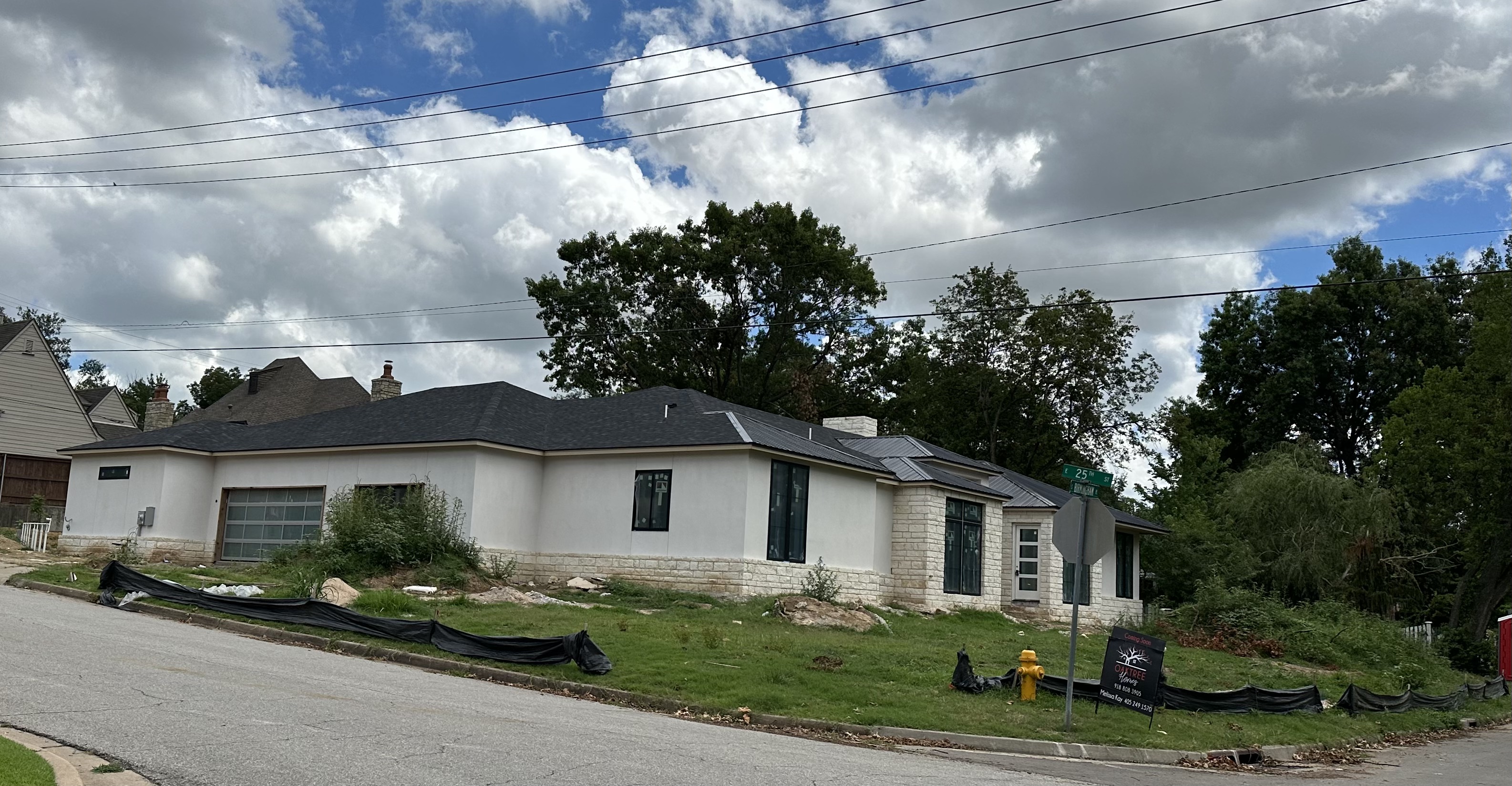
I’ve lived most of my life within about a square mile, so it was easy to drive by the house now and then. It was updated through the years, but it was still the house. A couple of months ago, I happened to turn that way and arrived just as the last piece of the house was demolished before my eyes. I was shocked, but shouldn’t have been surprised. Such is the world.

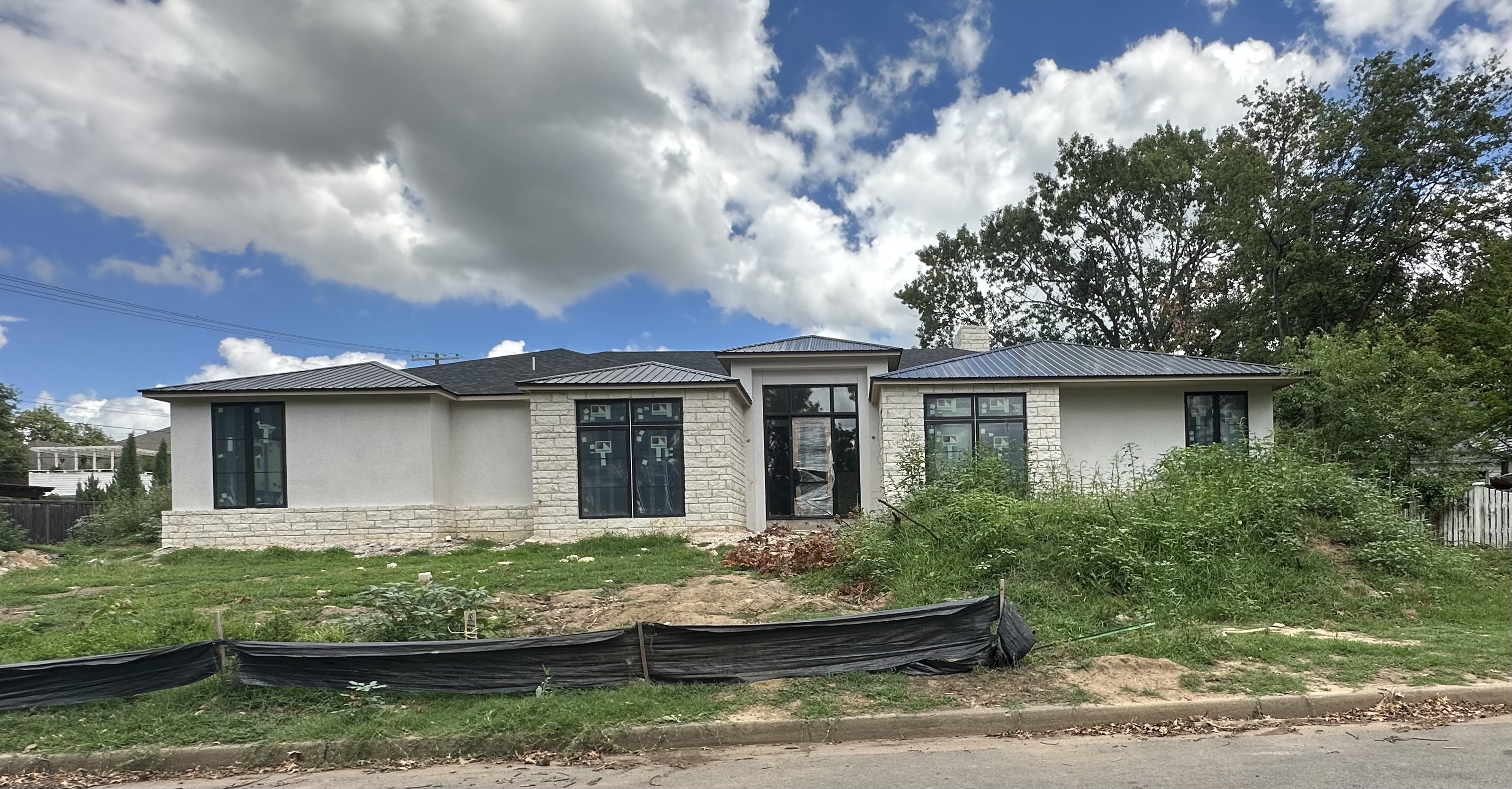
Here is the house being built there now.

It isn’t the worst it could be, but there is no side yard for playing and I’m sure the back yard is a carefully planned outdoor kitchen/patio. It will be a nice home and I hope that the families who live there make special memories.

For me, I have the memories of my years there that helped to make me who I am today. I’m basically still that little girl with the big imagination and the urge to explore and hoping to be brave enough to jump off that wall.

Recently, I came across this children’s book first published in 1929. I recognized the illustrator’s work from books I had as a child and started looking through it.

The author’s note inside tells the purpose.

There are pieces on children from almost every culture and the author talks about the physical differences in the way the children look as well as what they eat and wear, and shows the cultural customs of each country. It’s pretty straight forward and well done.

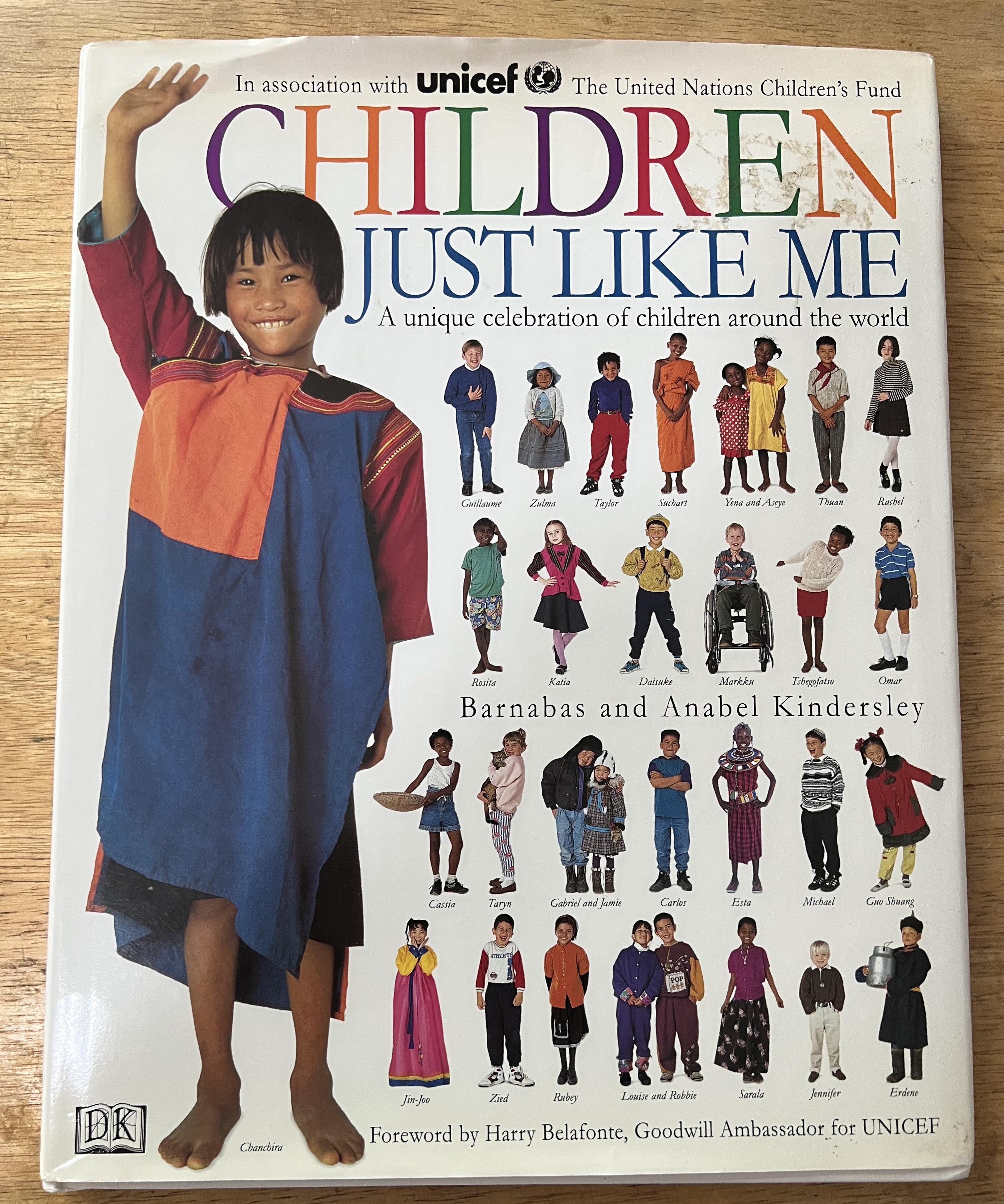
This reminded me of another book that I have and used when I used as a supplement to lead discussions from the programs in the “Different and the Same” curriculum for 2nd and 3rd graders developed by Fred Roger’s company. I was doing this when I worked for the American Red Cross, which must serve all people regardless of any differences. This book was developed by UNICEF in the 1990s:

The forward is by Harry Belafonte, the late, great entertainer and Goodwill Ambassador.

This book looks at over 30 countries and shows the children’s homes, food they eat, clothes they wear, along with photos of their families. I remember when I first saw the book thinking that we all just want to take care of our families no matter how we achieve it in our individual societies.

When I was a child, I loved the song “Jesus loves the Little Children” and it became a central part of who I am. Nothing I ever learned in all the decades sense has wiped that fact from my mind. Jesus loves the little children.

Jesus loves the little children

All the children of the world

Red and yellow, black and white

They are precious in his sight

Jesus loves the little children of the world

So, how did so many people who are afraid of anyone who looks different from them, or was raised in a different way, come to populate much of our society, spreading hatred and fear everywhere? When you watch little children play, they don’t see the differences such as color of skin unless someone points it out to them. The Rodgers and Hammerstein song, “You’ve Got to be Carefully Taught” from the musical “South Pacific” sums it up easily:

You’ve got to be taught

To hate and fear.

You’ve got to be taught

From year to year.

It’s got to be drummed

In your dear little ear.

You’ve got to be carefully taught.

You’ve got to be taught to be afraid

Of people whose eyes are oddly made

And people whose skin is a different shade,

You’ve got to be carefully taught.

You’ve got to be taught before it’s too late,

Before you are six or seven or eight,

To hate all the people your relatives hate,

You’ve got to be carefully taught!

After thinking about this, I realized that all of these things I have mentioned were geared for white people. That’s not to say that people of all colors don’t have prejudices, but, except for the UNICEF book, these were mostly for white people, like me. I was thinking about how my own prejudices developed because I don’t remember my parents or grandparents saying anything about other races. One of my first dolls was a little baby doll that was a black baby and I didn’t think anything about it, even back in 1948-50.

There were no people of any color but white in my school or neighborhood. The only black people I knew worked for us and we loved them. I don’t think we felt superior to them other than we knew they worked for us and didn’t have as much as we had. But neither did my grandmother, so that didn’t mean much either.

I didn’t really meet any people of other races or nationalities until I went to college and, even then, there weren’t too many. We had a big TIME/LIFE book of all the religions at home and I had studied it through the years so I wasn’t against other religions. My first Jewish friends were in junior high and many of them are still good friends 65 years later. I didn’t have gay friends until I was an adult because they couldn’t admit to the world who they were. Where did I get my prejudices – because I have to admit I absorbed some of the stereotypes through the years.

At 77, I have met people from all over the world and have friends from many cultures and races and sexual orientations. I’m not being sanctimonious because I still look at strangers warily. As a woman, I’ve been taught to be aware of my surroundings and regard any person with suspicion. Our 24/7 media alerts and ever present internet outlets, along with groups who promote hate and fear of anyone different, are bound to make people more afraid. I will say that for the past couple of decades I have been more afraid of white supremacists than any other group, but I live in Oklahoma and saw the first hand results of hate and evil in the Oklahoma City bombing.

So how do we get to the place where we all love the children of the world, red and yellow, black and white? How do we work towards this ideal as people? Here are a few suggestions…

Go out of your way to meet people who aren’t like you. One of the best ways is to travel, but that isn’t possible for many people. If you see someone different, smile. Start a conversation. Find things you have in common. Anything.

Learn about other people’s countries, religions and customs. We live in an age where you can find so many resources in the library, on the internet, documentaries on television, movies. Be curious and unafraid to learn about how we are different – and how we are the same. And learn to mind your own business about other things in other people’s lives that have no bearing on you.

I don’t have all the answers, but we really must look at each other in different ways. We need to open our hearts. We need to be kinder to each other. Those precious children are our future and our hope. Those precious children are us.

As a child, I often visited my grandparents’ homes and stayed for awhile since they lived in Oklahoma City and Ardmore and we were in Tulsa. There wasn’t a lot to do in the days before there was much television, and I was sometimes the only grandchild, away from my brother and sister and cousins, so I either followed them around or poked around in garages, drawers and closets or read books or played records. I wish I had asked questions as I prowled through their things, but I probably thought I wasn’t supposed to be where I was. Anyway, when I was an adult and they had passed away, I grabbed things like photos and the books I had read as a child, gravitating towards the sentimental things of my childhood.

My paternal grandparents had a built-in bookshelf in their den. In the drawers below were some Classic Comic Books that I read over and over. On the shelves, there was a set of very small books that were the works of Edgar Allen Poe, which now seems like a strange thing for them to have. There were others books, too. Recently, I looked through some of the old books I have and spotted one that I always loved. For one thing, it was a little book (I love miniature and little things) and then there were the illustrations. I re-read it and was amazed at the story and all the lessons in it.

The book is “The Hickory Limb” by Parker H. Fillmore and was originally published in a “Everybody’s Magazine” in 1907. It was published in book form in 1910.

The copy I have is inscribed to my father (born in 1912) from his grandmother. Everything about that tickles me because it is a very cute story, especially for the times and for a little boy. My father was born in his grandparents’ home in Uniontown, KY, a small Ohio River town, and lived there for several years, so he knew first hand about life in small towns.

The story is about a little girl named Margery, the younger sister of a brother and twin sisters. As we meet this little one, her sisters are about to leave with an older girl, Gladys, who is going to take them “calling” on the neighbors and teach them the manners of young ladies of the time. They have their hand-made cards in their purses and are dressed up as young ladies did. Margery is supposed to go with them, but the rather snobby or oh so proper guide decides she is too young and convinces her sisters to leave her behind. As they close the gate, Margery chases after them and throws a fit when she isn’t allowed to go.

The only thing that stops her is her mother’s voice from inside, telling her to behave. I am an older child, but I have truly witnessed what happens when the youngest child is left out from my own little sister and from my younger daughters and this scene is spot on. But, now the story gets really interesting, especially for 1907.

Margery is furious and decides she is going to get revenge on her sisters and the horrible Gladys by ruining the family’s reputation. She learns that some of the little boys in town are at the pond swimming and decides to join them. She gets permission to leave from her mother, who is buried in a book the whole story, totally removed from anything her children are doing. I’m not sure what that tells us about this particular mother, other than that she does what is expected of her and nothing else – as least as far as we are ever told.

When Margery has traipsed over the fields in her pretty dress with the ribbon in her hair, she finds the five boys swimming, naked, of course. They duck in the water up to their chins and tell her to leave, but she persists. Then, as little boys will do, they dare her to come in. And she does, with descriptions of her shedding all the layers of her clothing to the horror of the boys.

When she too is naked, she joins them in the water, hoping that swimming is all she has hoped it will be. After a time of awkwardness as they all sit in the water, the boys begin to ignore her and splash each other. She watches until she get the idea of what this is about and begins to splash them too, driving one of the boys out of the water.

This all continues until they are caught by her older brother who was fishing nearby. He hauls her out of the water and orders her to get dressed, although she is covered in mud and wet and has a hard time getting her stockings and dress on. After he gets her to a presentable stage, he tells the boys to never mention this and drags her back to town. Of course, they arrive home at the same time as her sisters and Gladys, and she can’t wait to tell them that she went swimming with boys, hoping to shock and humiliate them. She also begins to realize that she has not shamed the family as much as she has shamed herself. And, when her mother finds out, she calls the maid to give her a bath and goes back to reading her book. I’m still amazed at this twist with the mother.

Margery is listening to everyone talking about her and hears the boys coming by the house, chanting:

It dawns on the little girl that what she has done is only wrong because she is a girl and she thinks about the double standard for the boys and girls.

Gladys, horrible snob that she is, bemoans the fact that Margery’s father will have to listen to other fathers talk about how she went swimming with boys. She had never wanted to hurt her father and starts to feel badly. He arrives home, listens to the mother (who probably then goes back to her book) and comes up to see Margery. He listens to her tearful story and tells her he knows it will never happen again (I have condensed a few pages here) and the book ends with her in his lap telling him how the mud squished between her toes.

When I first re-read this story, I looked it up and found that it is included in the Library of Congress as an important work. I also found another little book written by Mr. Fillmore titled “A Little Question in Ladies Rights,” which is more of the adventures of Margery and other characters from this book.

Mr. Fillmore collected, translated and edited fairy tales from around the world, making sure to maintain the cultural heritage of the stories. As I read his stories of little Margery, I have to admire his story telling ability to give us precious examples of life after the turn of the century in America while teaching us lessons about women’s place. I haven’t found much more about him, but little Margery reminds me of several strong willed little girls I have known and loved who saw the inequity of the manners of the time and rebelled in ways that make us smile.

I also wonder what this book meant to my father and if he read it as many times as I have in my life. Or, what was his grandmother trying to teach him at a young age. So many questions, as always…

In my family, we all bring different dishes for holiday meals so nobody has to do the entire meal plus get their house and table ready. That’s one of the nice things about having grown children. It’s also one of the nice things about cooking in the 21st Century where people seem to be busier and don’t have the time. But, are we busier than earlier times? Are we?

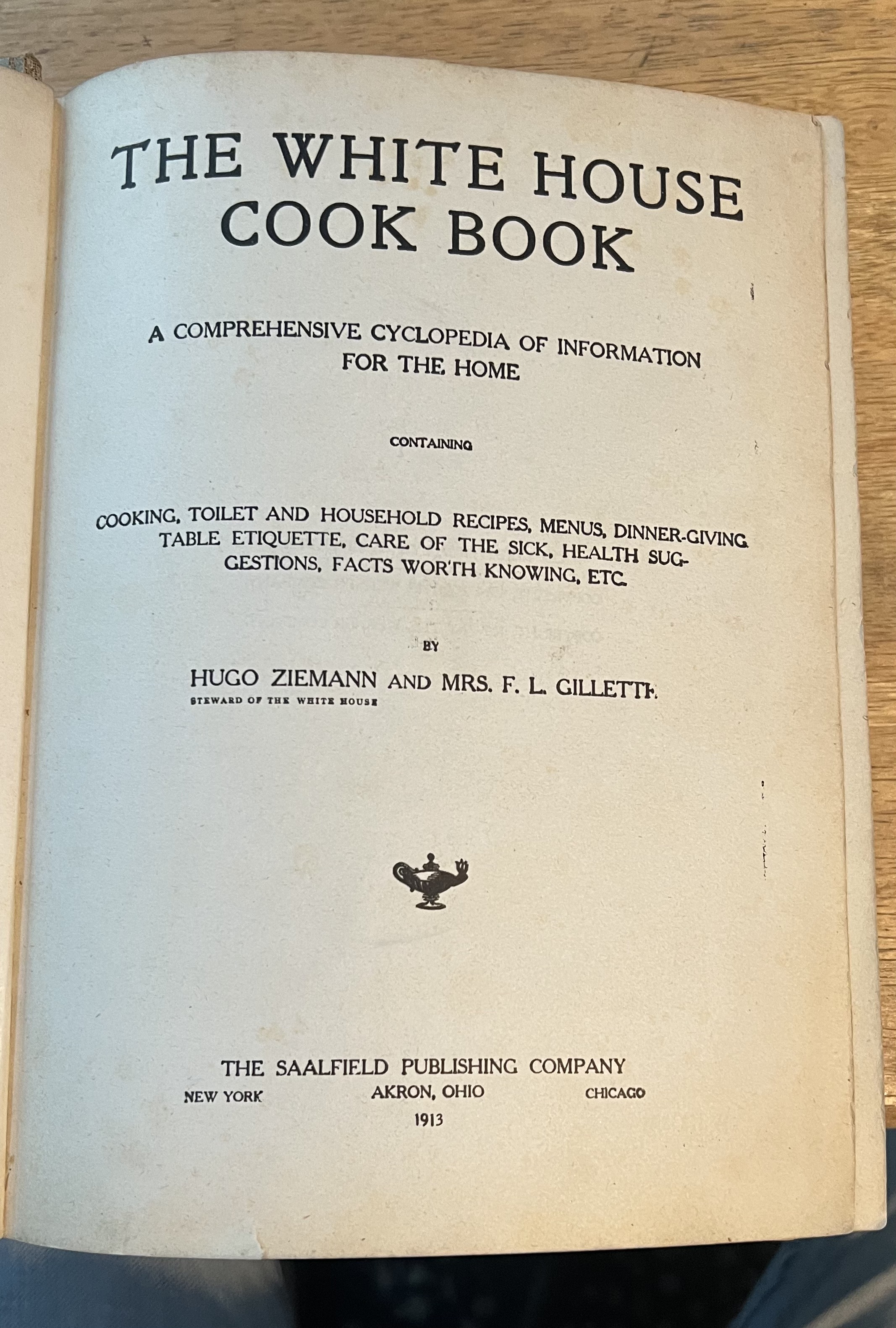
I recently picked up a book at an estate sale. It’s a big book, very big.

First published in 1887, this edition is from 1913 and has instructions for everything you can imagine with tributes to all the first ladies who have lived in the White House to date.

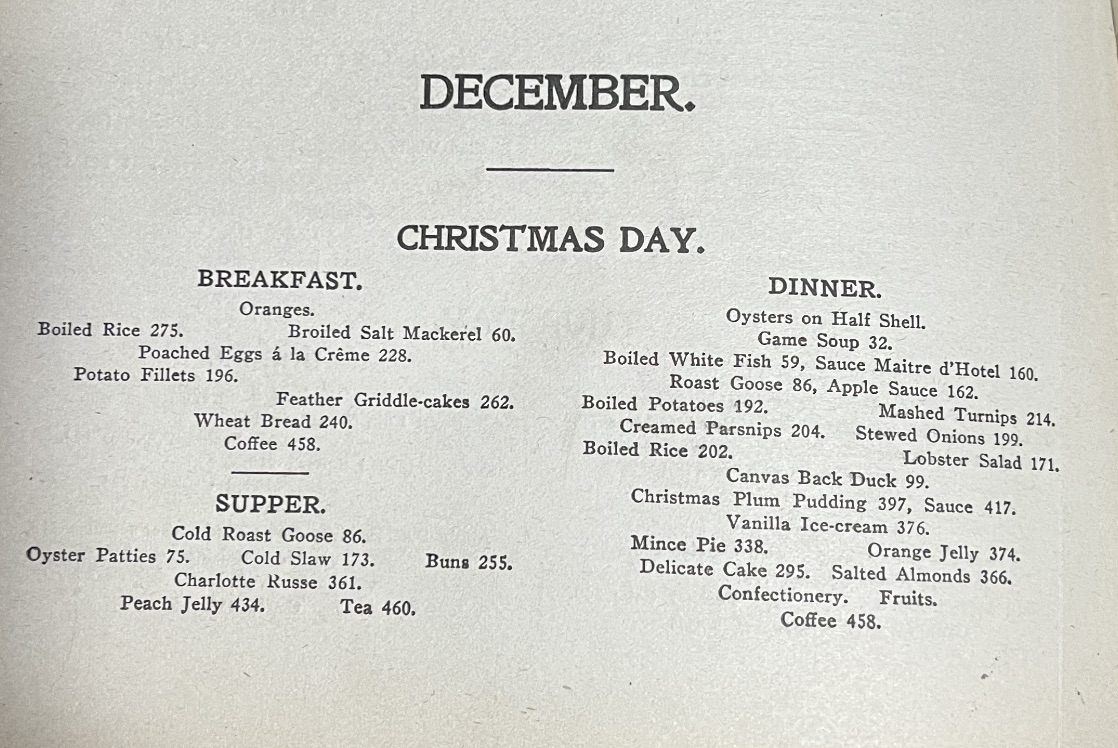
It truly does have instructions for preparing every kind of food you have heard or never heard of, plus instructions for homemade cleaning solutions, home remedies for every ailment, and tips on entertaining. Very comprehensive. Since we are in holiday season, I’m going to share the menus suggested for Christmas Day. Yikes!

The numbers are page numbers for the recipes. Can you even imagine having this much food on the table? Granted, the White House probably had a crew of cooks and servers, but here are a couple of the pictures they show of preparations

How early do you think they started cooking, even in everyday homes? Where did they get all their ingredients? They didn’t have supermarkets or online ordering. How long did all of this take? How hot was that kitchen? So many questions that basically are only asked because I feel such gratitude for my everyday luxuries today.

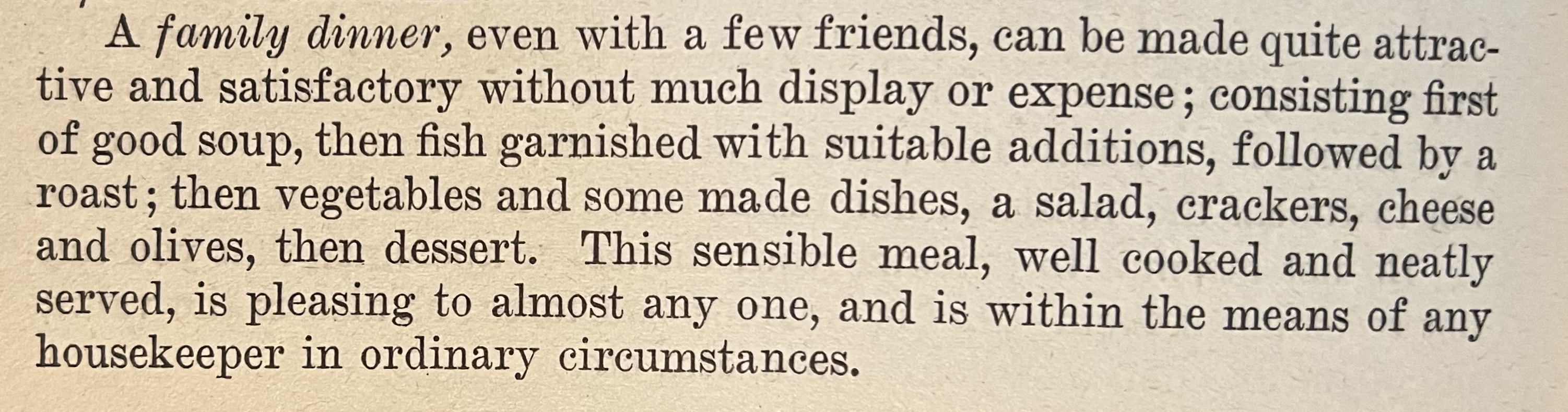
You’re probably saying that the White House is a little different from normal households. In the chapter on hosting dinners, I found this little suggestion for home dinners. What would your family think if you served this tonight?

Women in the old days spent a great deal of their time in the kitchen – all day long – from one meal to the next. It’s amazing they got anything else done, but they did. I say the women because that’s who did the majority of this work.

As you head into the final holidays of the year, keep remembering those who went before you. We have created our own hectic holidays, but be thankful for the advances that make our lives easier – at least in the kitchen!

Happy Holidays!

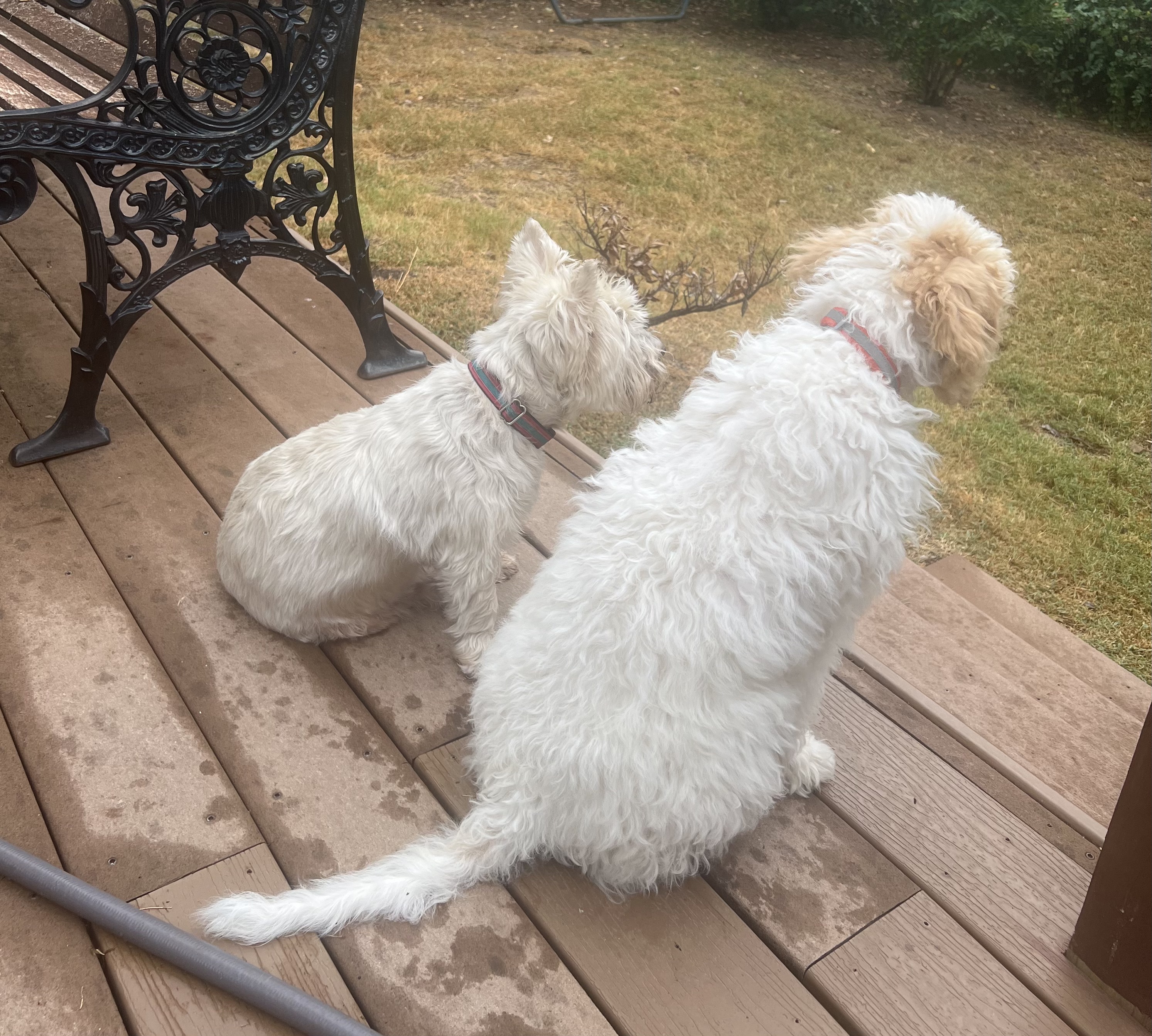
When I lost my 15, almost 16, year old Labradoodle Molly over a year ago, I really grieved. She was such a good girl. Well, most of the time she was. I overlooked the barking and digging and taking off when she had the chance and the chewing (when she was a puppy) because she loved me so much. I loved her too, but she was a big bundle of big love directed at me. It’s impossible to resist that. I still have my 15 year old Westie Annabelle who became my little sidekick. We were too old ladies in our routine and she was pretty easy if I overlooked the barking. Sigh.

I didn’t want to replace Molly, but I missed her and have to realize that, no matter how lively Annabelle still is, she too will be gone, hopefully before I am. I’m 76 and all the arguments for not getting another dog – or cat – are there. What if I outlive it? Do I have the patience to train a puppy? Do I want to adopt an older dog? What kind of dog do I want? I’ve had all kinds through the years so I’m open to different kinds. Do I want to spend the money it takes for a pet? What do I do when I travel? Isn’t it nice not having pet hair around?

The pandemic pups were everywhere. One friend I’ve known forever adopted two puppies as her older dog aged. Those years were some of the best with my dogs as I was home and they had me all to themselves with very few absences on my part. I made it through that period without worrying about the possibility of not having any pets.

Note here: I’ve also had fish, hamsters, lizards, birds, rabbits, ducks, chicks around the house, none of which appealed to me as a pet at this stage.

Not having any pets seemed like a good idea for about an hour. I’ve always had dogs around and cats here and there. I didn’t realize I took them for granted, but they were always there. Schmidt, Baroness, Pumpkin, Cookie, Sugar, Pepper, Salty, Guy, Tim – Dachshunds, English Setters, Pointer, Westies, mutt. black, white, brown, red. All kinds of dogs had stolen my heart. It was inevitable that I would see pics of all kinds of dogs.

My friends posted pets all the time on social media. I looked at every rescue dog and cat, waiting for one to click. I looked online for breeders and looked at mutts. I went back and forth. One day I went through the Craigslist pets for one more time and found several dogs I was interested in, all puppies. Yikes. I was going to make a big commitment to be patient, train and raise a baby although I’ve raised and help raise four children and eight grandchildren besides the other pets. To be honest, I found one online that turned out to be a puppy scam, but my bank stopped me. There was one I checked on that looked too much like Molly and I didn’t want to try and replace her and I remembered that I sometimes didn’t see her and tripped over her since she was black and hard to see at night. I remembered my age.

Anyway, I found a puppy that looked good and the price was pretty reasonable. I really wasn’t going to pay thousands for a puppy since I’ve never done that before. One dog I paid $10 for and she was a delight. Annabelle was a rescue puppy. Anyway, this puppy was meant to be. The owner called her an English Doodle, but, when I asked if she owned both the parents, she told me the mother was an English Setter and the father was a Standard Poodle, which makes her an English SetterDoodle. The ears were pumpkin colored, just like my husband’s old setter, Pumpkin, way back. I drove 1 1/2 hours with my almost 13 year old granddaughter to a small town I’d never heard of and met the owner and her young son. It was instant love. For some reason, I thought I’d change my mind, although I knew that was pretty unlikely.

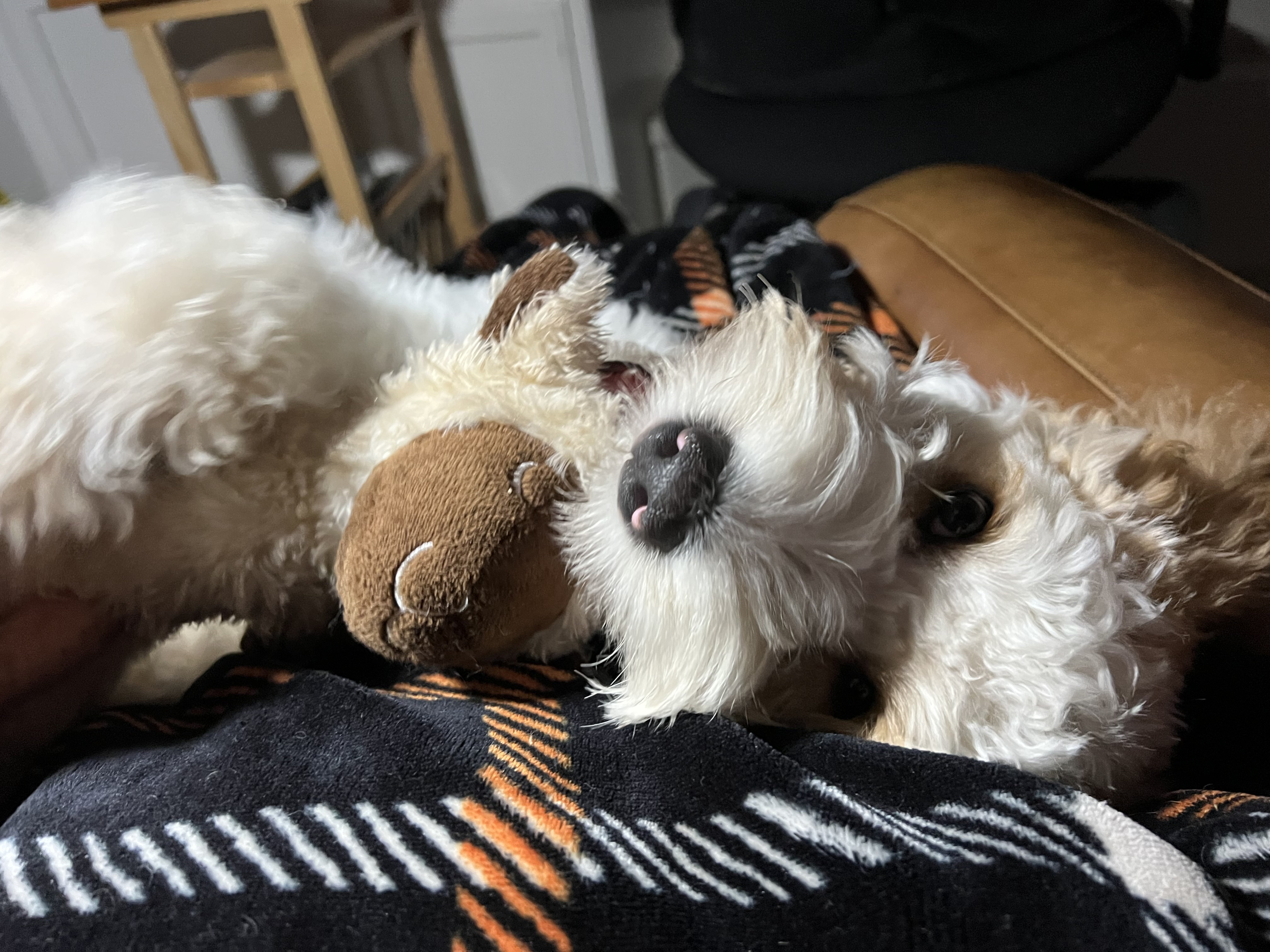
I mean. That face! The pink spots on the nose, the color around the eyes. She felt like a soft cotton ball. I was all in.

Of course, she threw up after we driven a block. We stopped and took care of that and she slept in the back seat with my granddaughter on the way home. I really hadn’t thought about what I would do when I got her home because I didn’t want to get a lot of stuff and then not get the dog. She was 8 weeks old and the owners probably weren’t going to breed their dogs any more. I think they’d had two litters – not exactly a puppy mill. I think she’d only been around her littermates, her parents, chickens and goats and a little boy. Really a baby.

I had a small sack of the food she’d been eating and an extra bowl at home. Hmmm. We stopped and picked up a dog bed and a toy and headed home. I’m not a very good crate person, although I know they are wonderful and my kids have loved them. Annabelle was fine with the new addition. I’m sure she realized she was just a baby and they were about the same size.

The first night, I really was tired and didn’t want to deal with her crying so I just put her on the bed with me. Annabelle sleeps on her bed beside me until we both get up in the night and she joins me on the bed. Amazingly, the puppy did just fine. That was just plain luck.

Oh – her name. I decided that, because her ears are orange, she should have a name connected to my alma mater, OSU. I couldn’t think of a name that went with cowboys so I tried to think of any red-headed cowgirls. She’s Jessie after the red-headed cowgirl in Toy Story. Random, but it works. We like feisty girls in my house.

The first time I had to leave her, I put her in the bathroom and had to leave this pitiful scene.

I ended up getting a crate for $10 from a friend and left her in it a couple of times. Of course, Annabelle wasn’t crated, so it was a little confusing. I actually quit the crate, although it still sits in my office and Annabelle has slept in it a couple of times. Jessie is doing fine. She recognized her name right away and learned to come, although we need to work on that.

Right away she learned to sit and now shakes hands. Jessie is 16 weeks old now and has been to the vet for shots twice and to the beauty shop. She rides in the car sometimes and I finally got her to walk around the block on a leash for the first time this week. Before, she was just not going to do that. We start puppy classes this week. She’s doing ok on her housebreaking – not perfect, but good. Mostly, like a toddler, I need to take her out every time I stand up. She will wait in my office with Annabelle while I’m out and is just fine until I get back, which is amazing.

And, she’s grown. I was told she would be 40-45 pounds when grown, but we’ll see. Molly was supposed to be 50 pounds and she ended up 80. Jessie was 11 pounds at her first vet visit here and 20 pounds a month later. It’s ok. I’m all in.

She’s going to be a counter surfer unless I can get that to stop (I’m trying).

She and Annabelle chase each other all over the place. She has perked up the old dog who mainly slept and chased a squirrel here and there. Amazing. Because they are old and young, they both wear out and flop for naps. It balances out. She’s grown into a bigger baby. Like all my little ones, human and animal, I’m watching to see how she’ll look as an adult. Pretty cute so far.

Did I make the right choice? Of course. She’s more work, but she’s funny and fun and keeps me moving so that we might grow old together. She’s a bit of light in a world that seems so dark right now. She’s a bundle of love who warms my heart on the days I need a boost. The day the dogs went to the groomer, the house was deadly silent and I realized that I need to have some movement and noise, some responsibility, a living being to talk nonsense to and another warm body to cuddle.

I mean. That face.

The problem with thinking of life in chapters is that there has to be a last one. Who wants to think about that? I’ve just been pondering where I am, following the quiet years of COVID-19 where I was home more than I had been in decades. There were good things about it. I spent more time with my pets, listened to the birds, walked the neighborhood and everybody smiled and waved. Now we’re back to mostly normal, but it’s hard to comfortably move from pandemic life to whatever the new one is.

I’m 76 right now and, pre-COVID, I was going all the time. Now it seems to be moving more slowly and that’s not just due to my age. We’re easing into life at a time when I feel like I need to be hurrying so I don’t miss anything before, frankly, I just can’t do it anymore.

There have been so many chapters in my life so far, starting with childhood in the 40s and 50s. I was fortunate to have a very peaceful, comfortable life.

Then there was junior high and high school, where I changed and grew and learned and questioned.

And then there was college, where I was away for the first time and made new friends and learned more and even got married.

And then I was a wife and mother to four before I turned 30, finding a life for myself through volunteer work and family activities.

And life went on as the kids grew up and went to college and married and I went to work part-time, then full time and then owned my own business. And then the shock of becoming a widow at 52 and starting yet another chapter where I had to close my business and find work that gave me health benefits and supported me and all of that. During that time, I pushed myself into going places by myself or with friends to meet me. The first was Alaska with my high school friend who lived there. It was a big trip to take alone when I’d always had my husband to travel with.

By the time my husband died, we had the first three of our grandkids, who proved to be my next chapter and my salvation.

I could go on about each chapter, but they are all parts of a huge whole life. I had several careers that I had never dreamed of as a young wife with an English degree, but my life experiences and my ability to communicate served me well through the years and I made new friends, accomplished new goals and was amazed at what I had done when I finally retired.

My other love has been travel and I’ve been grateful for special friends who were available to travel with me as I traveled the American West, South, and back to France. I’ve taken my grandchildren on trips and explored my own state of Oklahoma and the states around us. I’m always ready to go visit somewhere.

So, what is this new chapter? I’ve lost friends who were near and dear to me in recent months and spent the last week or two at memorial services. I’m not good at funerals, but two of my favorite people lost their husbands after long illnesses and I needed to be there for them. I also lost a friend at the end of last year who was 95 and another who was 101 in the last few weeks. I also went to a memorial for a friend’s mother who was 101 – two services for 101 year olds in five days!

But those deaths and the lives of these women we were celebrating have inspired me. I have had many men I loved and adored in my life, but it’s the women who are speaking to me at this time of my life. I had strong grandmothers and a strong mother and their lives have taught me so much. These other women I adored who lived so long were as strong as anyone can be. And I look at their lives and try to find the secret of what made them the role models they are for me.

First, all of these women had to face hardships at various times in their lives, whether loss of spouse, loss of child, loss of husband’s job, loss of any support other than themselves. They all lived on and smiled and laughed and loved and didn’t just sit around feeling sorry for themselves. None of them ever considered themselves a victim. There was no drama – just life.

Second, I can remember all of their voices and their laughter so well. The memories make me smile. They all had terrific senses of humor and were able to laugh at life’s little kicks.

Third, they never quit going as long as they could. They were always curious and learning and keeping up with what was going on in the world. They never stopped growing intellectually or emotionally. Several traveled until they had infirmities that made it difficult. The 95 year old and the 101 year old read all the time. The 95 year old was still reading about a book a day until close to the end.

They all loved their families as much as anyone could. They died beloved by their offspring.

So, where do I go from here? I’ll keep traveling until I can’t, reading until I can’t see (and then there are audio books), learning several new things every day, fighting for the things I believe in and doing what I can to leave the world a better place because I’ve been here, even if my contribution is something small. I’ll keep enjoying my children and grandchildren and be here to share their lives with all the ups and downs that there will be. I’m not sad that they’re all growing older because I’m so privileged to be here to watch it all and put it in the perspective of our world and all the family members who have gone before.

So this next chapter is exciting to think about and invites new goals. Basically, I’m just going to keep on keeping on for as long as I’m supposed to. Lucky me.

Born the end of 1945, I’m now almost 76 1/2 years old. That’s a lot of years to have watched people and events in the world, although I learn new things every single day. The observations here are based on what I’ve personally observed and lived through and I write this for those who live with the good things that have come from the past.

Growing up in the 1950s, my own childhood would be considered idyllic. We were a white family, living in a nice house, neighborhood and city, Tulsa, Oklahoma. We played in the yard, roamed freely, had advantages. I went to a lovely private school for my elementary years, a place where I was only around people like me, along with several who were very wealthy and had chauffeurs and cooks. We had a maid, but my mother worked alongside her to keep everything perfect. I think these are the “Good Old Days” that many idealize and long for. There are some things that were definitely sweet and innocent, but there is a reality that I began to see even then.

The only people of color we knew were people who worked for us or at the country club or restaurants. They all lived on the north side of Tulsa and my only views of their homes were when my mother would sometimes drive one of our maids home. My mother grew up very poor with a widowed mother during the Depression. My father grew up with a father who owned a growing business. As a small child, I only saw my grandparents homes as wonderful places to explore, but I would start observing differences early.

I was a quiet little girl who spent a lot of time reading and watching, listening and snooping around. Like most children, I saw and heard a lot more than I said. Children in those days didn’t ask as many questions and weren’t asked their opinions on much. My parents were great, but they weren’t sharing their everyday concerns and problems with us. I would now consider those days, in general, as the days of secrets and lies, not so much in my family, but in general.

After the war, women who had worked while their husbands served mostly became housewives and mothers. Men who were on the rise in companies were looked down on if their wives worked outside the home, seen as unable to support their families. If you wanted to be promoted, your wife was home building a beautiful home and waiting for you to arrive home after work with a clean home, cooked meal and children ready to greet you. My parents married at the end of the war and Mommy had worked for years so she was happy to assume this new role and teach us that Daddy was to be the center of our universe and we were to be forever grateful to him. The fact that he was a sweet man and they loved each other so much made this easy to buy into. Daddy worked hard, they entertained their friends, we had fun as a family and were picture perfect for the era.

Daddy always gave my mother an allowance. She used this to pay the maid, buy groceries and keep the household going. She handed him the bills and he took them to work and paid them. There were no credit cards in those days, but you could get a charge account at stores, with the permission of your husband. My mother was a good manager and managed to save money for herself out of her allowance. I always thought it was kind of sad that Daddy didn’t give her gifts but handed her a check through the years. I understand now that she was saving all of that until she had her own money and independence and didn’t have to ask him for every little thing. Not many women had this luxury or were smart enough to do this. I didn’t appreciate her independence until years later.

Women didn’t have that many rights in those days. Husbands had to co-sign or approve anything like the charge accounts. My mother didn’t have a checking account for decades because she had those charge accounts and cash. I remember when my husband and I were first married while in college in the mid-60s and applied for our first credit card, then a $100 limit, together. We had moved along by then to have joint accounts. Everything we ever did as a couple was in both our names. We never thought of doing it any other way. There was an incident when I was in my 30s where I was purchasing some clothing for him at a store where we had charged for years and the clerk said she would have to have my husband approve the charge. I was so angry. He couldn’t believe it. I can only imagine if that had happened over and over.

Back to my growing up and observing. While in high school, I began to notice that adults seemed to drink way too much. My mother never drank, but there was a lot of drinking. My father kept bottles of liquor in his desk drawer at work and had a drink when he got home from work. That was common. I’m sure he offered drinks to business associates who came by the office and had a drink or two when he worked late. I also began to hear things from the adult conversations. I realize now that many of my parents friends had affairs, but divorce was scandalous and the women had no way to make a living if they left their husbands, so they stayed. I watched many of them celebrate their Golden Anniversaries, knowing that their marriages had been up and down through the years.

I’ve also learned though the years that human behavior has not changed. There has always been rape, sexual abuse, child abuse, spousal abuse. Nobody talked about it. There were secrets everywhere. We know now that children suffered abuse from trusted teachers, scout leaders, church leaders, family members. Women were beaten and tortured in their homes. Before she died, my mother mentioned that one of the reasons that her mother never remarried after being widowed at 28 and left with three children during the Depression was that she was afraid of marrying someone who might harm her children. I found out as an adult that a boy I went to high school with, a handsome football captain, was beaten by his father. He actually lived away from home and snuck back before school every day so nobody would know. Brothers I met late in life were beaten regularly by their father who did everything he could to demean them in their lives. We had no idea that things like this happened in our idyllic “Good Old Days.” There were secrets everywhere.

My mother and I were talking about abortion many years ago and she told me she had one. Her doctor did it in his office, telling her she didn’t need another baby right then. She just took his word for it. She was so insightful and knew it was never a black and white issue. By the time I was in college, I had had a good friend commit suicide because she found out she was pregnant at 14, and saw girls leave school for time away with their far away aunts, where they either had abortions or had the babies and gave them up for adoption. Some of them were never able to have children after the experience. No telling how many girls I knew who went to scary people or did their own abortions. I once visited an abortion clinic when it was made legal and saw a 14 year old girl and her grandmother, a college athlete and his girlfriend, and mother of three who was alone. None of them looked anything but sad, but at least they were gently taken care of and able to go about their lives. I learned then that I had no idea what decisions people have to make and it’s none of my business.

Back to women’s issues, my college years were filled with experiences that shaped the women of my generation. My friends were very smart girls who were expected to go to good colleges and use our brains. The reality was that there weren’t a lot of career options out there encouraged for us – teachers, nurses, secretary were real choices. If you had to work, it was to take care of yourself until you could find a husband. A few were breaking out of that mold, but it was there. We were treated in different ways that the “men” we went to school with. While the guys had no curfews, we had to be in by 10 on weeknights and by midnight on the weekends. Women at Oklahoma State University were required to live in university housing (or sorority houses) until they were 23 years old or married. Many got married a young age then anyway. When I had my first daughter, I was 22 years old and the oldest new mother in Stillwater Hospital. College men were exempt from the draft for Vietnam if they were married, so there were many quick weddings. Some lasted, some didn’t.

I was not a big protester, although I certainly read all that I could. I marched for Academic Freedom, signed petitions to give coeds more rights on campus, and heard Gloria Steinem when she visited campus. Women were getting bolder about asking for their rights. When I realize now that my grandmothers couldn’t even vote until they were in their 20s, I realize how long it has taken for women to be recognized as equal human beings.

In junior high, I met my first Jewish friends. Their parents had their own country club because they weren’t allowed to join the other clubs until into the 70s or 80s. It didn’t matter how successful they were or how generous they were to the community, it took years for them to be accepted. I was proud when one of my good friends became the first Jewish President of the Junior League of Tulsa in the 1980s. Ridiculous that it took that long.

I had my first friend who was a person of color when I was in college. She was the only girl in our dorm and one of the few on campus. She was great fun and offered us insights into her life in Arkansas. Growing up in Oklahoma, you would think we knew many Native Americans, but nobody was claiming that heritage then. A friend I met as an adult told me how she was looked down on in Tulsa growing up, obviously not in my lily white neighborhoods. She earned her PhD and educated many of us on the reality of the tribes. Now everyone wants to find some Native blood in their family, a far cry from the earlier years in the “Good Old Days.”

When I was in junior high and high school, guys would ridicule each other using words like “queer” and “fag.” Talk about a big secret in those days. My mother had two women friends who came to visit us that she had known when she was younger. She just adored them and explained them vaguely, but I caught on that they were a couple. It was hard to conceive then. Through the years, I had friends who left their families as they came out, but remained terrific fathers and friends to their former wives. I remember a close friend from high school who called me to tell me she was gay. She had been through a horrific marriage and had a child. I took that announcement in, realizing how hard it was for her to tell me, and told her I was just happy she had found love in life. I got it. I had that experience more than once as friends came out and other friends found that they had gay children. Something I had not really had an opinion on was an issue I understood and could appreciate for my friends. I was learning how many people I knew who had lived secret or suppressed lives for so many years.

Religion was a mixed bag in our house growing up. I always leaned towards going to church and found it a place where I could spend time thinking and learning more about people. As I grew up and took leadership positions, it was apparent that the perfect life of church members was just a microcosm of society with adultery, lies, bullying and, we later, learned abuse. When I worked with Domestic Violence victims in the 1980s, we found that churches were one of the obstacles because they were still telling women that they needed to stay in marriages and obey their husbands and their wedding vows. Churches have come a long way. For all the attempts to be more perfect, the reality of being human is even more apparent under the spotlight of religion. I once told a grandson, who asked, that the difference in churches or congregations is in the people, the structure, the governance. You might feel most at home at one denomination in one town and another one somewhere else. They have their own identities. We are fortunate to be able to choose our means of worship.

Back to the women’s issues, the first big volunteer job I had in 1973 was to publish a cookbook as a fundraiser for an organization. The recipes were listed under our married names (Mrs. Alan C. Fraser). This amuses/horrifies me today because I had always taken pride in using my maiden name with my married name. We were young and proud to be married, I guess. In the decade to come, many of my friends found themselves divorced because their husbands had affairs and left them, unlike my parents’ friends who stayed together and probably led separate lives or made each other miserable in some cases. These women, in their 30s and 40s, found themselves with college degrees they hadn’t used and a workforce where they weren’t welcomed. I’m proud to say that many built lovely careers on their own. Actually, I found myself in the same position when I became a widow at 52 and had to build a life and career/careers. We were getting stronger and gaining more respect and resources. Women can be their own worst enemies and I’m always sad to see those who choose not to support each other.

I’m not going to talk about the diseases that ran through the “Good Old Days” and the medical breakthroughs that save people today or the children who had undiagnosed learning disabilities or the pollution caused by industries and the inequalities in pay between the workers and the executives. You get the point. The “Good Old Days” weren’t all bad, but they certainly weren’t times to return to. Sure, it would be nice to be as innocent as I was a child, but I grew up and learned and continue to learn.

People are capable of extreme good and unfathomable evil. We make strides and then fall back. As a woman, I can truly say I have watched so many advances made through the efforts of smart, determined women and understanding, supportive men. A few years ago, I thought I would be able to live out my life watching my grandchildren and their children and so on inherit a better life and world. Now I’m not so sure.

Many of my most respected friends are depressed and angry and concerned about the direction society is taking. Of course, I also have friends who are excited and even those who think we are going to go back to the “Good Old Days.” I think I’m most depressed about the polarization and the inability of anyone to sit down and find common solutions or even to recognize that some of these issues are a problem.

One thing I am sure of is that I have watched and learned over the past 7+ decades because of the people I have met who have taught me the reality about some situations in life. When I see things I believe to be wrong, I have to speak out because if I don’t, the results will be partly my fault. You can’t ignore problems and hope they will go away. Those weren’t the “Good Old Days” they talk about. They were just the Old Days. We are supposed to be getting better, or at least trying. Aren’t we?

There’s a difference in hoarding and collecting. Hoarding, in my mind, is keeping things because you might use them some day. I do way too much of this and try to thin out the stuff every year. It’s a remnant of having parents and grandparents who lived through the Depression. Or not wanting to waste things. Or keeping them for someone else. I’ll move on to Spring Cleaning soon. I promise.

Collecting is almost a blood sport. It’s in my blood because I had a father who collected stamps and cigar rings as a child and coins as an adult. His sweet mother would lean down to pick up the cigar rings from gutters for him. We rolled our eyes at his coin collecting as he bought bags of coins from people in remote towns to bring home and clean, looking for the rare penny or nickel or silver dollar. He hid them in our air conditioning vents and my mother threatened to spend them all. She wouldn’t have, but it was funny to watch him dig through them and she enjoyed the drives to meet people he heard about who would sell him coins in the days before the internet.

My mother didn’t collect until later when she started going to auctions and antique sales. I spent a lot of time going with her and learned to bid watching her go head to head with dealers to get a piece she wanted. She loved being the winner of a bid and loved even more meeting all the people who were selling items and learning about the story of the pieces. She told me that a collection is at least three pieces and she would sometimes get three of something and say that was her collection and wait to find something else. Her competitiveness was another story.

When I was a young married lady, I read that you should group your collection and did that with some things and found I had several collections or larger ones than I thought. Santas were the biggest one. I had Santas from my childhood and had always loved them. Once I grouped them for the holidays, it all exploded. Since my birthday and anniversary were also in December and I worked on several Christmas projects with craftsmen and artists, I started getting more. As I told someone, if you get ten a year and you’re in your 70s, you have a whole lot of them. I picked them up when I traveled, when I was in antique shops or at sales, and received them as gifts from family and friends. That’s what happens once people know you collect something.

Here are a very few of the ones I have. My collection includes silly ones, antique ones, artist originals, cheap and expensive ones. Whatever catches my eye. I’ve found them (or figures that look like Santa) in a flea market in Vienna and a shop in Hong Kong. The tall skinny one in my kitchen window is the one I’ve had the longest since he was there when I was a child. The Lego ones are from Denmark before they had them here and the wooden ornaments are from Hawaii. Some are from dime stores, some from fancy places. I have them all over the place, big & little. There’s no room in this story to show them all.

The thing about anything I have is that it comes with either a story or a memory. I think that is what I like most about collecting and collectors. I’m not much of a minimalist, not in any way. I like to see what people are about, what they like.

My mother loved talking to people and I’m sure most of her collections came from meeting an antique shop owner or someone who told her the story of a piece and she had to have it. We both loved buying art from artists we met on the street when we traveled or from supporting artists we became friends with. She and my father purchased several bronze statues of cowboys from a man they met and corresponded with for years. They liked knowing him and his story and supporting his work.

She also collecting things like miniature antique leather books, preferring ones with topics or stories that interested her, although she had some lovely ones in foreign languages. We both loved anything miniature and she had a fun doll house that she loved to furnish with things she made or found. She started collecting magnifying glasses, many with handles from antique umbrellas. I have part of her collection, which I have added to. I’ve found that I actually use them these days, so they’re kind of scattered around the house.

I recently found a couple of small ones to go with this one of hers with the tassel. You can also see some antique inkwells. Three of them were her collection and others are mine, one found in London and another found at an estate sale.

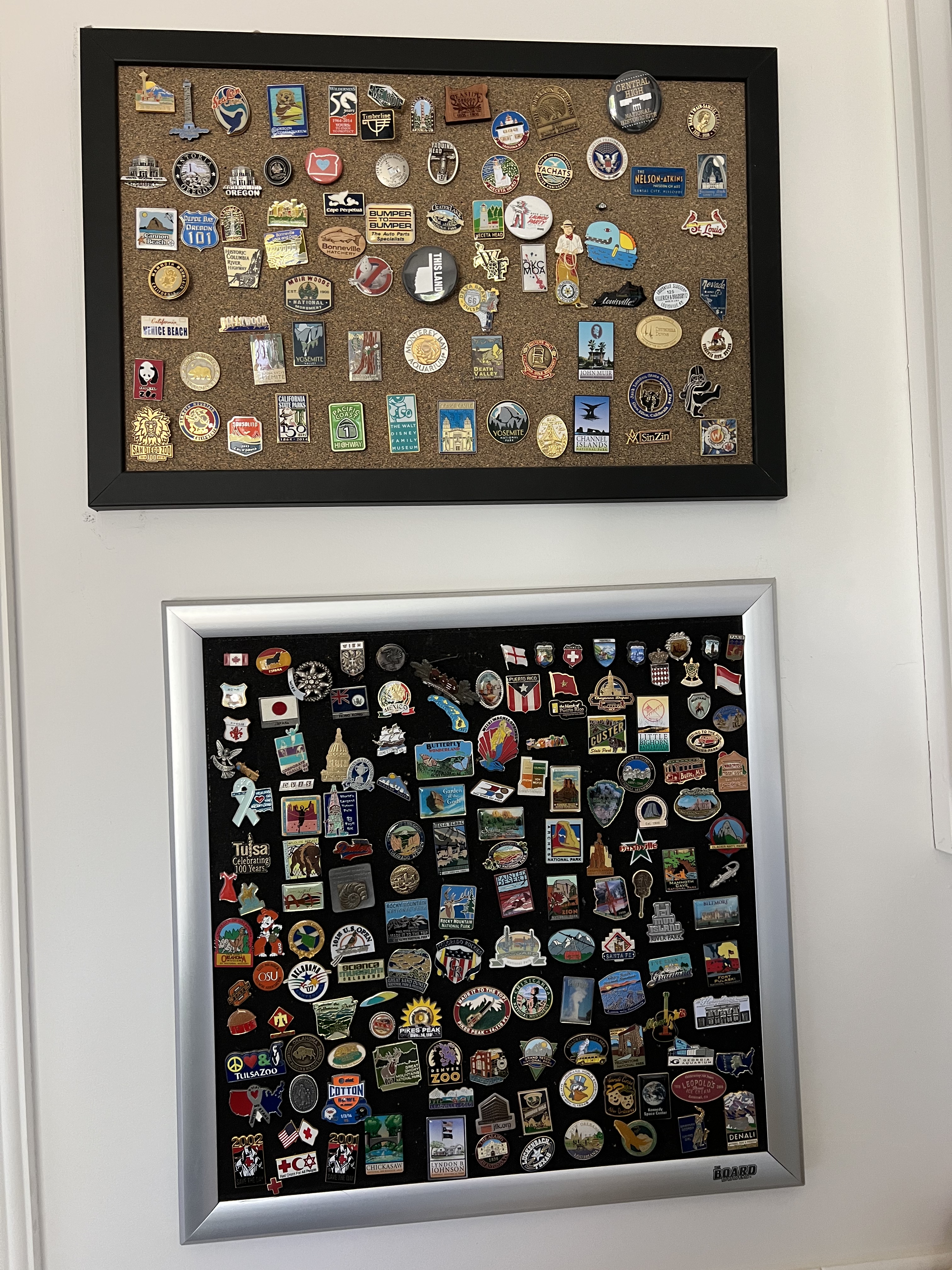
One of the first times I traveled to Europe, way back in the early 70s, I saw people collecting pins which they wore on Alpine hats. I didn’t want the hat, but I started collecting the pins and included some antique ones I found there. I still collect them, but have they are harder to find and so I have a magnets. It may be silly, but I get a nice feeling when I remember interesting places I have been. I must not have much of a memory because I depend on photos and things I pick up to trigger mine.

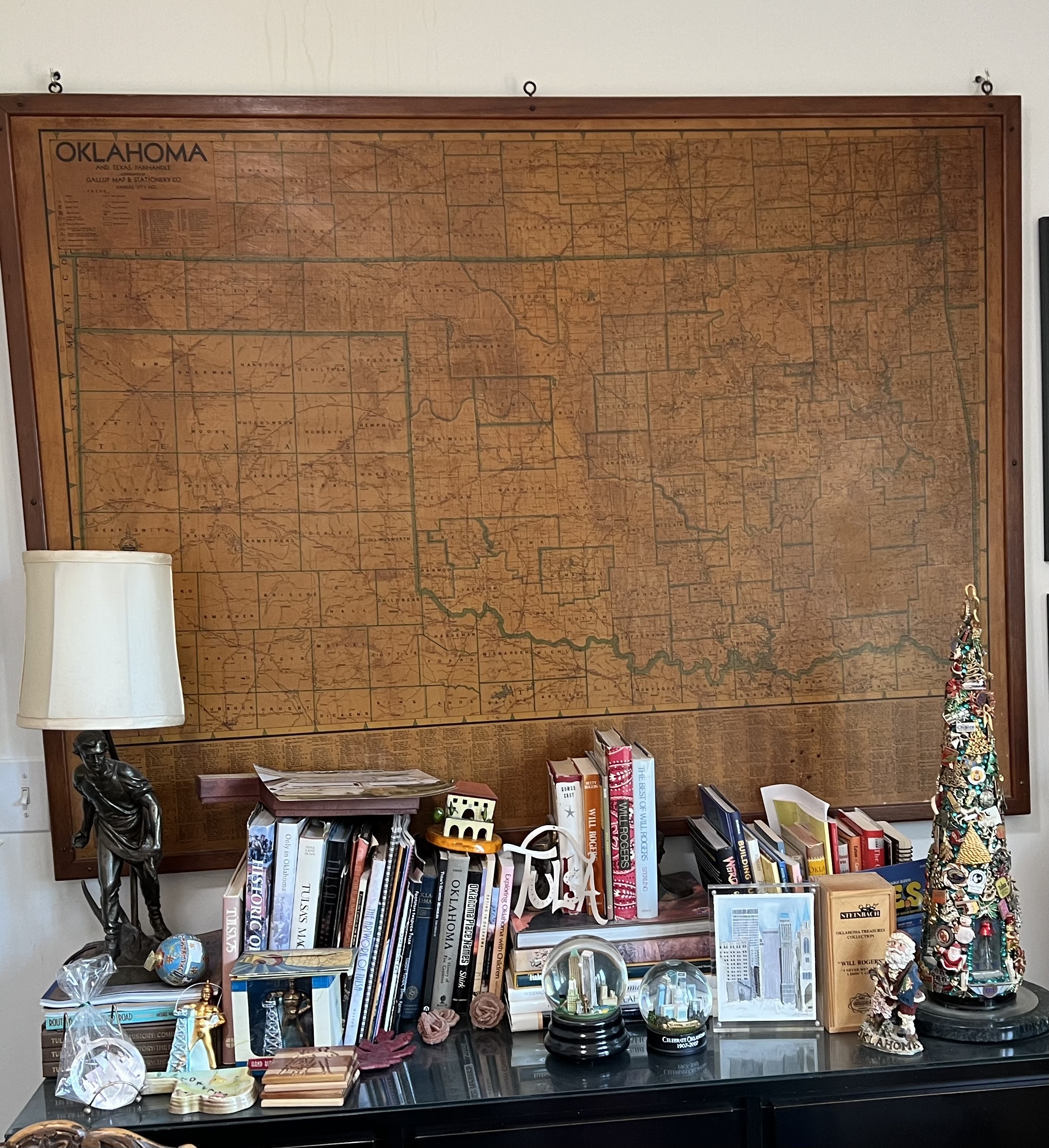
Sometimes we start collecting because we are just interested in something. This map of Oklahoma hung in my father’s office from the time I was little. I think he got it when we moved to Tulsa in 1948. He used it to map places for his salesmen to go and to find spots for his quail hunting trips. It’s yellowed from the smoke that was in the rooms back in the days of smokers. I claimed it years ago and it led to a collection of books and things about Oklahoma. I had to move some of them for space recently.

Once I was at an antique auction with a friend and there were a bunch of small English wooden boxes. We learned the word “treen” and became interested so we bid on some. I’ve only added a couple, but do love wooden or treen boxes. Note that one was chewed on by a puppy sometime through the years.

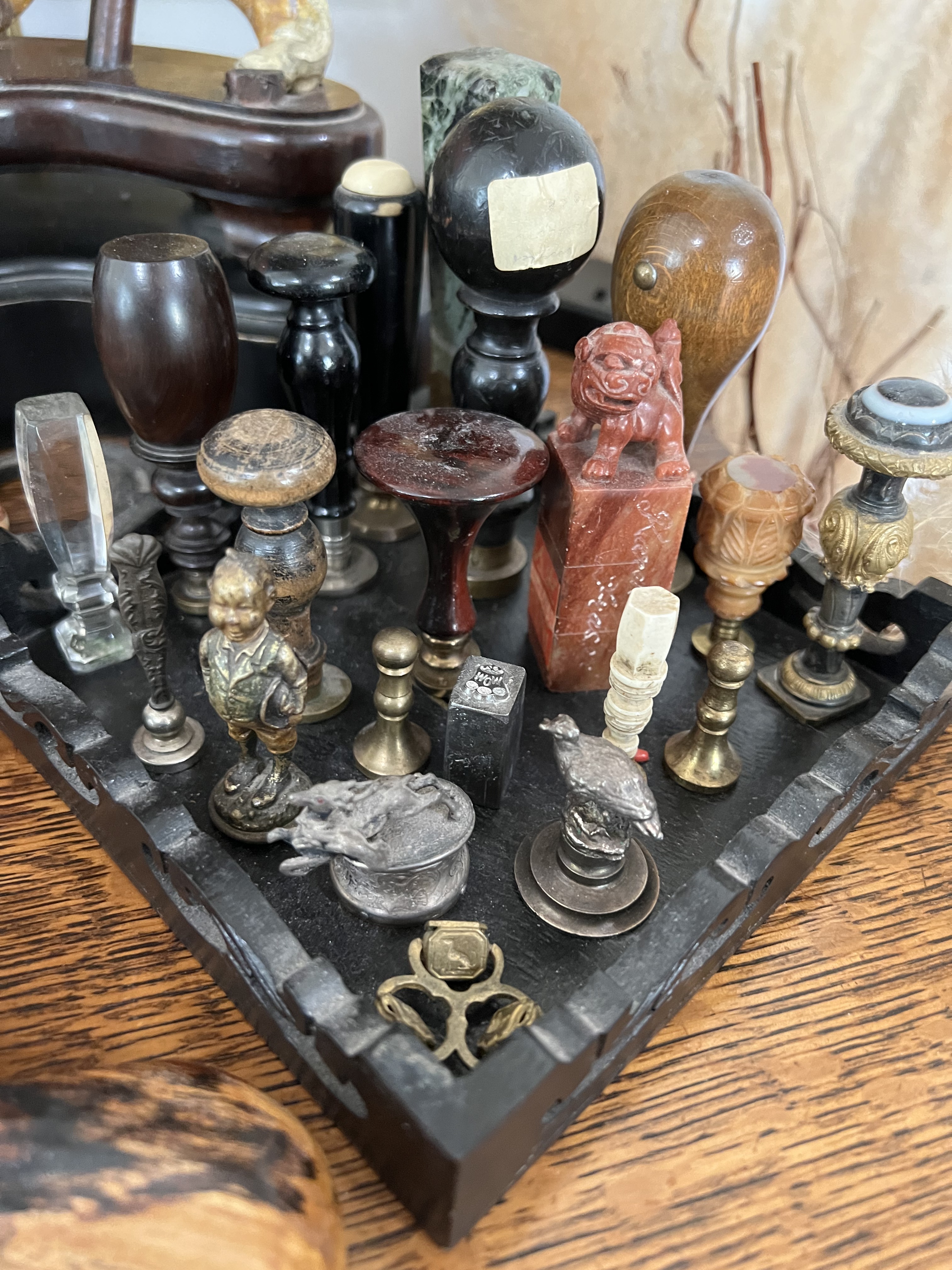
For a few years in the 80s, I worked on and chaired an antique show for a non-profit and we brought antique dealers from across the country. I listened to their lectures and stories and loved so many things that I couldn’t afford. I got interested in the little wax seals that people used to use to seal their letters and thought that was something I could look for that was affordable and a way to support the dealers. I don’t look for them as often these days, but I do see an interesting one every now and then. I love to picture people writing with their pens dipped in ink and then sealing the letters with a dab of wax and their monogram. The reddish Asian one is from Hong Kong. Supposedly, it was a Chinese version of my name, but I doubt that Karen translated very well. There’s a small one with a stag being attacked by a dog on top that was supposed to be a prop in a movie, although I always thought that was a stretch and probably just a good story from an antique dealer to sell it. It’s still interesting and antique.

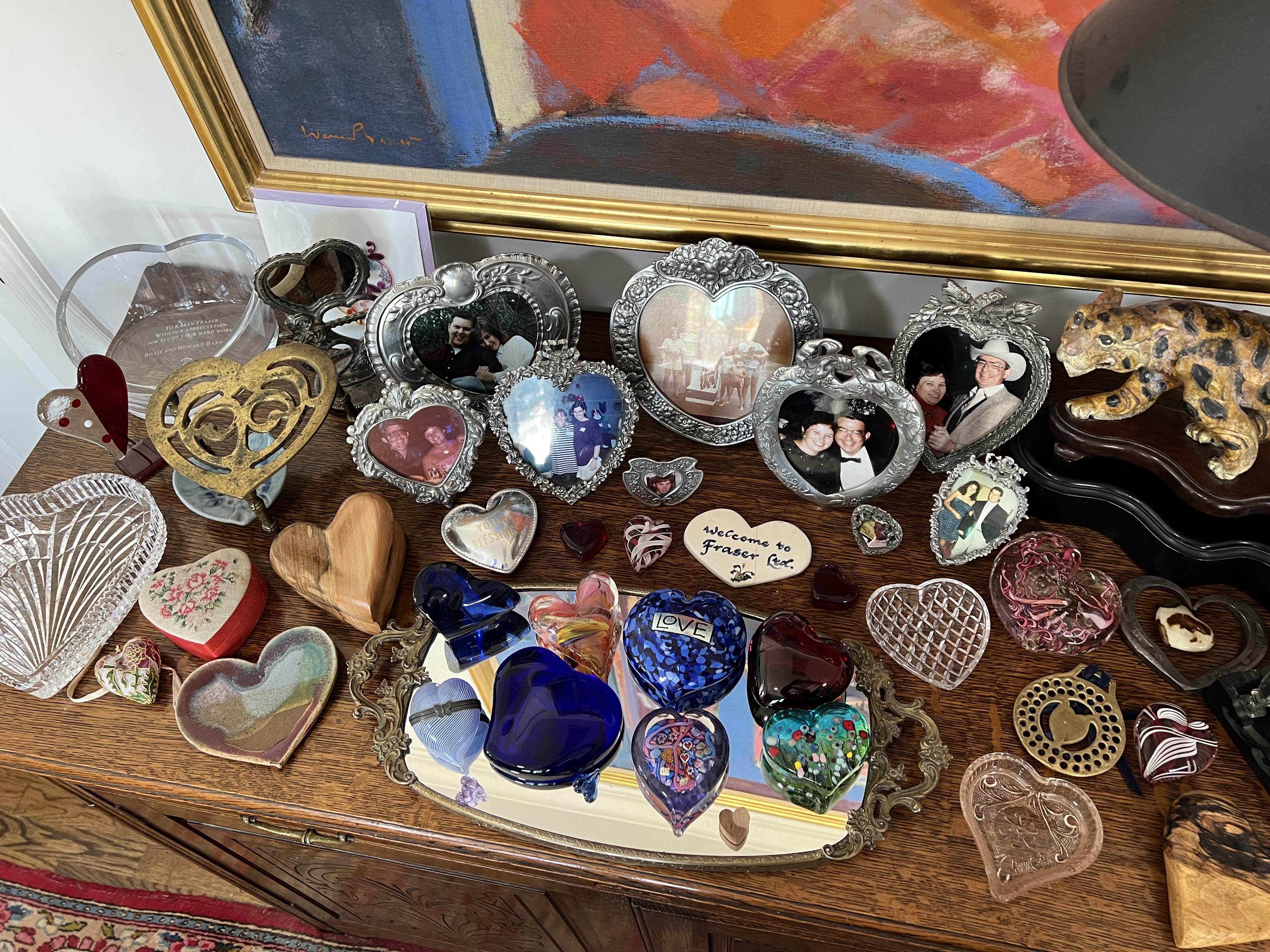
Hearts are one of those things I just suddenly had a bunch of. I had picked them up in art galleries and antique stores and sales and gift shops and been given them. There is one from Tiffany that was a gift and some wooden ones made from driftwood on the beaches in Oregon. There are glass ones from the volcanic ash in Washington and artist ones from museum gift shops and I see a clay one from an artist in Sedona and another glass one from a young artist in Oregon. I had grouped my heart frames and then the hearts started piling up. Good grief. They are kind of fun though and make me smile. I have more hanging artist ones and others just kind of around. Whatever. I have a friend who collects hearts because her last name is Love and another who collects them because her birthday is on Valentine’s Day. We all have our reasons.

There are some strawberry things around my house because the name Fraser comes from the French word for strawberry, fraise, and there are strawberries in the Fraser clan badge. Not too many, just a few I’ve found.

The thing about collections is that you start to see the things you like everywhere. It gives you something to look for when you are traveling or shopping. I’ve also found that many collections lead to doing research on the item and learning more about its history, along with meeting some of the most interesting people.

I called collecting a sport and it can be. Going to auctions or estate sales or combing through flea markets and antique shops can be competitive. Sometimes you are just looking at everything, but mostly your eye stops on either something that you like or have been looking for. You see something and want to know more about it. Many collectors become experts on their collections. I have a friend who started collecting vintage hats and clothing and recently donated her collection to the Tulsa Historical Society where she has her own exhibit.

I love standing in line to get into an estate sale and seeing what everyone else is looking for. I feel like I need to race to the things I want, but most people are collecting things I would never have thought about. They have become interested in things and are building their collection. I’ve met people looking for vintage toys, pyrex ware, old cameras, certain kinds of glass. Tom Hanks collects vintage typewriters. There is a competitiveness in being the one who finds the rare item you are missing, just as my father looked for certain stamps or coins. I don’t know if there is such a thing as having a complete collection of anything, but people keep trying. People like having a piece of history, many considering themselves keepers of something that may have been thrown away but needs to been kept for future generations. I do lament the things that we tossed and would like to see again from my lifetime, even knowing that we can’t keep everything. Some of collecting is nostalgia, a way to keep memories of our own lives. Rarely do I think people are collecting because they plan to sell the items and make money, unless they are dealers.

There are people who collect sneakers these days just as there are people who collect cookbooks and first edition rare books, vintage albums, sports equipment. There are people who collect art, including photographs, paintings, sculptures. I have a friend who collects etchings and has a museum quality collection, which is lovely. She is an expert on her pieces now and knows what to search for. Another friend collects tea strainers. I have a daughter who collects Toby jugs and another who is interested in mid-century modern furniture. A son-in-law collects bourbons. There is a surge of young people (younger than I am, which includes most people), interested in antiques. One of my Native American friends collects items from her culture and an African American friend collects the kitchy kind of figures, such as Mammy dolls, sold in earlier days. They are preserving their own histories.

There is no one reason or thing to collect. I can attest to the fact that it makes you learn, leads you to meet new and interesting people, takes you to fun places and can make you smile. What happens to our collections when we are gone is that they either are interesting enough to be in a museum or display or they are passed along or they go to sales for the next generation of collectors to add to their collections and enjoy.

My son was a collector from a young age. He started with his Star Wars toys and teddy bears but moved to beer cans. I would take him to the flea market and watch that nine year old bargain with dealers over a can he spotted. He was always an expert on pop culture. He moved on to lunch boxes and had quite a collection in his lifetime. His wife still keeps them and I have one of them to remind me of that little kid who inherited the family obsession.

As I said, the things I collect usually come with a memory. Sometimes they are just things I enjoy looking at or learning about, but they almost always have a memory attached of how I got them or who gave them to me or where I was or who I was with or what they mean.

And all those memories are good.