
My maternal grandfather’s parents settled in Indian Territory, near where Ardmore is now located. It’s hard to find many details, but I know they lived on a farm where my mother was born. My maternal grandmother’s parents lived on a farm closer to Durant, where they must have moved from near Bonham, Texas, where my grandmother was born. I keep finding little details to put this story together.
My grandfather’s parents married in 1876, when my great-grandfather, E.Z. (Ephraim Z.) West married Hattie Artie Mills. My grandfather was born in 1876 in Denton County, Texas. E. Z. and Hattie had two more sons who died young, George at age 8 and John at age 20. E. Z. opened one, possibly two or more, wagon yards, including the West Wagon Yard, in Ardmore and built a house on the property of the wagon yard. The house was on the corner of 1st St SW and E St SW, across from Central Park. My grandfather worked with his father in the wagon yard (kind of an early motel for people coming to town by wagon) until the wagon days were waning due to automobiles and then he went to work for the telephone company, which must have been a pretty new industry.
I’ve seen photos of my grandfather, Ben, mostly at play with other young people or with his lodge. He looks playful and fun and at ease with everyone. In 1915, at the age of 38, he found my 18 year old grandmother, Artie, married her and brought her home. They soon had three children, two boys and a girl, my mother. My grandmother didn’t speak of my grandfather much, but I always think of her telling me how he would get up and start the fire and then wrap her up in a blanket and bring her downstairs. That may be all I need to know about him.
At some point, my grandfather became ill with Bright’s Disease, a kidney disease that could probably easily be cured today. I don’t know how long this lasted, but I know he purchased a small neighborhood grocery store for my grandmother to run after he was gone. Neighborhood groceries were still around when I was a child and they were small, about one room, and located in neighborhoods. I guess they were the first convenience stories. My grandfather died in 1927, leaving his young widow with three children. My great-grandfather had died in 1920, so my great-grandmother was also a widow with only her daughter-in-law and her three grandchildren left. I have a much earlier photo of her, but this is how my mother knew her. At some time, between 1930 and 1940 (according to census records), my grandmother moved her family to the house I always associate with her. My great-grandmother owned property around town and made sure that each of her grandchildren owned a house. My mother told me they had dignity during the Depression because they owned their home, even when the gas was turned off. My mother also spent a lot of time with her grandmother and could describe her, her clothing and everything in her house and yard in detail. My great-grandmother died in 1940 so I never got to meet her.
I’ve written about my grandmother before. Her name was Artie but she was so prissy as a child that her brothers nick-named her Dude. She was Mommie Dude to me. She was the cutest thing, always curious, always ready for adventure. With only about a ninth grade education and great strength, she faced the world that was given her. My mother told me once that she thought she never remarried because she was afraid another man might hurt her children. Here she is at the corner of the house in about 1940. My mother left home after high school and sent money home to help her mother for the rest of her life. Mommy went to business school, returning during World War II to work at Ardmore Air Base, where my grandmother worked packing parachutes. My father was a Squadron Commander, a Lt. Colonel, assigned to Ardmore after he had completed his 50 missions, for which he was awarded the Distinguished Flying Cross. They were a glamorous couple when they married and moved to his home in Oklahoma City, where he was in business with his father, brother and brother-in-law.
I was a tiny baby, born at the end of 1945. I was in the hospital for several weeks until I reached 5 pounds. My mother had never been around babies, so she wasn’t surprised when Mommie Dude came to help and ended up taking me home with her. That was the beginning of the bond between us as I was her first grandchild. Until I was married, I spent time in Ardmore with my grandmother and my aunt and uncle, who lived in the house my great-grandparents had lived in until they sold it and moved to a new suburb. My memories of that home are vague, but I remember being in it. When I see photos with a glimpse of the house behind me, I realize how old it was. By the time I was 2 1/2, my family had moved to Tulsa and lived in a nice house with modern appliances (well, modern for 1948). We were comfortable, my parents each had a car, and my mother had help with my baby brother and later my sister. It was a different life from my grandmother’s, but I didn’t really think too much about it. I realize now how much I learned from my visits with her.
At some point, my grandmother gave up the neighborhood store. By the time I can remember, she rented out rooms in her house and rooms in another, bigger, two story house across the street from her mother-in-law’s old home. The house I knew had a front porch that I could hardly wait to see. Here is my mother in about 1940 in front of the house.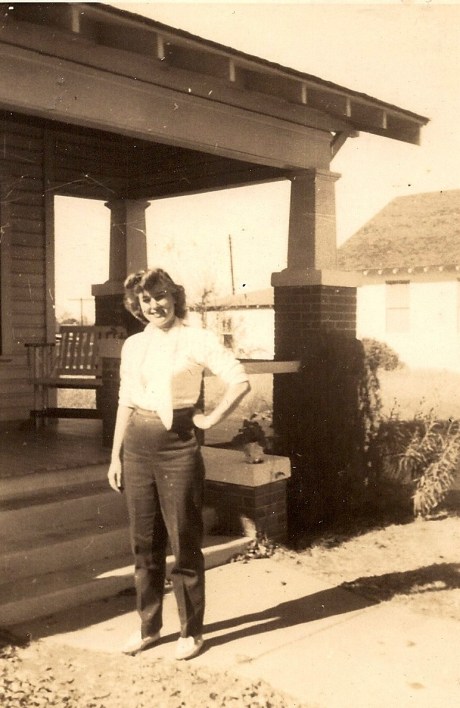 I spent hours alone, with my brother and sister, or with my cousin, swinging on that porch swing, playing on those stairs, catching horned toads in the yard. In the back yard was a pear tree where we ate the juicy fruit right off the branches. She even had chickens for a short time. Her garage was another source of amazement, where we could explore the boxes and trunks. My grandmother also had a wringer washer and a clothesline in the back yard. We had a clothesline at home, but the fun of running clothes through that wringer out in the yard never ended for this kid from the big city. We walked down the street to the ice house for chips of ice in the summer, visited a neighborhood store nearby with the nickels my grandmother gave us, or walked downtown to see the big stores or visit my uncle at First National Bank where he was a clerk and later Vice-President until his health made him retire early.
There was a living room, a bedroom behind it, then the kitchen and a sleeping porch. There was a door with a screen door in the kitchen that led to the hall and the bathroom at the end. I remember one bulb which made the hallway a little dark and scary when I had to walk down there alone. The other side of the hall had rooms, also with screen doors. I can’t remember if there were three or four rooms. These were the rooms that my grandmother rented to older men. I finally got curious enough to ask my mother who the men were way too many years later. She told me they were pensioners. I asked what that meant and she said they were veterans, living on a government pension. There was a porch on the side of the house where they could sit outside. Their rooms were tiny with a bed, chest of drawers and a table, as I remember. I think this is the side porch behind my mother.
There was another room at the front of the house that you entered either through the living room or from the hall. My grandmother rented this to a lady for a few years and then reclaimed it for another bedroom. I think it may have been my mother’s room when she lived there. Because of all these people in the house, we weren’t allowed to use more than a few inches of water when we took a bath. At night, my grandmother kept a chamber pot, actually an enamel bowl, under her bed for us to use rather than walking down the hall. I never got used to that.
In the kitchen, my grandmother had the phone on the wall that was used by everyone in the house. It was a party line and I loved to quietly pick it up and listen to the local ladies’ conversations. For all I know, they knew I was listening, but they continued talking anyway. At some point, my grandmother got a black phone like we had at home, which wasn’t nearly as interesting. On the window sill, she had various items, including this little pitcher, which once held syrup, and this small enamel coffee pot. They have been on my kitchen window sill or window shelves as a sweet reminder of those days. I also have my great-grandmother’s coffee grinder. I don’t remember what else my grandmother cooked in that kitchen, but I know she made Kool-Aid and poured it into ice trays before we arrived. We called them squares and we could take a couple of the frozen treats in a bowl to suck on while we pushed ourselves as high as we could on the porch swing. I spent my days listening to her old 78 records or looking through her cedar chest where she kept a fur stole and a tissue wrapped piece of her hair. I don’t know how she got a fur stole and why people kept their hair when it was cut, but it was endlessly fascinating to me. Her cedar chest is in my bedroom. I can’t remember if the fur stole is still in there or not, down at the bottom.

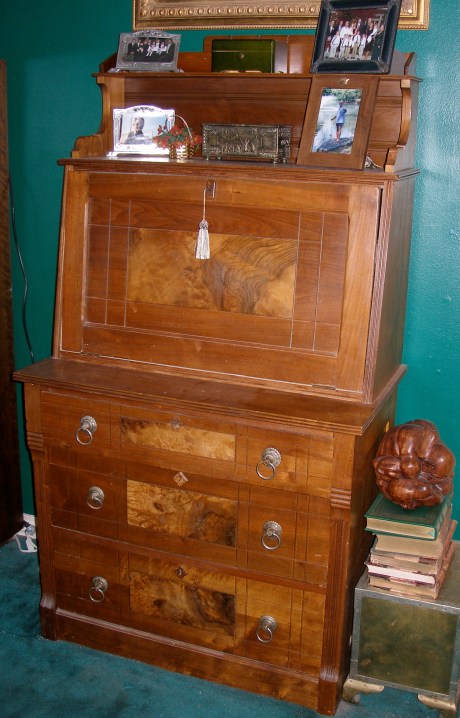
The other piece of furniture I have from that house is my great-grandmother’s desk, which I have had since I was 12. I need to think about passing that along to one of my granddaughters, if either is interested.
 As you can tell, I am more than sentimental about my family. The older I get, the more fascinating their stories are to me because they explain so much about who my parents were and who I became because of my ancestors. I like the links to my ancestors and I like having them around me.
My last vivid memory of my grandmother’s house was soon after I was married and my husband and I stopped by. It was early 1967. We probably didn’t visit much after that, being busy having our own kids and getting our first home and building our life in Tulsa. At some point, my grandmother sold the house and moved to a smaller house a couple of blocks away until she was crippled by Rheumatoid Arthritis, almost overnight, and spent the rest of her life in nursing homes, dying in 1981 in Tulsa. At least my children got to meet her, although they didn’t get the joy of being around her when she was at her best.
With no relatives in Ardmore, I hadn’t returned for years until 2014, when a friend of mine and I made an impulse trip to that area. I started driving around town, finding the cemetery and then the houses my grandmother lived in. I found many familiar places and the memories flooded my mind. My grandmother’s house was looking ragged, but was still standing. When I was taking a photo, someone walked up to me on the street and said it was probably a crack house. The neighborhood had definitely changed, but it had been decades since I had been here. My friend and I ate dinner at a Mexican restaurant downtown before we left. The restaurant was in an old store downtown and the food was good, the people very nice. I didn’t think anything else about it.
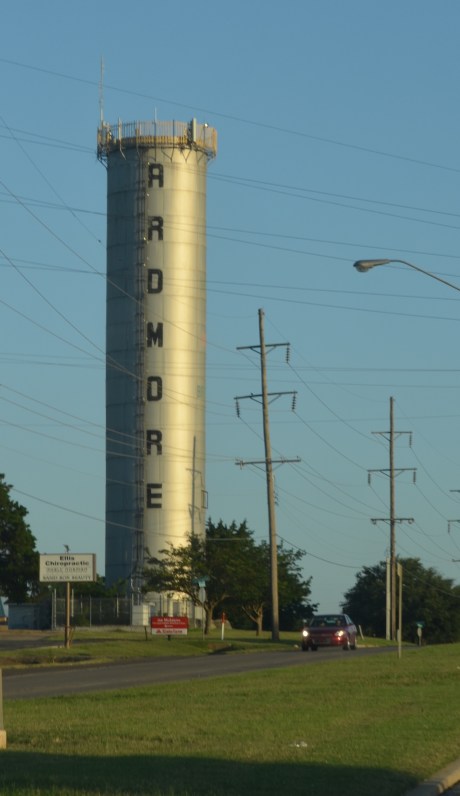
Last month, I was driving to Texas and had a glitch in my plans, so I ended up with an unexpected stay in Ardmore. The drive down is different with the Interstate highway. When I was young, we drove through small town after small town until we hit the Arbuckle Mountains with the winding roads and steep drop-offs. Large trucks met us as we drove around the curves cut through the rocks. Here’s an old postcard I found showing part of the road. I have to laugh now since I’ve driven through the Alps and the Rockies, but it was scary to a little girl in the back seat looking down the slopes.  Once we got through the Arbuckles, we kept our eyes open for the standpipe, signaling that we were in Ardmore. I can’t tell you how it delights me to see it to this day, even though the highway is located a few blocks away.
 My summer stop this year left me with an evening of daylight, so I drove to the cemetery and then looked for the houses once again. To my delight, my grandmother’s house looked like someone new had moved in and was taking care of it. The whole neighborhood was starting to look a little better. They closed in the front porch years ago, but I can look at the house from each side and see how it used to look.
  I have no idea what possessed a 71 year old woman, me, traveling alone to suddenly stop and ring the doorbell. I was greeted by a man who wasn’t unfriendly, but was surprised to see me. I started pouring out the story of my family and the house to him and he took interest. He had to leave and I wasn’t going to intrude, but he asked questions about the house and I told him I would send him some more information. He told me his family had moved to Ardmore from Central American and found the house taped up. I think they were able to get it if they agreed to fix it up.
About a week after I got home, I wrote the family (whose name I didn’t catch, but I knew the address) and sent them a rough drawing (I can’t draw) of the inside of the house as I remembered it and a little history and the few pictures I could find. I thanked them again for taking care of the house that had meant so much to me.
This week, I received a letter from the 21 year old son of the family. First of all, how many 21 year old boys would write to a stranger, an old stranger at that? I was immediately touched. He told me the story of his family’s move to America in 2015 from El Salvador, where it had become too unsafe and too economically insecure to stay. I can’t imagine what it took to make that decision. His family consists of his father, mother, and three sons, ages 25, 21, and 19.
The oldest son is a computer programmer and has taken some courses in Oklahoma City since moving here. The middle son, the one who wrote me, had a year of college in El Salvador, studying electrical engineering. He is trying to get into college here and is studying to get his ACT scores high enough to get a full scholarship. He has set a goal for himself and is sure he can reach it. The youngest son just graduated from high school as the Valedictorian (after being here only two years). The mother happens to work in the Mexican restaurant where my friend and I had eaten and makes the tortillas and cleans the tables. The father works as a handyman, learning new skills which are helping him with the house remodel. All the boys have jobs in either restaurants or other places around town. Here’s the family.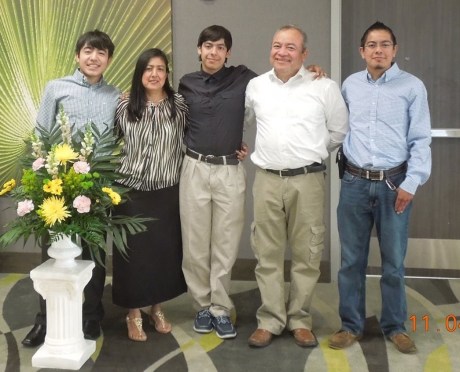
In a year when I have questioned what is happening to our country, when I have wondered how I can make a difference or help or educate myself or do something, this is a pretty strong reminder of what America is all about. My relatives on my mother’s side made their way from Europe and worked their way across the south farming until they ended up in Indian Territory before it was Oklahoma. When the Great Depression, the Dust Bowl and all the other hard times of the 1930s and then the War in the 1940s came to test this young widow and her children further, they found a safe haven in their home in Ardmore, where they took care of each other with love and hard work through those years until the children all grew up into productive adults with very nice lives.
Decades passed and that house still stood strong with who knows what families moving in and out. When the house was about at the end of its use, this lovely family arrived in America with new hopes and dreams. They reached out to me with warm hearts and open arms, inviting me to come see the house and meet them in person. The photos they sent show me the work they have done on the house and how delightful it is. Although I can see where walls have been knocked out through the years (such as from the kitchen to the sleeping porch), I could recognize certain things. The kitchen sink is right where it always was and those may be the original cabinets. I knew that spot in my heart immediately.
As my new friend wrote, “We are working little jobs right now because we just haven’t had the opportunity to do something bigger, but we’re making our lives change little by little and one day we’ll be in a better position.” Isn’t that what America offers all of us – the chance to work and make our lives better?
I now have an email, so I wrote back immediately. My new young friend sent me photos of the family, their cat, and the inside of the house. I reciprocated with some of my own family. The photos show a home much like any of ours, including one of a birthday party of his brother where the Santa placemats on the table are similar to some I have and the cake looks like one we would have in our family. We aren’t different at all when you look at it.
Of course, I’m going to find a time to visit again when all of our schedules allow us to be together. A line jumped out at me from the return email I received.
“Is nice to know that there are still nice people in this world!”
Isn’t it?
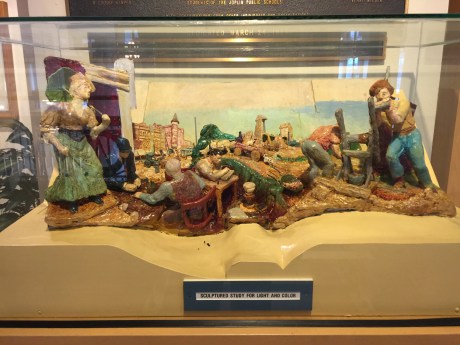
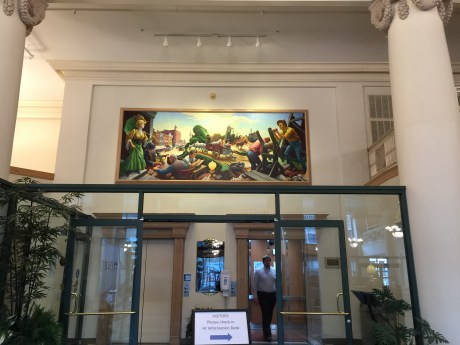 The interesting thing about this mural is the extra display that shows all the drawings, plans, letters, and models that went into making a mural. It’s a very complicated process. Here is a clay model Benton used.
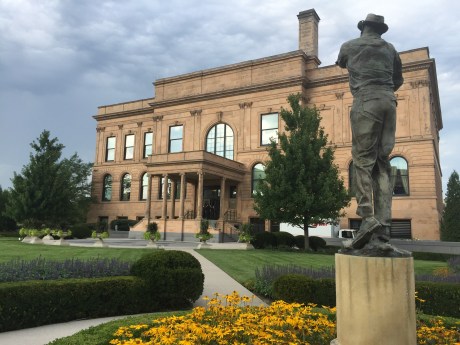
 The Joplin City Hall is an interesting building to see and it was a nice stop along the way.
 We sped towards Des Moines so we wouldn’t miss the first party of the weekend and were awed by the beautiful site for the event, the World Food Prize building. This was an old Beaux Arts library that was scheduled for demolition before wise Des Moines benefactors saved it and spent millions renovating it for the headquarters of this organization which gives an annual prize to the individual who has done the most to stop hunger in the world. It’s quite impressive!
 The inside is stunning. My favorite part was the sculptures of different grains adorning columns in the Rotunda.
 Every detail of the building was gorgeous.
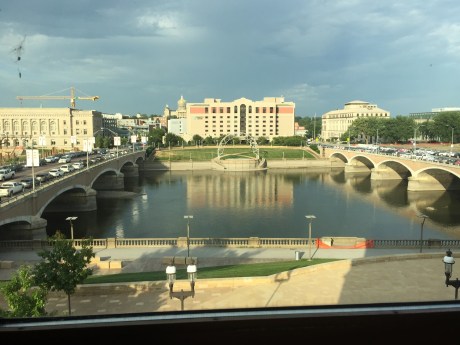
 I was getting more impressed with Iowa and the Iowans who planned this city. Here was a view from the second floor towards the Des Moines River that runs through the city. The state capitol is in the background, as is our hotel, peeking out from behind the hotel in front.
 On Saturday, we were invited to brunch, so we walked across the river, along the river walk and into the incredible Farmer’s Market with over 300 booths along the way to the Des Moines City Government building at the end.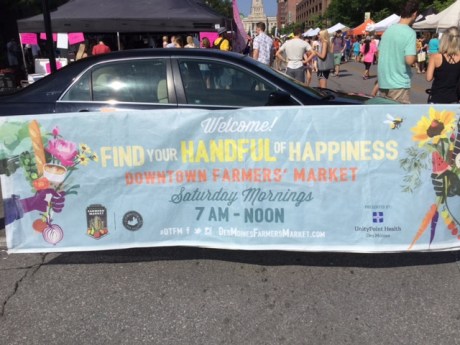
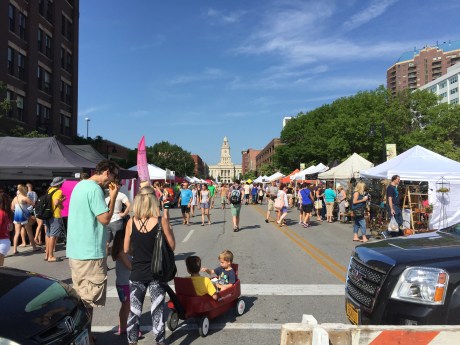

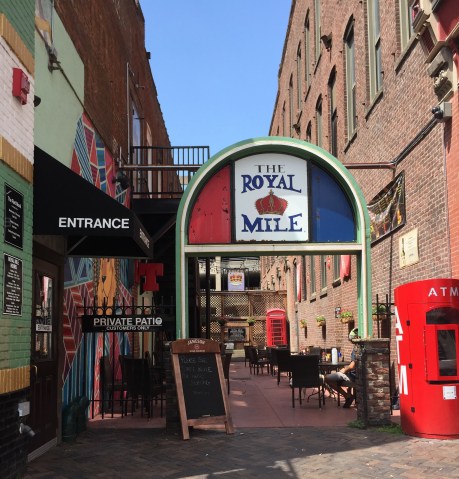 After shopping our way down the street, buying food, clothes, Amish woven ware, and other trinkets, we arrived at the historic Kirkwood Hotel with its wonderful Art Deco lobby. Here is the desk.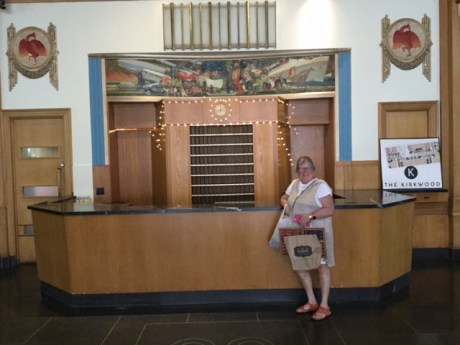
 In the afternoon, we drove to the Capitol building, one of two in the country with five domes (the other is in Rhode Island). I had to admire the gumption of these Iowans who built this city in the middle of the country with such great aspirations.
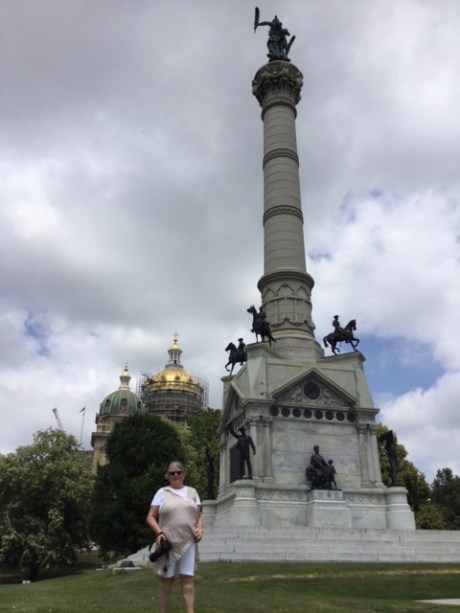
 I guess they are re-gilding the dome. We visited the monuments on the capitol grounds, including the Soldiers and Sailors Monument honoring Civil War heroes. It was very impressive with large sculptures all around honoring the men and women of Iowa. I’m standing by it for scale – it’s 135′ high.
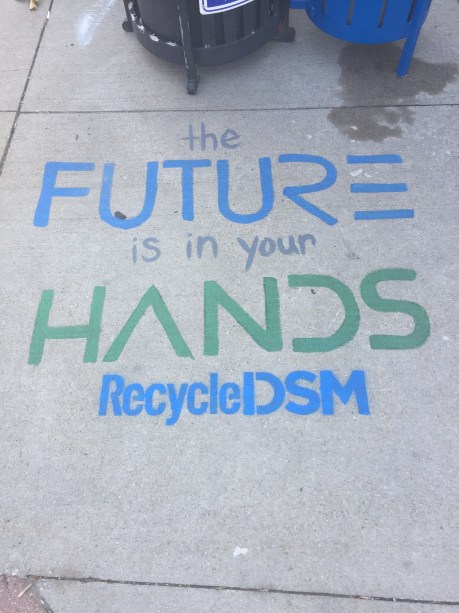
 One of the things my friend, Edie, and I both loved about Des Moines was the whimsical art everywhere we looked. It is a clean, vibrant, fun city with lots to do. There were unique shops, restaurants, bars and entertainment everywhere we were downtown. Paul McCartney was playing and there was a Broadway play, both within blocks of us Friday night. People were walking and having a wonderful time.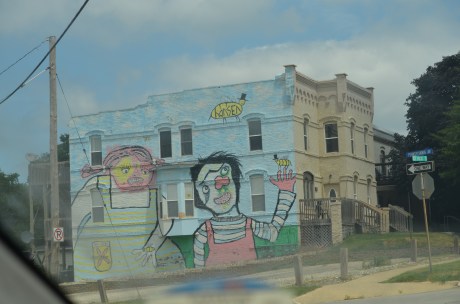

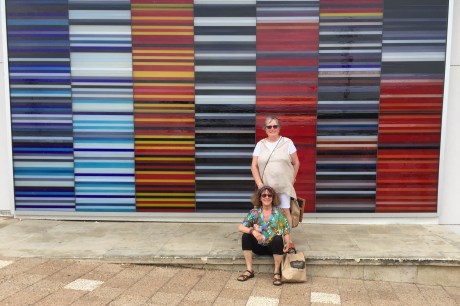
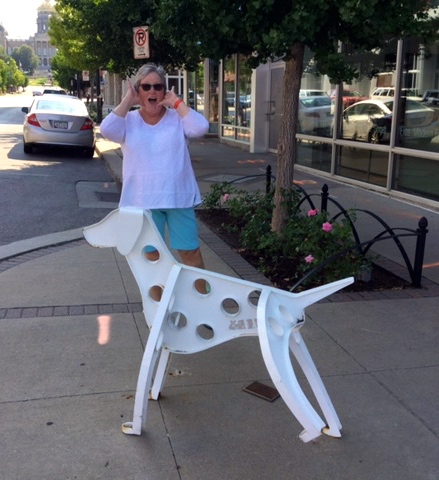
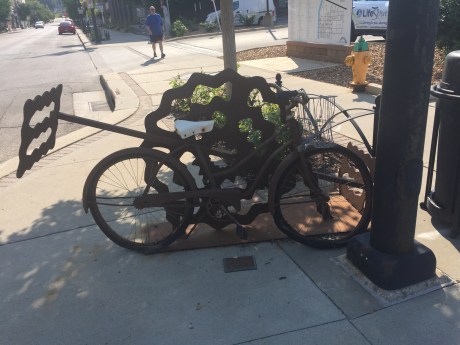
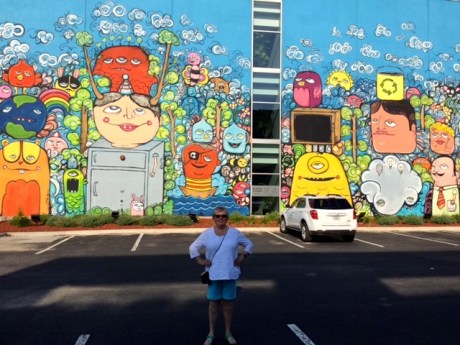 Our hosts captured the spirit of Iowa with a photo stop at the big party Saturday night. In fact, we drove by lush fields of corn from Oklahoma through Iowa. What a rich, abundant country we live in!
 After the party, we spotted an outdoor concert on the river and stopped to watch. Phillip Phillips was playing to the paying crowd and the audience along the bridge.
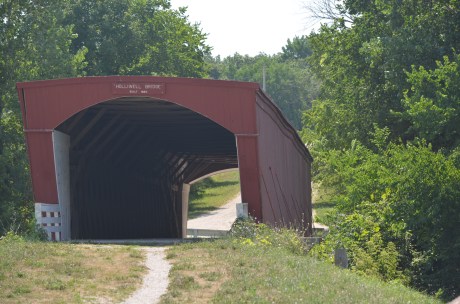
 Before leaving Iowa, we had to stop at some of the Bridges of Madison County, just south of Des Moines. We managed to see two of them and they were worth the visit. The first was the Holliwell Bridge, built in 1880, and the longest of the wooden bridges still standing.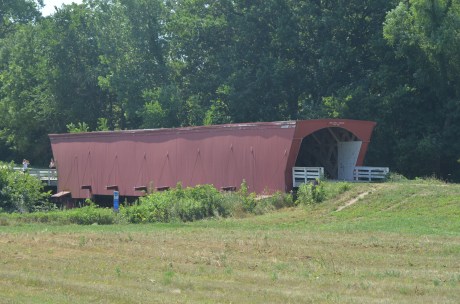
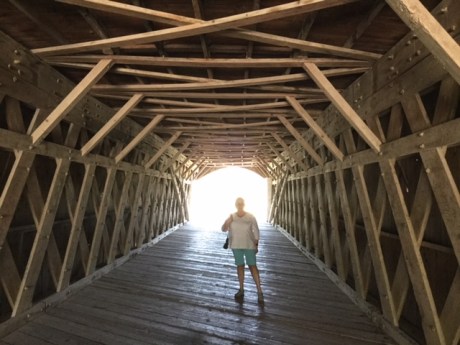

 The second bridge we visited was the much smaller Imes Bridge, built in 1870. It was a cutie and a good comparison with the other one.
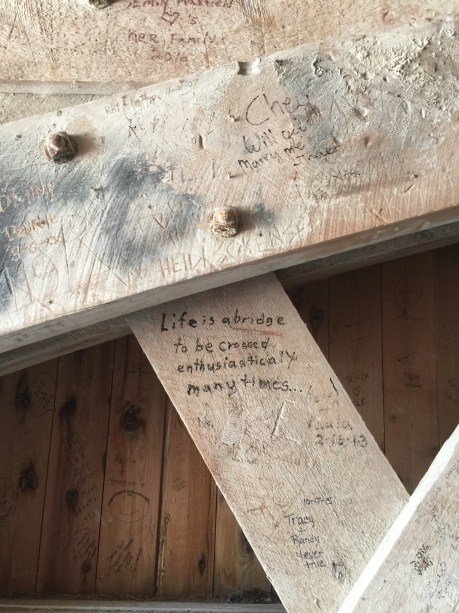
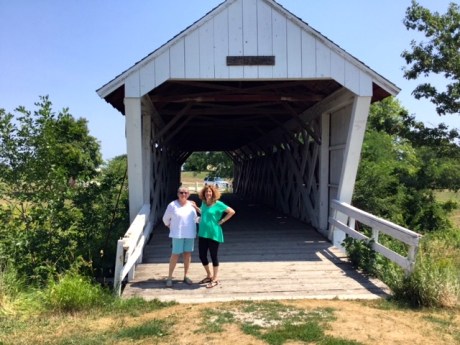 Part of the fun was seeing all the graffiti left by visitors, which they must paint over periodically, just as they do the wall at Graceland.
 We left the rolling hills and lush cornfields of Iowa, headed back to Tulsa.
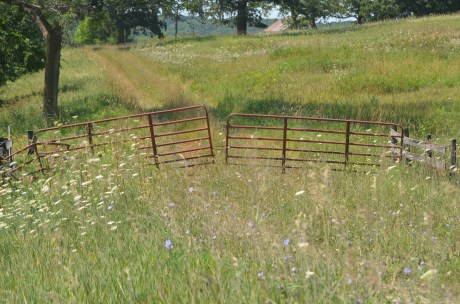
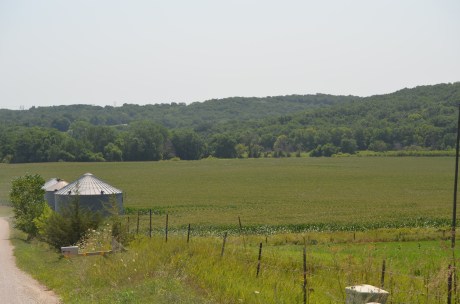 I didn’t mention the beautiful fields of wildflowers that waved at us as we drove. I love this old gated road.
 On the way north, we had seen the sign for Peculiar, Missouri, and felt we had to stop and explore this town on our way home. You can look up the origin of the name, but we had fun using it as we drove into town along Peculiar Way and Peculiar Road. Actually, the town has grown and has a lot of new homes. We saw the high school and stadium where the Peculiar Panthers play. I wanted to hear their cheers.
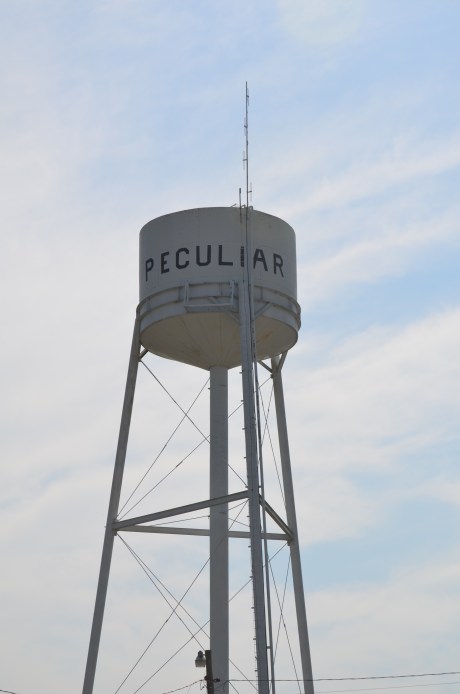 There were a few buildings left and a hint of civic pride and desire to bring back some of the history.
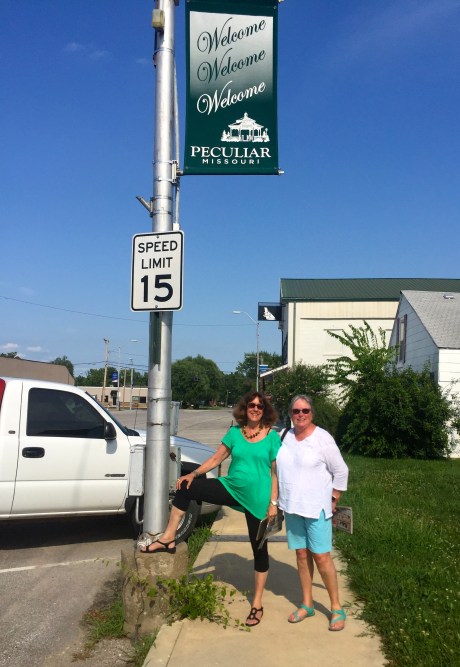 We were lucky enough to meet ReGina Edmondson, who has lived in Peculiar since her military father and her mother decided to settle there and raise eleven children. ReGina has lived there since she was three and owns the house, one of the early ones on the main street, where she was raised. She is a writer for the paper and is working to have a museum. She was a delight and a source of information we couldn’t find anywhere else.
 She steered us around the corner to a Feed Store that is being refurbished for something historic and fun to see.
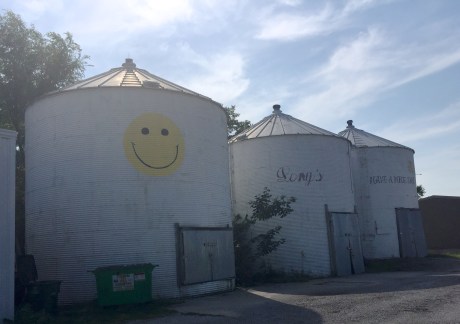
 Such a fun little piece of America. One can only imagine the jokes they have to put up with.
 We finished our tour of Peculiar, stopping at the local market to find a magnet, which we didn’t find (they’re missing a marketing opportunity). Edie captured this sign, which kind of summed up our trip.
 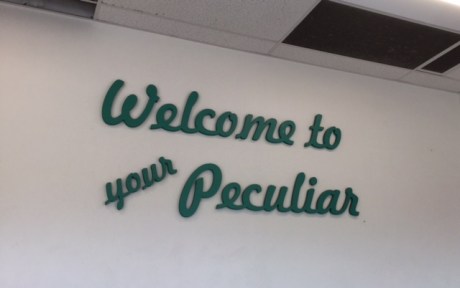 We started out as two old friends who kind of knew each other and discovered a mutual passion for photographing and exploring all the places along the way, catching up on 50 years as we drove. That wasn’t so peculiar, but it was a whole lot of fun!
 You have a little girl who wanted to please and could empathize with people. A girl who graduated from high school in 1963, right as the world, our world at least, was about to be shaken to its core.
 and set out early. In the usual chaos of my life, I also had a grandchild’s performance to watch in the afternoon so I would have to leave early. I wanted to be counted no matter what.
 My kids had told me to be careful. I hadn’t forgotten that there are crazies out there and you can’t predict what will happen, but I wasn’t worried. Remember, I’m the 2nd tier kind of radical, the ones who wait for the revolution to be absorbed into the establishment to help with the changes. The rules were posted online and as I entered.
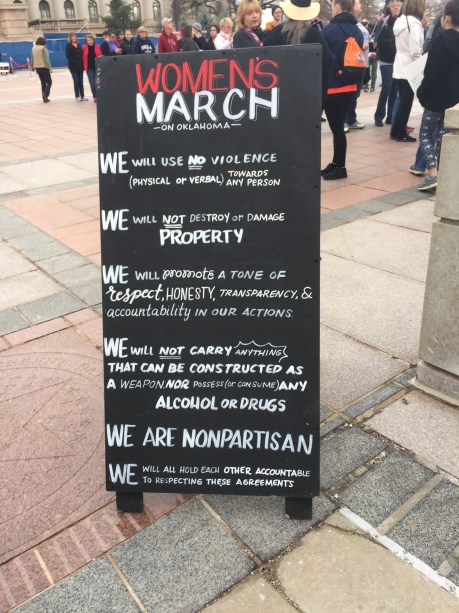 For those of you who have preconceived ideas about a march, I’m sharing some of my pictures and thoughts to help you understand what was happening. This was in the very so-called Red State of Oklahoma.
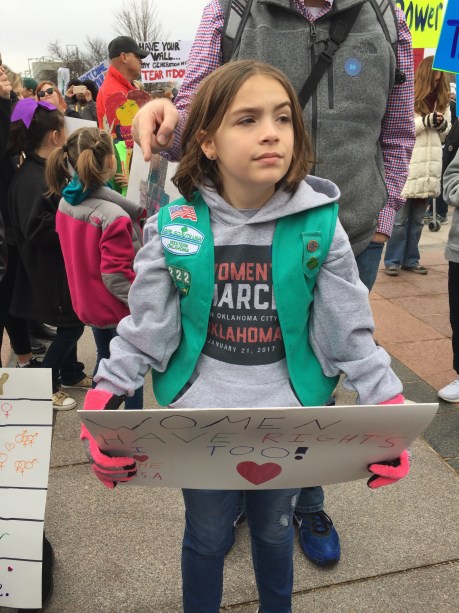 There were people of all ages, all races, and all economic levels. I looked around at women wearing expensive running shoes and outerwear mingling with others who obviously had other fashion statements to make. There were actually no social tiers at this march. We were all in this one together. There were the usual women’s rights signs and a few anti-Trump signs. Mostly, this was about being for issues and causes, being pro-active! This man was a veteran of protests and I watched a very stylishly dressed African American woman ask to take a picture with him and her young daughter.
 Yes, it was a women’s march and there were lots of women and lots of pink pussy hats (which were just the kind of humor this serious issued needed)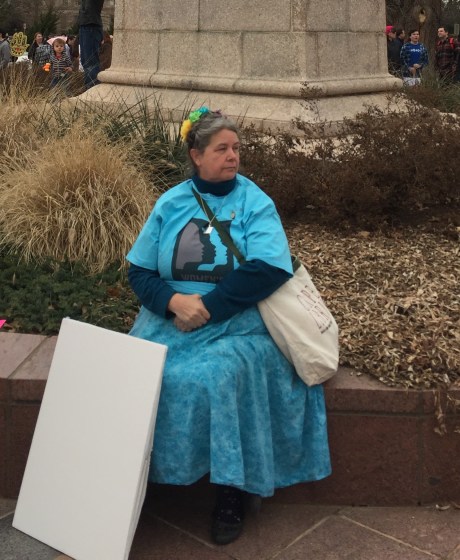
 The biggest surprise, although it shouldn’t have been, was how very many men were there. This man was registering voters.
 There were men of all ages and they made up a very big part of the crowd. You saw generations and families. I think that was the most heartwarming thing I witnessed – all the men who understood why there was a march and why the women were there. They were so very supportive.

 I ran into a friend and we spent a few minutes talking about how long it had been since we felt the need to protest like this. She commented that she had always been a Republican and I said I had too. We laughed at how we had left the party as it drifted and were now Independents. Who ever even knew an Independent? That shows something.
 I was delighted by all the signs for so many issues but some of these said it best. We were all there for everything!
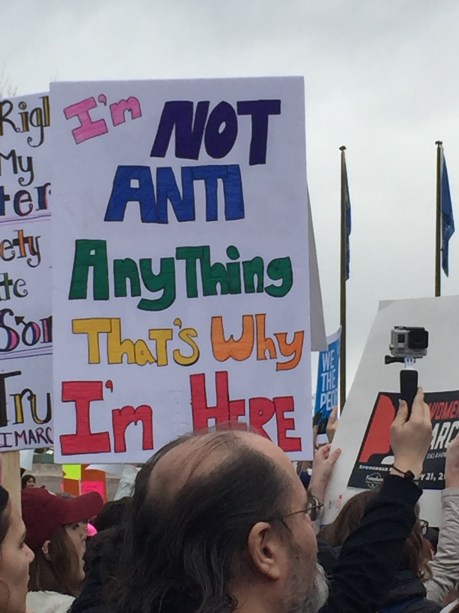
 As with all of the marches across the country and around the world, the crowd was larger than anticipated but everyone was content to visit, take lots of photos and enjoy being with people who also cared. There was hope and joy in the air, to tell the truth. As the march was finally starting, I had to make my way to the car, but had to empathize with those of us who thought we had some of these issues solved.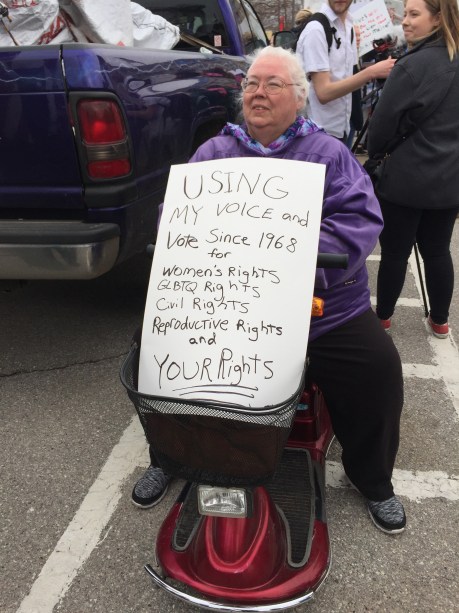
 When I got to the car, my phone had died so I reached for my big camera and watched a bit of the march go by me. It came in waves that washed over me. No loud noises, just people who cared and shared and came from all over the state to be heard. This one broke my heart and brought me back to the reality of this for many.
 So several thousand Oklahomans who couldn’t make it to Washington D. C. came by car and bus on walkers and wheelchairs, carrying babies and pushing strollers and holding children by the hand. They carried homemade signs with messages that were powerful in their many diverse messages for so many concerns. They came to be with others and share something that became more powerful as word started spreading about the size of the crowds in Washington and the numbers of similar marches around the world. The sense of hope built and the strength was palpable.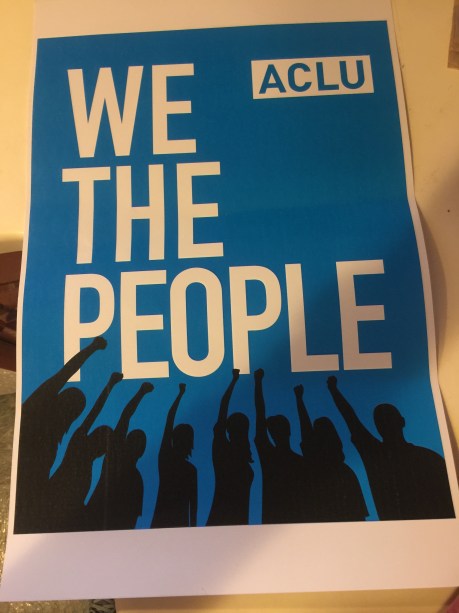
 My father had his branch of the family business and my mother stayed home with me, my brother and, soon, my little sister. She had help in the house, the first Negro (as we knew them), I ever knew. We met others when we went to the country club where my father played golf and we dined, played golf and swam in the summers. More Negro helpers that we knew so well but didn’t really know at all. I don’t remember meeting any other people of different races or even different religions through the 1950s. It was a pretty white life in my little world, even when I went to visit my grandparents in Oklahoma City or my grandmother in Ardmore.
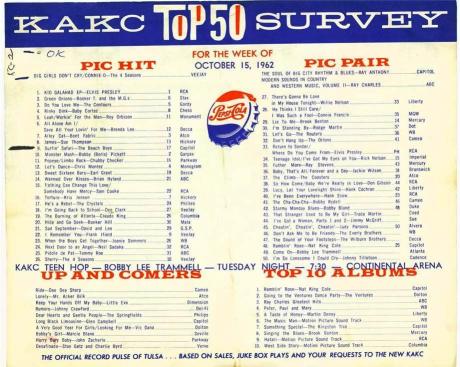 Most of it was fun and silly. Some of it was sexy. We had learned to do the Twist and we were listening to folk music. We had progessed from The Kingston Trio to Peter Paul & Mary. We were on the verge of Joan Baez and Bob Dylan and songs with messages. Our world was about to be rocked.
 We were talking now. And we were raising our children differently, just like we wanted to. By now, I had three girls and a boy and it was just 1975. I wanted them all to grow up with choices, all kinds of choices. They were raised with this…
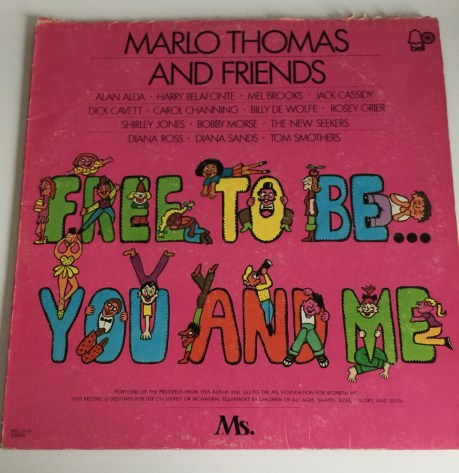 Yes, life was different for my generation. We talked about things and we learned about all our choices. By the time we were in our 30s, lives were changing. A friend lost her husband and all those years she had spent home raising the kids were now a challenge because she was a single mother having to enter the work force when she had lost ten years or so of career advancement. Other friends faced divorce because men now had the freedom to leave their wives for the girlfriends they had found. These women also found that they had to reinvent themselves. Life was not as simple as we thought it would be.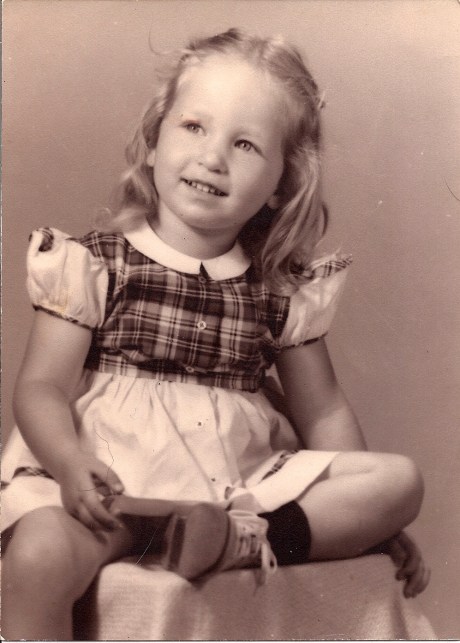











 Confetti Thoughts