I started the 60s as a teenager in 9th-10th grade and ended the decade as a college graduate, married and pregnant with my second child. It was a time of immense change in both me and the world we had known.
Not sure if I was a typical teen, but I was a busy one. I studied hard, learned all the social graces, dated and fell in love, got my driver’s license and cruised with my friends, went to movies and football games and laughed a lot. I was an oldest child, anxious to please adults and do the right things…and I was a girl who was taking in all the things I saw adults doing that I thought were not quite right. I wasn’t as much quiet as observant. And, I read a lot. I’m a month too old to be a legitimate Baby Boomer, which makes me the end of the Silent Generation. My parents and grandparents had lived through the Depression and World War II, which they didn’t talk too much about. I learned through digging through the photos and objects in their houses. In school, we read all the dystopian novels, “1984,” “Lord of the Rings,” “Animal Farm,” “Fahrenheit 451,” and I was absorbed with the “Diary of Anne Frank,” both the book and movie. By my senior year, I was exploring the works of Camus and Kierkegaard and other existentialists while developing my own faith and belief system.
By college, we were listening to folk music along with our beloved rock and roll, which we danced to with great joy. I spent many years rolling my eyes at my parents as they rolled theirs at the music, the slang, the way we dressed. My freshman year had barely started when we were rocked by the assassination of President Kennedy, followed by the Beatles coming to America the following spring. Everything was changing so rapidly and we were watching all the things that had seemed so stable begin to show the cracks in the systems.
I recently watched the Bob Dylan biopic, “A Complete Unknown,” and actually got teary listening to the music and watching the images of the 60s. In my Freshman dorm room, we only had one or two electrical outlets, which my roommate and I shared. We had a popcorn popper, hair dryers, lamps, and I had an electric typewriter (I think I had an electric one by then), a clock radio and my record player. I played my records all the time, listening to Joan Baez, Peter, Paul & Mary, and so many other folk singers over and over. As the Viet Nam War started to build up, we saw our contemporaries going to college and/or getting married to avoid the draft. Many of my classmates were shipped out after they graduated. One classmate was killed as soon as he arrived. Protest songs were becoming more relevant to what we were living.
The Civil Rights Movement, the Women’s Movement, the Anti-War Movement were all around us. In particular, we were seeing the inequalities for women. We had different curfews, campus rules. Once we were out of college, we had to either hope to get married to someone who could support us or get hired. The most touted options for us were Secretary, Nurse, Teacher. I went to hear Gloria Steinem on campus and read the latest feminist works. Even the women’s magazines my mother subscribed to were beginning to have articles on women’s place in society.
My boyfriend was in the Navy and we married when he got out and returned to school. We were poor and happy and welcomed our first child with complete ignorance of what to do. He joined my father’s business and I became the housewife and mother I was supposed to be. But, I found that there was so much more to do. I joined a discussion group of other young mothers, I volunteered in the community, and I kept questioning all of the norms in society. I could write more about all the things women couldn’t do, even as educated white women, but there were so many. We were basically still second class as far as many businesses and laws were concerned. By the time I had three daughters, I was doing all I could to make sure their world had more opportunities for them and their daughters. My last child was a boy and he was the one who really cared about women’s rights by the time he was in college. His mother and three sisters motivated him, as he said.
That decade of the 60s was definitely a major time period in my overly privileged, white life. From my lofty perch as I rapidly approach 80 this year, I wish that I lived in a society that listened to its elders and learned from the wisdom we have acquired, but I also see people my age living greedy, selfish lives and impacting others in negative ways. There are so many times I think we are going backwards – in a bad way.
I guess we all take different ideas from our lives. I like to think that this Child of the 60s came out of that time with a greater appreciation for those who didn’t have my advantages and a greater sense of empathy for the suffering of others. This makes it my responsibility to always do what I can for others, whether it is speaking out or making contributions or taking actions to make changes for the betterment of others. I’ll never get too old for that. Peace and Love!
Forgive my eye roll as I listen to discussions in the news on how women are most fulfilled by staying home and raising babies. Everyone knows how much I love my children and how I enjoyed being home with them, but…here’s my story.
When I went to college in 1963, women were beginning to be expected to work really hard through high school to get into college and then…well, the options we were given were ok but really an excuse to stay in school and find a college educated husband. If you had to work after college until you found one, that was ok, but you were still kind of expected to start a family as soon as possible.
I’m not sure I really had a goal of any kind. I was smart, observant, in love, and thought my life would mirror my parents’, which was pretty nice I thought. I was very naive about how the world was going to work for me and my friends. I got married right after I turned 21, finished school, started grad school so I could teach while my husband finished up, and had my first child. Our life progressed as we thought it would and I stayed home and had three more kids before I turned 30. My husband worked with my father, I loved the babies (which I had never even thought about before I had them), and we were happy.
But, there was the fact that I got bored when the kids were asleep or at day care, preschool, school. Housework and playing bridge weren’t really doing it for me. I started doing volunteer work, as was expected of those of us who had it so seemingly easy, and found an unpaid career that filled my time, brought me new friends and taught me more than I ever imagined. I learned new skills and attained new leadership positions. My thought was that I couldn’t be out saving the world, but I could save my own little world, one day at a time, while still doing all the mom things, which I loved.
By the 1980s, I had edited a cookbook, a magazine, planned for city growth, worked with the arts, helped educate people on Historic Preservation, served on Boards of Directors and was feeling pretty good. It was the 80s and women were speaking up more and more. I had heard Gloria Steinem speak when I was in college and read all the women’s and new magazines and current books and was up on Women’s Lib, as it was called, sometimes not in a nice way. I understood and empathized, but I was busy driving a billion carpools and leading committee meetings and selling popcorn after school – all things that were needed. I wasn’t out marching for Women’s Rights. I didn’t have time.
The Equal Rights Amendment was in the news and states were ratifying it and dismissing it. Would it ever get passed? Nope. Women were slowly gaining more rights but were still not considered equal under the law in the United States. That’s the truth and still is to this day. It doesn’t mean that we can’t get more rights, but it means that they can more easily be taken away. Eventually, it was out of the news and women were content with small victories along the way. NOTE: we never should have stopped fighting for it.
I thought of myself as a person who was good at bringing people together to make decisions and finish projects and get things done. I was aware of inequities for women, but I wasn’t much of an advocate – yet. The Junior League of Tulsa was a bastion of educated women who spent their time trying to make the city a better place. It was the epitome of what women, even women who were proud homemakers and mothers, could do to make change. In 1983, two projects were proposed for the coming year. One was to work with domestic violence advocates and organizations to increase awareness. This was a new movement at the time.
The second project was to collaborate with The University of Tulsa to open a resource center for women who needed help as their lives changed due to numerous upheavals and changes of direction. This included women who needed to go to work, women who were widowed or divorced and left to fend for themselves and would help women who didn’t have the opportunities and contacts my friends had at the time. I first heard the term “displaced homemakers.” For some reason, the Catholic community decided that this project would be doing abortion counseling and there was a big uproar with even the Bishop becoming involved, articles in the paper about it all causing much division in the Junior League membership. After all of this, when it came time to vote for new projects to give our time and money to, I wasn’t sure if we should do something that was causing so much friction. I’m not sure how I voted, but both projects passed and were ready to go. Then it was time to choose chairmen for the projects. I was more than shocked when I got a call to chair the women’s resource center project. My first inclination was to say no, because why did I need to have stress like this, but a good friend convinced me that I was the right person precisely because I didn’t have a side in it and could work to bring everyone together. Flattery and a new challenge were appealing and I took off on a year that would be life changing in so many ways.
Our joint committee of volunteers and representatives from TU worked for nine months to set up the policies and hire a professional Director for The Women’s Center, as we decided to call it. We had a converted house donated by the university to furnish and set up, materials to collect, and publicity to generate. By the time we opened in January, 1984, women were pretty much lined up for the services. I’m proud to say that the center, under a different organization, still exists in Tulsa today. I met women who were desperate for job counseling, looking for places to live, needing just anyone to talk to. Nobody was asking about an abortion, by the way.
A couple of years after this project, I was asked to chair the domestic violence project as the new shelter was opened and new programs being developed. After that year, I continued to serve on the Board of Directors for six more years, including a year as Board President. In all those years, I never spoke to a community group without a woman or women coming up to me afterwards to tell me their story. They were beginning to break free with education about the issue.
This was becoming personal because I was the mother of three girls and I felt like I needed to be a role model in the fight for other women. I needed to expose them to the things that happen to women. And, I was the mother of a son who needed to be a man who respected women. My son was the one who worked for women’s rights while he was in college. Hopefully, they all absorbed some of what I was doing.
Another reason this was becoming more personal was because at the same time, my friends were also going through major life shifts. In my parents’ time, there were few divorces, mainly because the women had no recourse. They had no education or skills, no money except through their husbands, and no support from churches, society or even family. You were expected to stay in a marriage, no matter how bad it got. Cheating and abuse and addiction and gambling and men who couldn’t provide for their families are nothing new, but nobody talked about it. It was the age of secrets. By the time I was in my thirties, more marriages were falling apart. We had married young for so many reasons. Birth control was new and only available if you were married. Girls had to either have abortions in secret places, give their babies up for adoption or get married. Guys could get exemptions from Viet Nam if they were married or couples married because the guy was drafted. You were expected to have your children young for health reasons. But now, maybe some of those reasons weren’t good enough for a sustained marriage. Guys who cheated felt free to leave their families for their new love, husbands died, husbands were cruel. I also had friends who realized that they were gay, which was fine with me. They really weren’t any different, just happier. When I wasn’t out saving the world for others, I was on the phone with friends who were facing new realities.
Those who suddenly had to find work learned that those degrees we got were pretty useless if you hadn’t been in the work force building up your resume. Many sucked it up and called people they had worked with as volunteers to see if there was a paid job they could do. Networking was key to survival. Whatever job was found was mostly at entry level and many still had children at home to take care of. Divorces were messy and many a friend became a fierce advocate for their children and themselves in courtrooms where men still had an advantage. Once you were out there, it was just becoming a thing for women to get their own credit and bank accounts. There were those who suggested that women should stay married no matter what and were no support at all.
Through the 80s and into the 90s, I did a lot of writing, speaking and advocating for these women, these “displaced homemakers.” In that time, my own children went to college. The three girls married and had their first babies and my son was in college. I had gone to work part-time, then full time and had my own business. Then, suddenly, I was one of the displaced. My husband died of cancer very quickly and, after almost a year of being immersed in the world of medicine, I was out there on my own. After putting four children through college and having three weddings, selling our family business and watching my husband have to reinvent himself, our resources were at a low. I was a widow at 52. Life happens.
In the 25+ years since, I have reinvented myself so many times, used every skill I ever had, laughed and cried with friends and watched the world changing all the time. There are so many new developments in medicine and technology for my children and grandchildren. My friends are still going through transitions and reinventing ourselves for our later years. I survived because of the experiences I had through the years, the friends and family who gave me love and support, and because of the strength of the women in my family whose stories I tell with such pride. My daughters, and daughter-in-law, mother and grandmothers and all the women I have known have made me stronger and happier than I ever expected. I ride on all their shoulders.
Looking back, I smile at the dream of the “Happy Homemaker” that we believed in so blindly. It is a great part of life, but it is only part of who we will be as women. “Children are the best thing in your life” is an easy thing to say, but they can be a challenge. Some are born with physical or mental disabilities, some become addicted, some just seem to defy everything we give them, some make bad decisions. And some die. Some women cannot have children by birth and may struggle through fertility issues and adoptions. And, some women just don’t want to have children. Children cannot be the only way to happiness.
I am a lucky girl. My children were healthy and sweet and fun and came out ok. I am a lucky, lucky girl. I will always be grateful for my wonderful children. I will also say that I also had wonderful men in my life, including a supportive husband. I will always be grateful for the loving, kind men I have known and been friends with throughout my life. Because I have been so lucky, I will aways fight for the women who haven’t been. I will write and talk and post and march and vote for the homemakers and the “displaced homemakers” and those who chose another direction.
The thing is that we cannot make decisions for other people. We cannot force them to believe as we think they should or live as we think they should. We cannot judge them for their beliefs and decisions. None of us know what is going on in other people’s lives. We need to support and love and listen. We need to live the Golden Rule. Life isn’t always easy and we don’t need to make it harder for anyone. We need to be kind.
Politics has become a way to beat other people down instead of lifting their lives up. We need to be better.
We’re into a new year and I’m trying to live up to one of my own resolutions – to be a better human being by recognizing the humanity in all of us. I could preach about this, but I’m better off just trying to live up to it.
People tend to put other people in categories, which is normal. When you see or meet someone, you immediately register their size, their skin color, their voice, the way they dress, etc. It’s how we tell each other apart. The problem comes when we start to put people into categories and decide if we like them or not based on what we are seeing. I know we won’t like everyone we meet, nor should we, but we at least need to try and understand them and recognize that they are human beings.
Human beings are capable of such kindness and such cruelty and it doesn’t seem to take much to push us to either extreme. The extreme of cruelty crosses all peoples throughout history. Robert Burns wrote of “man’s inhumanity to man” in his dirge, “Man was made to Mourn” in 1784, but there are examples we are all too aware of, from the cruelty of slavery through the ages to the torture and mutilation of people by almost every culture.
“The Purpose of Propaganda is to make one set of people forget that other sets of people are human.” Aldous Huxley
We’ve seen the use of propaganda by Nazis and the Ku Klux Klan in more recent years. Elie Wiesel wrote of the “Dehumanization in Night,” where the concentration camp guards shaved the heads and branded the prisoners with numbers to make them less human so they could more easily torture and murder them. The Ku Klux Klan considered so many groups to be inferior that it’s difficult to understand who the members who considered themselves so pure were. They were against Blacks, Jews, Catholics, Irish, Italians, and anyone who didn’t fit their image of who they thought they were.
My daughter and I were in Ponca City, Oklahoma a few years ago and visited the statue of Standing Bear, a Ponca chief who sued the United States government and won. In 1879, he argued that Native Americans were “persons within the meaning of the law,” which was the first time that Native Americans were recognized as human beings by our government. Let that sink in. This did not stop the injustices that they were subjected to, but it was a beginning.
Several years ago, I worked for the American Red Cross and did educational programs in several counties in Oklahoma. The Red Cross is very focused on serving diverse populations as its mission is mandated by the U S Congress and they must give aid to everyone, regardless of who they are. After each program I gave, I needed to give the racial makeup of my audiences. I usually got this from teachers when I was in a school setting. I found that there were so many combinations of races in our state, a true melting pot of white, black, brown, red and yellow. For such a “red state” politically, we are certainly one of the most diverse.
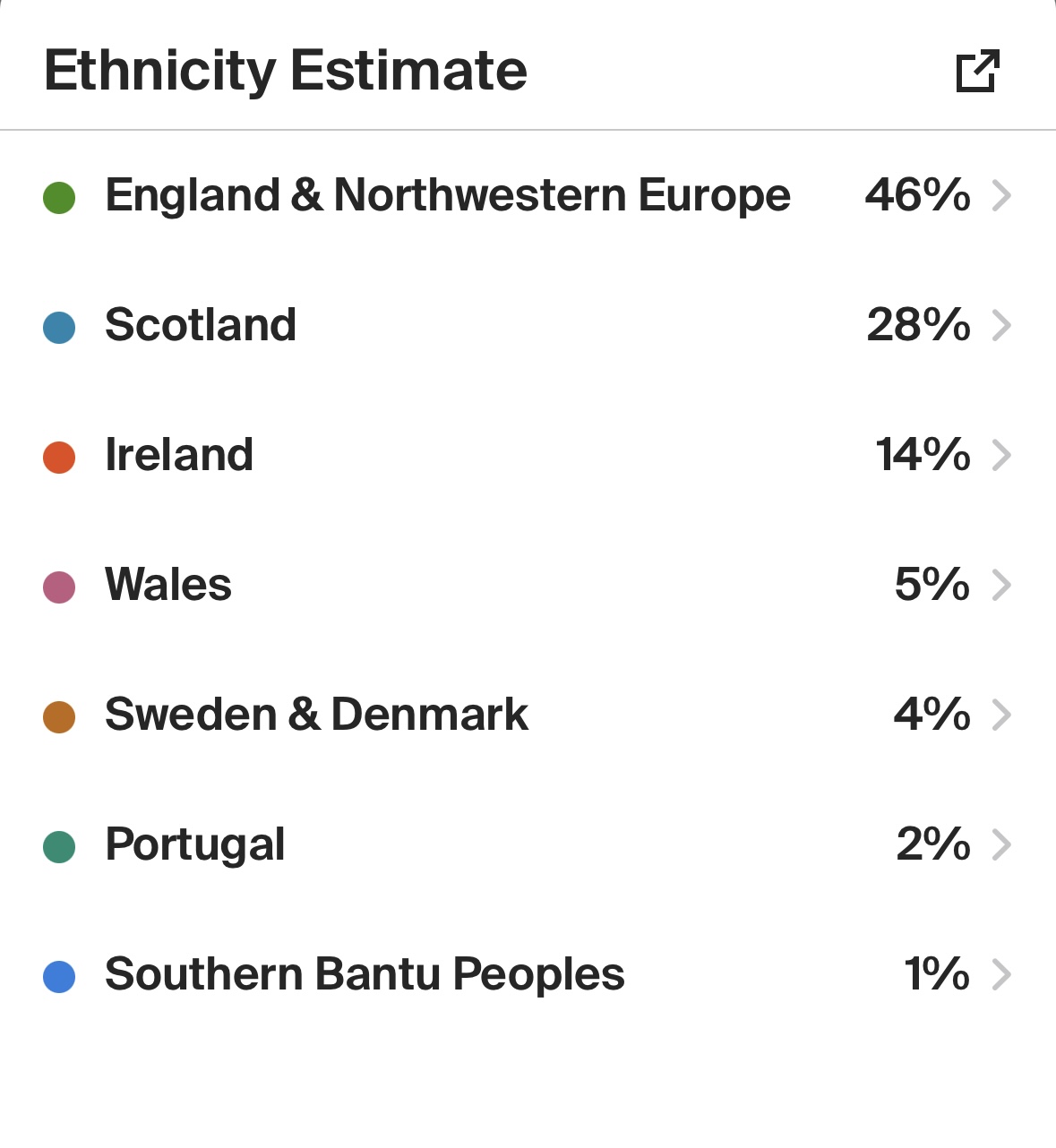
Looking at my own DNA, as broken down by Ancestry, I am pretty white, although through various decades, I would have been hated for being Irish, Scottish, Catholic, and poor.
As the DNA tests become more sophisticated, I started seeing that I had some people in Northern Africa, which could mean all kinds of things. As I check the latest findings, I see that they have narrowed it down to the Southern Bantu peoples. I looked them up and here are my new relatives.
I’m really fascinated about the stories that brought so many cultures into my own personal DNA. Ancestry says that the Bantu are from my father’s side, where I know that there were some slave owners along the way. My ancestors range from well to do to Catholic nuns and priests to poor farmers just in the most recent times, so digging into the past yields all kinds of possibilities. I have a very rich heritage of all kinds of traveling people who merged with other peoples along the way. I’m a purebred nothing.
The point is that we all have stories in our ancestry and who are we to think we are any better than anyone else? Why are we afraid to embrace all that those various peoples contributed to who we are today?
Friedrich Nietzsche wrote “The surest way to corrupt a youth is to instruct him to hold in higher esteem those who think alike than those who think differently.” We need to celebrate all views and all cultures and quit being afraid of anyone who is the slightest bit different than we are. We are missing so much when we shut out the possibility of what other people can give us or the fact we could learn from what they have to say.
I’m going to work hard to ignore the propaganda that surrounds me telling me to think this person has no idea what they are talking about and this person is not worth my time and that person is just plain horrible and try to see each person in their own place in their own life. I still won’t like all of them, but I can at least open my ears and my heart and see them as human beings just like me, just trying to make my way through this life we have been given.
“Nothing is more important than empathy for another human being’s suffering. Nothing – not career, not wealth, not intelligence, certainly not status. We have to feel for one another if we’re going to survive with dignity.” Audrey Hepburn
And, I’m going to take these words and try to be the best human being I can be. It’s sad that it takes any effort at all, isn’t it?
In my day, we didn’t get to vote until we were 21 years old, but that’s better than my grandmothers who didn’t get to vote until they were into their twenties because they were women and it was against the law until then. I was all for giving the vote to 18 year olds if we were going to be sending them into wars as teens. They should at least have a say in their futures.
I remember having a discussion with my father about an election while I was in college and he didn’t like the way I was leaning. I had to tell him I couldn’t vote so I wouldn’t be canceling his vote – yet. Actually, I was a pretty conservative, middle of the road voter for most of my life. I considered myself an educated voter because I read about the candidates, read the editorials in the local papers, listened to the speeches, read magazines and watched debates for national elections and tried to do my best. I often went with the recommendations I read, although I never just checked the party emblem box for a straight party vote. I was a little to the right fiscally and more to the left socially, but mostly in the middle.
There really wasn’t too much of a threat if my candidate didn’t win, which happened often. I felt like all of the people running for office would work with the other elected officials to find equitable solutions for problems. Isn’t that what politics is? People with different opinions sitting down to find a common solution?
So, what happened?
Well, while we weren’t watching very carefully, people were working behind the scenes, making it legal to give politicians insane amounts of money to vote as they wanted them to. Also, the way we get our information changed with 24/7 news channels of all kinds on cable. We are bombarded with images and ads and people talking to fill the hours they have to fill. The money candidates receive not only filtered into their pockets, but into the media to produce slick ads filled with negative or false images to sway our votes. After a lot of blah, blah, blah, we have ended up the current state of affairs with the most partisan politics I have ever seen, candidates who shouldn’t be in ANY elected office, and a world filled with fear and hateful opinions voiced in every venue, including houses of worship.
I am still a voter and always will be. I’ve changed from a member of a political party to an Independent, which is helpful when people start calling me names (which is pretty childish, but they do). I’m shocked that young people haven’t rushed to the polls in droves and don’t even seem to realize elections are going on unless it’s a presidential race. I still have faith that they will be the salvation and learn that their power is in their votes to make the world they want to live in. Recent developments in human rights, education and health care should wake them up.
A few years ago, I realized I was going to be out of town for an election, so I applied for an absentee ballot for the first time ever. That was a wake-up. In Oklahoma, absentee voters receive their ballot to fill out and then they place it in an envelope, which they then place in another envelope which has to be notarized before placing it in the final envelope for mailing (which takes two stamps, although they don’t tell you that & I think the post office has to deliver them). My first thought was that there must be many people who look at the instructions and toss it all in the trash. And then there are those who have no idea where to find a notary or even what one is. And, how do they get there if they don’t have transportation? Even my most educated friends have been confused and confounded. So, I became a notary to help people get through the process. I wasn’t the only one. It turned out that we were going into the strangest election to date in my lifetime with Donald Trump running against Hillary Clinton. Not surprisingly, many others in our state had the same reaction I did and became notaries. There is a Facebook page where they organized us to go to locations to help before that Presidential election. Anyway, that was my first step to help in elections.
For myself, I have new ways to prepare for elections. I can go online and read the ballot thoroughly before I go to the polls, even printing or taking a picture of the actual ballot. I got through every candidate and look up everything about them, from their campaign pages to their social media to every news item I can find. I listen to their speeches, check what organizations fund them or who endorses them or what they do in their lives. Voting for judges and school board members used to be pretty routine. No more. I’ve looked up judges to see who appointed them in the first place and found clues in their biographies that alert me to how they might vote. It’s a virtual detective game but our lives and the future of our country seem to depend on all of us taking more time to think about our votes and then actually getting our votes counted.
I’ve written before about the 7th Generation Rule, taken from an Iroquois saying, that we must make decisions based on how it will affect our grandchildren’s grandchildren’s grandchildren. We can’t continue to live in the moment only.
On my darkest days, I’ve decided that human beings are going to be extinct. We aren’t kind to each other and we don’t take care of the planet. We’re bent on destroying everyone and everything around us. Then I look at my grandchildren and I want them to be able to look to their grandchildren’s futures and I dig in and work to make my own little corner of the universe a little bit better for them.
I won’t tell you to vote, because a lot of people vote without thinking about what or who they are voting for. In our last election, 34% of the voters checked the straight party box. And only a small percentage even showed up. But, if you care, don’t give up. We can’t afford to give up.
As a child, I often visited my grandparents’ homes and stayed for awhile since they lived in Oklahoma City and Ardmore and we were in Tulsa. There wasn’t a lot to do in the days before there was much television, and I was sometimes the only grandchild, away from my brother and sister and cousins, so I either followed them around or poked around in garages, drawers and closets or read books or played records. I wish I had asked questions as I prowled through their things, but I probably thought I wasn’t supposed to be where I was. Anyway, when I was an adult and they had passed away, I grabbed things like photos and the books I had read as a child, gravitating towards the sentimental things of my childhood.
My paternal grandparents had a built-in bookshelf in their den. In the drawers below were some Classic Comic Books that I read over and over. On the shelves, there was a set of very small books that were the works of Edgar Allen Poe, which now seems like a strange thing for them to have. There were others books, too. Recently, I looked through some of the old books I have and spotted one that I always loved. For one thing, it was a little book (I love miniature and little things) and then there were the illustrations. I re-read it and was amazed at the story and all the lessons in it.
The book is “The Hickory Limb” by Parker H. Fillmore and was originally published in a “Everybody’s Magazine” in 1907. It was published in book form in 1910.
The copy I have is inscribed to my father (born in 1912) from his grandmother. Everything about that tickles me because it is a very cute story, especially for the times and for a little boy. My father was born in his grandparents’ home in Uniontown, KY, a small Ohio River town, and lived there for several years, so he knew first hand about life in small towns.
The story is about a little girl named Margery, the younger sister of a brother and twin sisters. As we meet this little one, her sisters are about to leave with an older girl, Gladys, who is going to take them “calling” on the neighbors and teach them the manners of young ladies of the time. They have their hand-made cards in their purses and are dressed up as young ladies did. Margery is supposed to go with them, but the rather snobby or oh so proper guide decides she is too young and convinces her sisters to leave her behind. As they close the gate, Margery chases after them and throws a fit when she isn’t allowed to go.
The only thing that stops her is her mother’s voice from inside, telling her to behave. I am an older child, but I have truly witnessed what happens when the youngest child is left out from my own little sister and from my younger daughters and this scene is spot on. But, now the story gets really interesting, especially for 1907.
Margery is furious and decides she is going to get revenge on her sisters and the horrible Gladys by ruining the family’s reputation. She learns that some of the little boys in town are at the pond swimming and decides to join them. She gets permission to leave from her mother, who is buried in a book the whole story, totally removed from anything her children are doing. I’m not sure what that tells us about this particular mother, other than that she does what is expected of her and nothing else – as least as far as we are ever told.
When Margery has traipsed over the fields in her pretty dress with the ribbon in her hair, she finds the five boys swimming, naked, of course. They duck in the water up to their chins and tell her to leave, but she persists. Then, as little boys will do, they dare her to come in. And she does, with descriptions of her shedding all the layers of her clothing to the horror of the boys.
When she too is naked, she joins them in the water, hoping that swimming is all she has hoped it will be. After a time of awkwardness as they all sit in the water, the boys begin to ignore her and splash each other. She watches until she get the idea of what this is about and begins to splash them too, driving one of the boys out of the water.
This all continues until they are caught by her older brother who was fishing nearby. He hauls her out of the water and orders her to get dressed, although she is covered in mud and wet and has a hard time getting her stockings and dress on. After he gets her to a presentable stage, he tells the boys to never mention this and drags her back to town. Of course, they arrive home at the same time as her sisters and Gladys, and she can’t wait to tell them that she went swimming with boys, hoping to shock and humiliate them. She also begins to realize that she has not shamed the family as much as she has shamed herself. And, when her mother finds out, she calls the maid to give her a bath and goes back to reading her book. I’m still amazed at this twist with the mother.
Margery is listening to everyone talking about her and hears the boys coming by the house, chanting:
It dawns on the little girl that what she has done is only wrong because she is a girl and she thinks about the double standard for the boys and girls.
Gladys, horrible snob that she is, bemoans the fact that Margery’s father will have to listen to other fathers talk about how she went swimming with boys. She had never wanted to hurt her father and starts to feel badly. He arrives home, listens to the mother (who probably then goes back to her book) and comes up to see Margery. He listens to her tearful story and tells her he knows it will never happen again (I have condensed a few pages here) and the book ends with her in his lap telling him how the mud squished between her toes.
When I first re-read this story, I looked it up and found that it is included in the Library of Congress as an important work. I also found another little book written by Mr. Fillmore titled “A Little Question in Ladies Rights,” which is more of the adventures of Margery and other characters from this book.
Mr. Fillmore collected, translated and edited fairy tales from around the world, making sure to maintain the cultural heritage of the stories. As I read his stories of little Margery, I have to admire his story telling ability to give us precious examples of life after the turn of the century in America while teaching us lessons about women’s place. I haven’t found much more about him, but little Margery reminds me of several strong willed little girls I have known and loved who saw the inequity of the manners of the time and rebelled in ways that make us smile.
I also wonder what this book meant to my father and if he read it as many times as I have in my life. Or, what was his grandmother trying to teach him at a young age. So many questions, as always…
Anyone who has been on one of the many committees or Boards I’ve served on or worked with me at any of the companies or organizations where I’ve been employed, probably knows how much I revere the history of institutions. I have researched and put together histories of events and groups as I worked to make changes. Yes. You can love and respect the history and still want to make changes.
Here are some reasons it’s important to know the history.
You sound a whole lot smarter if you know what has happened in the past to get your group to where it is today.
The changes you want to make today may have been tried before and failed. It’s not that you can’t try again, but it’s important to know why it happened and why it failed – or succeeded. You don’t want to be in a meeting and propose something only to have someone say “we’ve already tried that.” Yes, you may have tried it before, but here is why it failed before and here is why it may work this time. Changes happen and you have a better change of making it work this time if you can understand the past.
You can use the history in so many ways to promote your group. Celebrate anniversaries, acknowledge former leaders, have fun with it.
I’ve watched a lot of new leaders take over companies or organizations in my 77 years. Many come in with great new ideas, sweeping all of the people who have been there for a while out the door so they can remake everything as they think it should be. To me, this shows a weakness in leadership. Why would you not acknowledge the people who know the past of the organization and can help you remake it? I know there are some who will shake their heads and say it’s always worked before, but there is room for both new ideas and institutional knowledge. The best leaders are those who bring the ones who know the history along with them as they guide them into the future.
These are just observations from my own experience. Watching the politicians and business leaders of today, you can see how much we need the people who know how to work together to find common solutions to problems that affect all of us. Throwing out entire departments or staffs, listening only to those who want to throw out all that has gone before seems to be the way of the world and it doesn’t seem to be working very well. I’ve always worked best with people of all ages and all experiences coming together. New ideas and old experiences are invaluable.
Politics has been described as bringing different points of view together to find common solutions. Polarization doesn’t seem to get anything accomplished. Standing your ground is just stubbornness in cases where you need to move a group forward or help the most people. There are times you need to stand up for what you believe and there are times when you need to compromise and we should acknowledge when it is important for each.
Just a lecture from the experience of years as I watch and wait for the winds of change.
There’s a difference in hoarding and collecting. Hoarding, in my mind, is keeping things because you might use them some day. I do way too much of this and try to thin out the stuff every year. It’s a remnant of having parents and grandparents who lived through the Depression. Or not wanting to waste things. Or keeping them for someone else. I’ll move on to Spring Cleaning soon. I promise.
Collecting is almost a blood sport. It’s in my blood because I had a father who collected stamps and cigar rings as a child and coins as an adult. His sweet mother would lean down to pick up the cigar rings from gutters for him. We rolled our eyes at his coin collecting as he bought bags of coins from people in remote towns to bring home and clean, looking for the rare penny or nickel or silver dollar. He hid them in our air conditioning vents and my mother threatened to spend them all. She wouldn’t have, but it was funny to watch him dig through them and she enjoyed the drives to meet people he heard about who would sell him coins in the days before the internet.
My mother didn’t collect until later when she started going to auctions and antique sales. I spent a lot of time going with her and learned to bid watching her go head to head with dealers to get a piece she wanted. She loved being the winner of a bid and loved even more meeting all the people who were selling items and learning about the story of the pieces. She told me that a collection is at least three pieces and she would sometimes get three of something and say that was her collection and wait to find something else. Her competitiveness was another story.
When I was a young married lady, I read that you should group your collection and did that with some things and found I had several collections or larger ones than I thought. Santas were the biggest one. I had Santas from my childhood and had always loved them. Once I grouped them for the holidays, it all exploded. Since my birthday and anniversary were also in December and I worked on several Christmas projects with craftsmen and artists, I started getting more. As I told someone, if you get ten a year and you’re in your 70s, you have a whole lot of them. I picked them up when I traveled, when I was in antique shops or at sales, and received them as gifts from family and friends. That’s what happens once people know you collect something.
Here are a very few of the ones I have. My collection includes silly ones, antique ones, artist originals, cheap and expensive ones. Whatever catches my eye. I’ve found them (or figures that look like Santa) in a flea market in Vienna and a shop in Hong Kong. The tall skinny one in my kitchen window is the one I’ve had the longest since he was there when I was a child. The Lego ones are from Denmark before they had them here and the wooden ornaments are from Hawaii. Some are from dime stores, some from fancy places. I have them all over the place, big & little. There’s no room in this story to show them all.
The thing about anything I have is that it comes with either a story or a memory. I think that is what I like most about collecting and collectors. I’m not much of a minimalist, not in any way. I like to see what people are about, what they like.
My mother loved talking to people and I’m sure most of her collections came from meeting an antique shop owner or someone who told her the story of a piece and she had to have it. We both loved buying art from artists we met on the street when we traveled or from supporting artists we became friends with. She and my father purchased several bronze statues of cowboys from a man they met and corresponded with for years. They liked knowing him and his story and supporting his work.
She also collecting things like miniature antique leather books, preferring ones with topics or stories that interested her, although she had some lovely ones in foreign languages. We both loved anything miniature and she had a fun doll house that she loved to furnish with things she made or found. She started collecting magnifying glasses, many with handles from antique umbrellas. I have part of her collection, which I have added to. I’ve found that I actually use them these days, so they’re kind of scattered around the house.
I recently found a couple of small ones to go with this one of hers with the tassel. You can also see some antique inkwells. Three of them were her collection and others are mine, one found in London and another found at an estate sale.
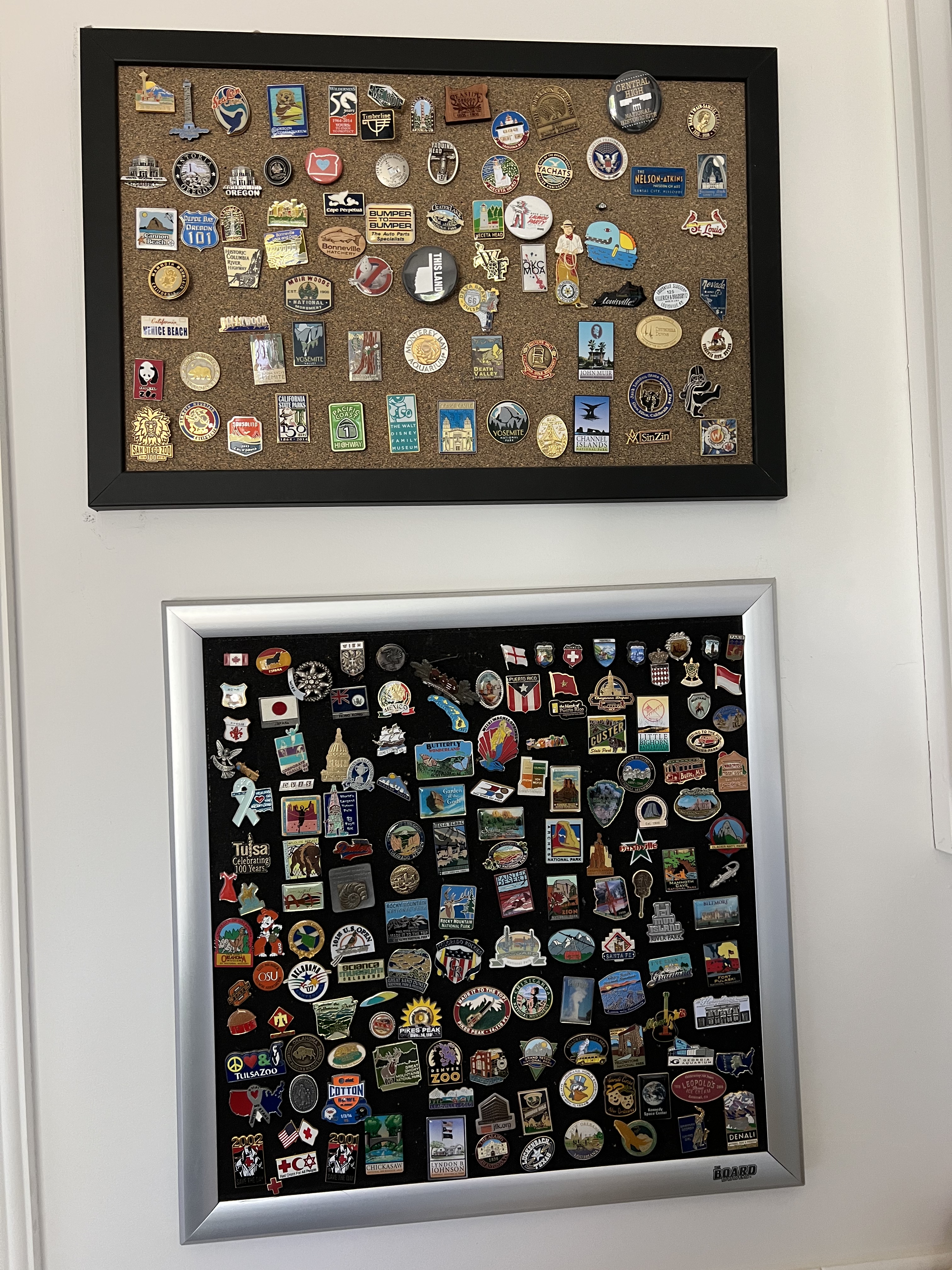
One of the first times I traveled to Europe, way back in the early 70s, I saw people collecting pins which they wore on Alpine hats. I didn’t want the hat, but I started collecting the pins and included some antique ones I found there. I still collect them, but have they are harder to find and so I have a magnets. It may be silly, but I get a nice feeling when I remember interesting places I have been. I must not have much of a memory because I depend on photos and things I pick up to trigger mine.
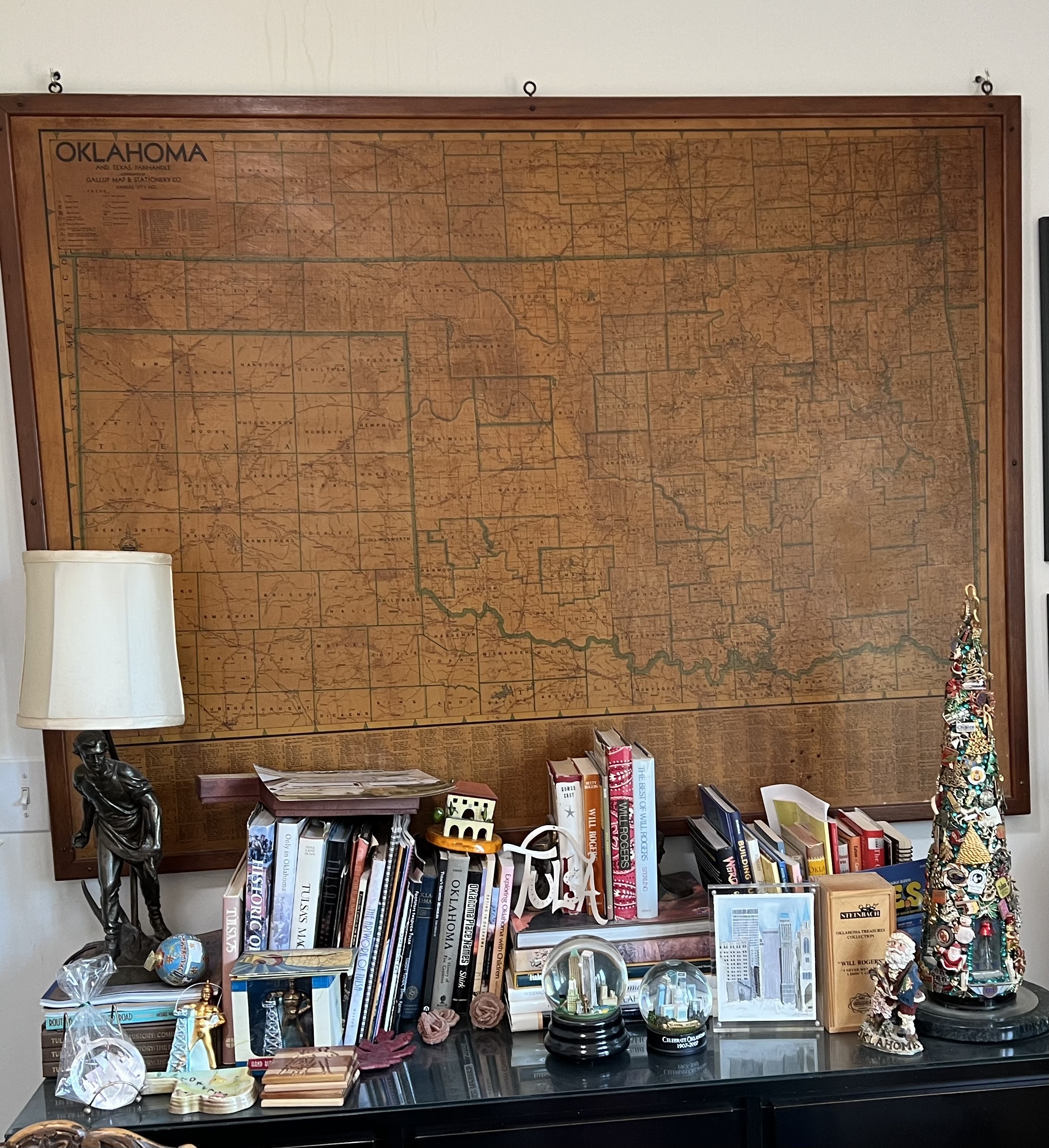
Sometimes we start collecting because we are just interested in something. This map of Oklahoma hung in my father’s office from the time I was little. I think he got it when we moved to Tulsa in 1948. He used it to map places for his salesmen to go and to find spots for his quail hunting trips. It’s yellowed from the smoke that was in the rooms back in the days of smokers. I claimed it years ago and it led to a collection of books and things about Oklahoma. I had to move some of them for space recently.
Once I was at an antique auction with a friend and there were a bunch of small English wooden boxes. We learned the word “treen” and became interested so we bid on some. I’ve only added a couple, but do love wooden or treen boxes. Note that one was chewed on by a puppy sometime through the years.
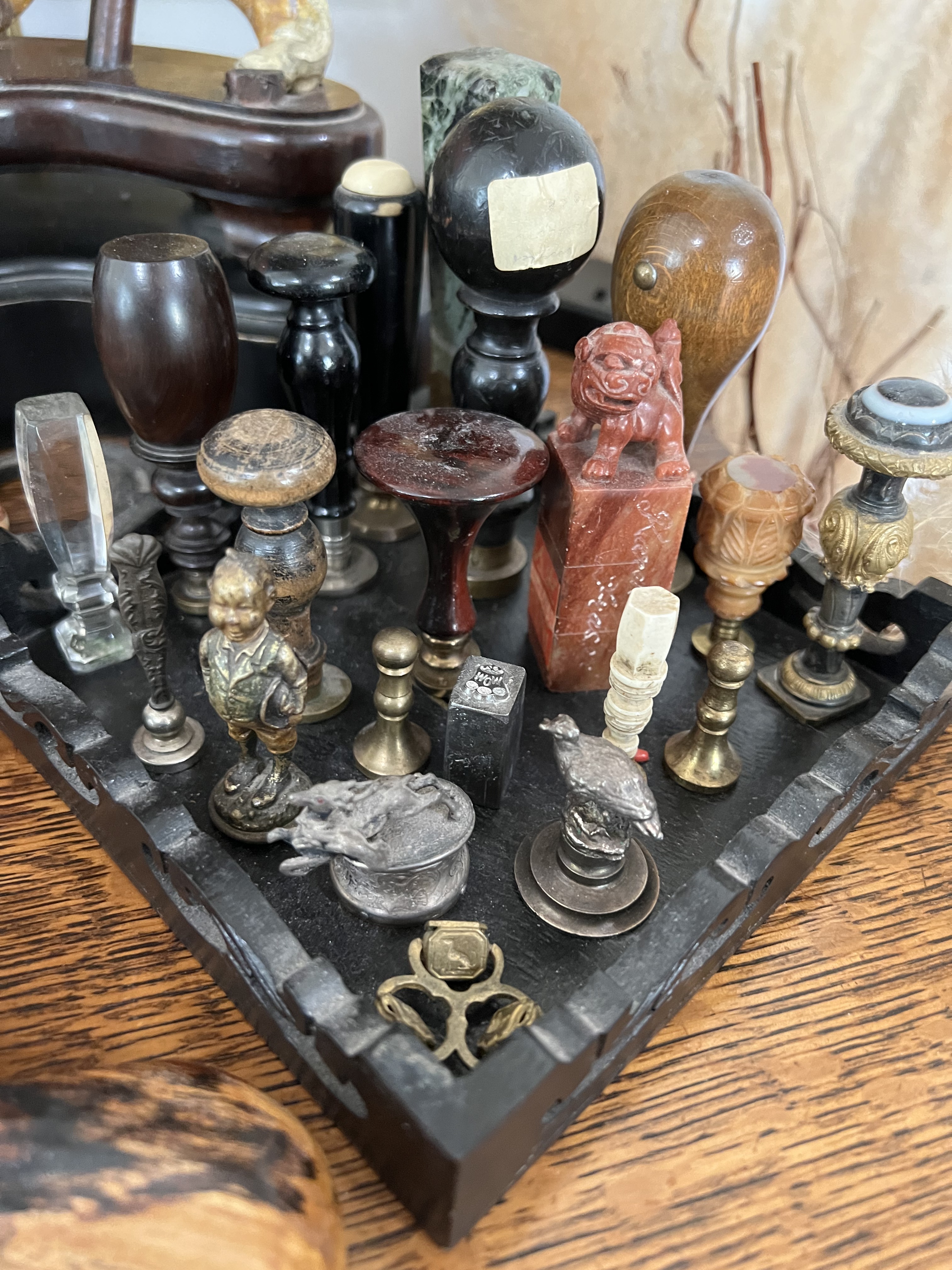
For a few years in the 80s, I worked on and chaired an antique show for a non-profit and we brought antique dealers from across the country. I listened to their lectures and stories and loved so many things that I couldn’t afford. I got interested in the little wax seals that people used to use to seal their letters and thought that was something I could look for that was affordable and a way to support the dealers. I don’t look for them as often these days, but I do see an interesting one every now and then. I love to picture people writing with their pens dipped in ink and then sealing the letters with a dab of wax and their monogram. The reddish Asian one is from Hong Kong. Supposedly, it was a Chinese version of my name, but I doubt that Karen translated very well. There’s a small one with a stag being attacked by a dog on top that was supposed to be a prop in a movie, although I always thought that was a stretch and probably just a good story from an antique dealer to sell it. It’s still interesting and antique.
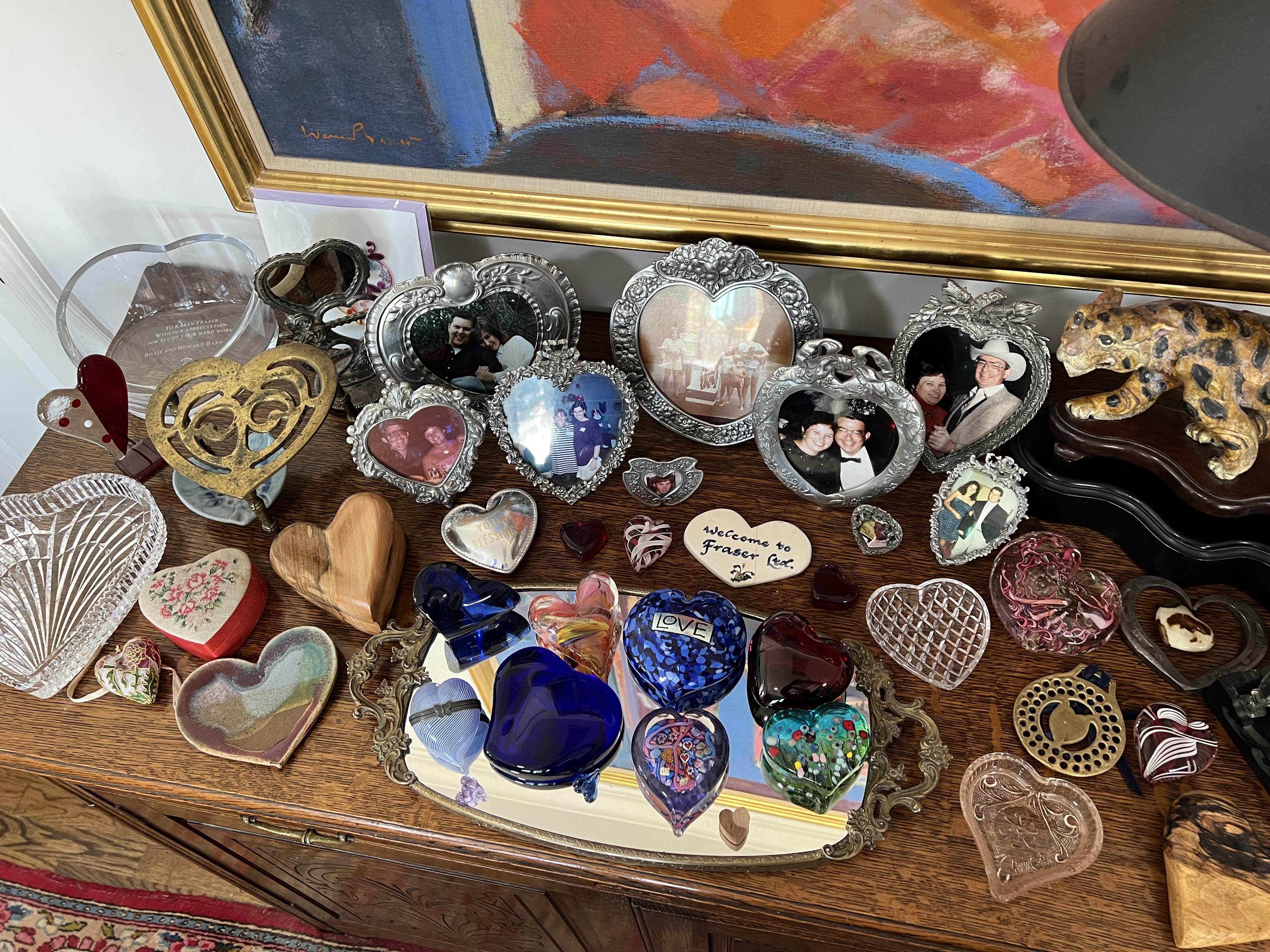
Hearts are one of those things I just suddenly had a bunch of. I had picked them up in art galleries and antique stores and sales and gift shops and been given them. There is one from Tiffany that was a gift and some wooden ones made from driftwood on the beaches in Oregon. There are glass ones from the volcanic ash in Washington and artist ones from museum gift shops and I see a clay one from an artist in Sedona and another glass one from a young artist in Oregon. I had grouped my heart frames and then the hearts started piling up. Good grief. They are kind of fun though and make me smile. I have more hanging artist ones and others just kind of around. Whatever. I have a friend who collects hearts because her last name is Love and another who collects them because her birthday is on Valentine’s Day. We all have our reasons.
There are some strawberry things around my house because the name Fraser comes from the French word for strawberry, fraise, and there are strawberries in the Fraser clan badge. Not too many, just a few I’ve found.
The thing about collections is that you start to see the things you like everywhere. It gives you something to look for when you are traveling or shopping. I’ve also found that many collections lead to doing research on the item and learning more about its history, along with meeting some of the most interesting people.
I called collecting a sport and it can be. Going to auctions or estate sales or combing through flea markets and antique shops can be competitive. Sometimes you are just looking at everything, but mostly your eye stops on either something that you like or have been looking for. You see something and want to know more about it. Many collectors become experts on their collections. I have a friend who started collecting vintage hats and clothing and recently donated her collection to the Tulsa Historical Society where she has her own exhibit.
I love standing in line to get into an estate sale and seeing what everyone else is looking for. I feel like I need to race to the things I want, but most people are collecting things I would never have thought about. They have become interested in things and are building their collection. I’ve met people looking for vintage toys, pyrex ware, old cameras, certain kinds of glass. Tom Hanks collects vintage typewriters. There is a competitiveness in being the one who finds the rare item you are missing, just as my father looked for certain stamps or coins. I don’t know if there is such a thing as having a complete collection of anything, but people keep trying. People like having a piece of history, many considering themselves keepers of something that may have been thrown away but needs to been kept for future generations. I do lament the things that we tossed and would like to see again from my lifetime, even knowing that we can’t keep everything. Some of collecting is nostalgia, a way to keep memories of our own lives. Rarely do I think people are collecting because they plan to sell the items and make money, unless they are dealers.
There are people who collect sneakers these days just as there are people who collect cookbooks and first edition rare books, vintage albums, sports equipment. There are people who collect art, including photographs, paintings, sculptures. I have a friend who collects etchings and has a museum quality collection, which is lovely. She is an expert on her pieces now and knows what to search for. Another friend collects tea strainers. I have a daughter who collects Toby jugs and another who is interested in mid-century modern furniture. A son-in-law collects bourbons. There is a surge of young people (younger than I am, which includes most people), interested in antiques. One of my Native American friends collects items from her culture and an African American friend collects the kitchy kind of figures, such as Mammy dolls, sold in earlier days. They are preserving their own histories.
There is no one reason or thing to collect. I can attest to the fact that it makes you learn, leads you to meet new and interesting people, takes you to fun places and can make you smile. What happens to our collections when we are gone is that they either are interesting enough to be in a museum or display or they are passed along or they go to sales for the next generation of collectors to add to their collections and enjoy.
My son was a collector from a young age. He started with his Star Wars toys and teddy bears but moved to beer cans. I would take him to the flea market and watch that nine year old bargain with dealers over a can he spotted. He was always an expert on pop culture. He moved on to lunch boxes and had quite a collection in his lifetime. His wife still keeps them and I have one of them to remind me of that little kid who inherited the family obsession.
As I said, the things I collect usually come with a memory. Sometimes they are just things I enjoy looking at or learning about, but they almost always have a memory attached of how I got them or who gave them to me or where I was or who I was with or what they mean.
Tracking your family history is an amazing journey down so many trails leading to more names and places and mysteries that make us realize how our personal stories are intertwined with so many others as we strive to see how our present day lives evolved from the layers of our country’s development. A casual question to my mother in her later years opened my eyes to things I hadn’t even envisioned as part of my own story. I think I asked her what her father and grandfather did for a living in Ardmore, Oklahoma. Fortunately, it was so fascinating that I made her tell the story again and made a recording of her telling me all the details.
To begin the story, I have learned that my great-grandfather, E. Z. West (Ephraim Zachariah) and his wife, Hattie, moved north from around Grapevine, Texas. Hattie was born in Alabama and somehow ended up in Texas. I’m surmising that her family kept moving west in search of a better life along with countless others. She and E.Z. had three sons, the youngest dying at age 8 and buried in Grapevine. They moved with the other two sons, Ben (my grandfather) and John to the area around Ardmore. They were probably part of the “Intruder” movement of white and black non-citizens who moved onto land owned by the Chickasaw Nation and eventually quit paying the Chickasaw natives for the use of the land. I’m not sure what year they arrived, but thousands of people were coming to the area to take advantage of all the opportunities. I don’t get the impression the Wests had a lot of money and I see them in their covered wagon looking for a place to settle in this newly developing area.
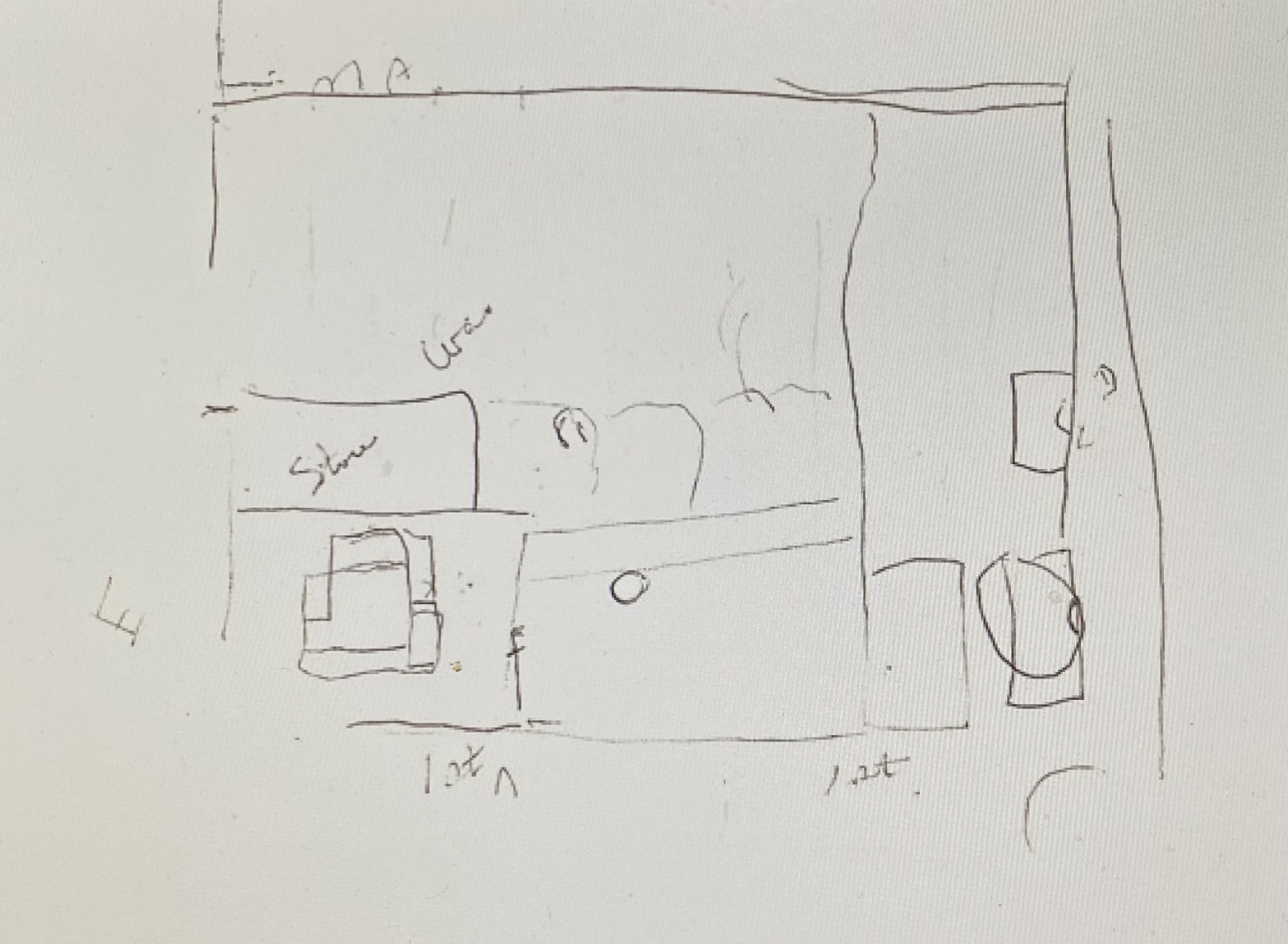
I know there was a house in the country owned by the West family because I think my mother and her brothers were probably born there. At some point, they began to purchase property in the new town of Ardmore, where E.Z. built a house with a wagon yard next door. This is the part that was new to me. I knew the house because I had been in it many times as a small child when my aunt and uncle lived there. I had no idea what the wagon yard was. I asked my mother when she mentioned it, thinking it was a place where wagons were built or repaired. She explained that a wagon yard was a place where people who came into town stayed and parked their wagons, kind of an old time motel. She picked up a scrap of paper and drew me a picture of the wagon yard as she remembered it.
She was in her 80s at this time and remembered details, even though she only remembered being in it once or twice as a child. Since she was born in 1921, it was not too long before the wagon yard was leased to be a lumber yard. She showed me on the drawing where there was a store for the people to buy supplies and how there were little rooms with a fireplace for them to stay. At the same time, she drew a picture of the house, remembering what every tree in the yard was and where every piece of furniture was, what my great-grandmother wore and what she ate. I couldn’t believe I had never heard this story before, but that’s my fault for not asking sooner.
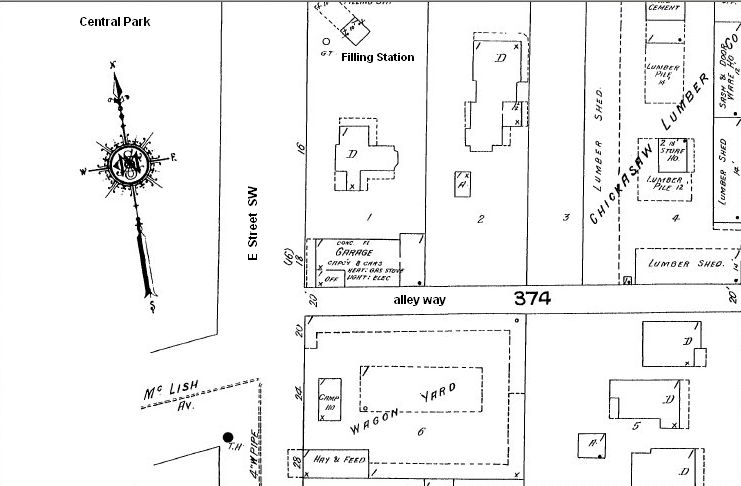
Here is a map I found later, showing the wagon yard, much as she had described it.
I looked up wagon yards and found they were probably the biggest business in town. Between 1893 and 1925, there were 39 wagon yards in Ardmore, Oklahoma, which was a major importer of cotton at the time and farmers were bringing their crops to town. Rooms in hotels were $1 a night, while wagon yards only charged about 15 cents, so they were crowded and popular. Photos of the times show the main street absolutely blocked with lines of wagons going down the street.
Here is a photo of E. Z. and Hattie with their son John from when they were in Grapevine. John died at the age of 19 and is buried in Ardmore’s Rose Cemetery along with his parents.
This mystery has taken me years to uncover – not that I was spending that much time on it. I would get interested again and the beauty of the internet would unlock another piece of the story. I kept finding out more along the way, even traveling to Ardmore to see if I could find more information in a casual way, unlocking dates on Ancestry.com, etc.
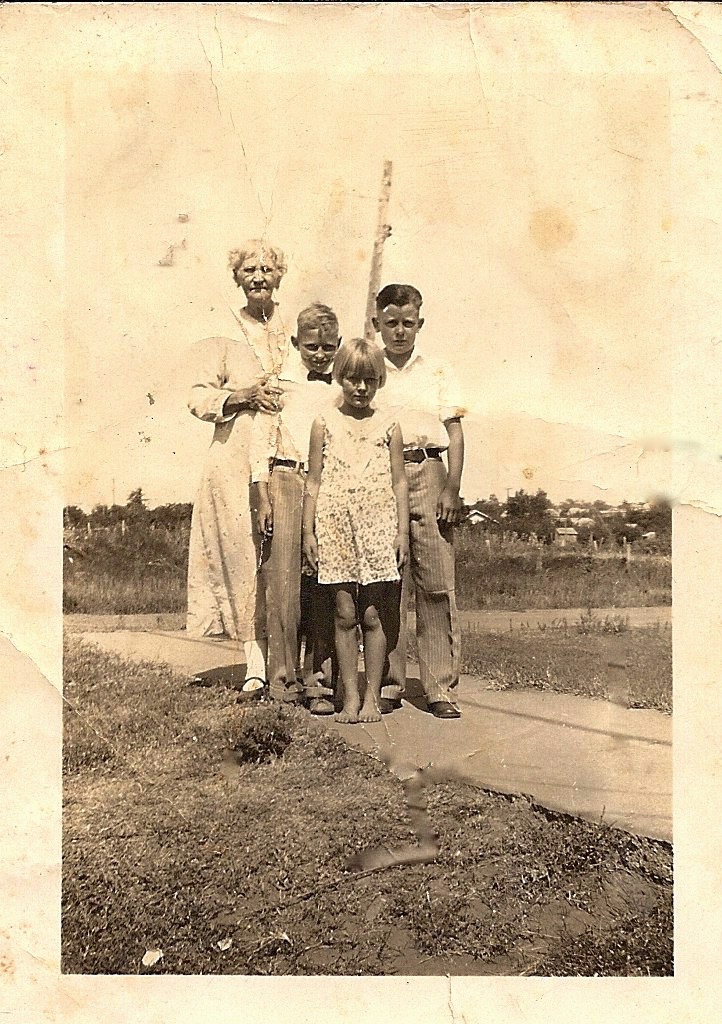
I know my great-grandparents began to purchase more property around town. My grandfather, Ben, died at 50, leaving my grandmother with three children during the Depression. My mother spent a lot of time with her grandmother, who was a widow by this time since E.Z. died in 1920. Here is a picture of my mother and her brothers with Hattie, probably around the time Ben died.
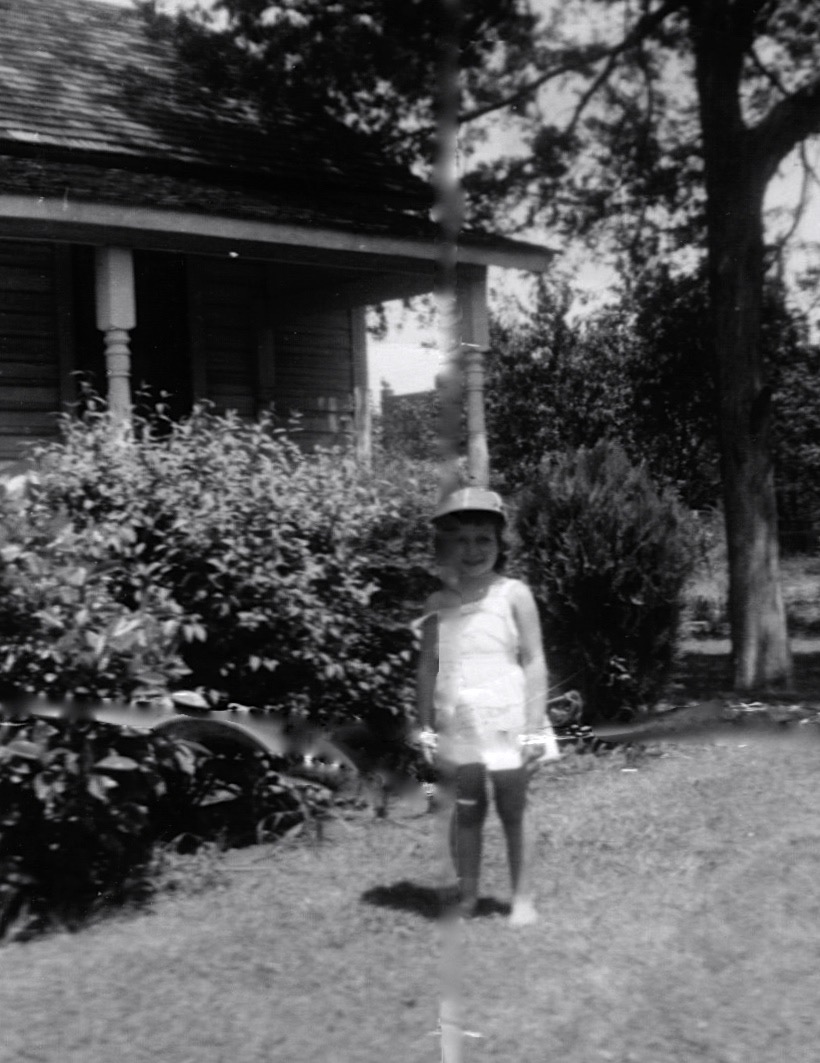
I know that Hattie left each of the grandchildren a house of their own, along with other property in town. Here I am as a child in front of the house that my great-grandparents and later my aunt and uncle lived in, across the street from Ardmore’s Central Park. Since I was born in 1945, you can see that the house was there for a long time. Today, there is a performing arts center on the property along with a law office.
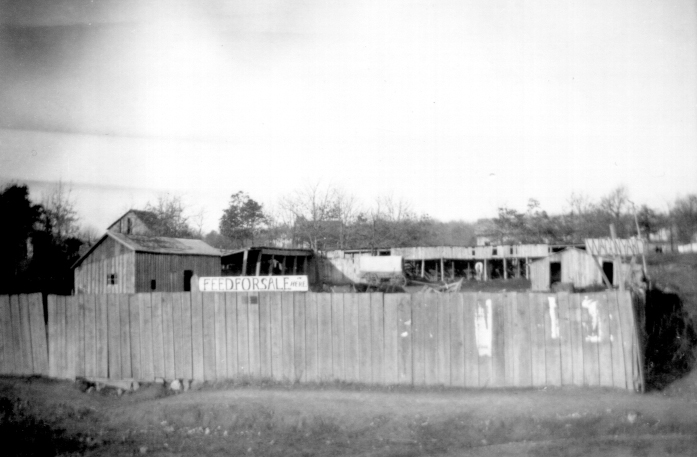
My fascination with wagon yards continued and I recently found photos of a couple of examples in other towns.
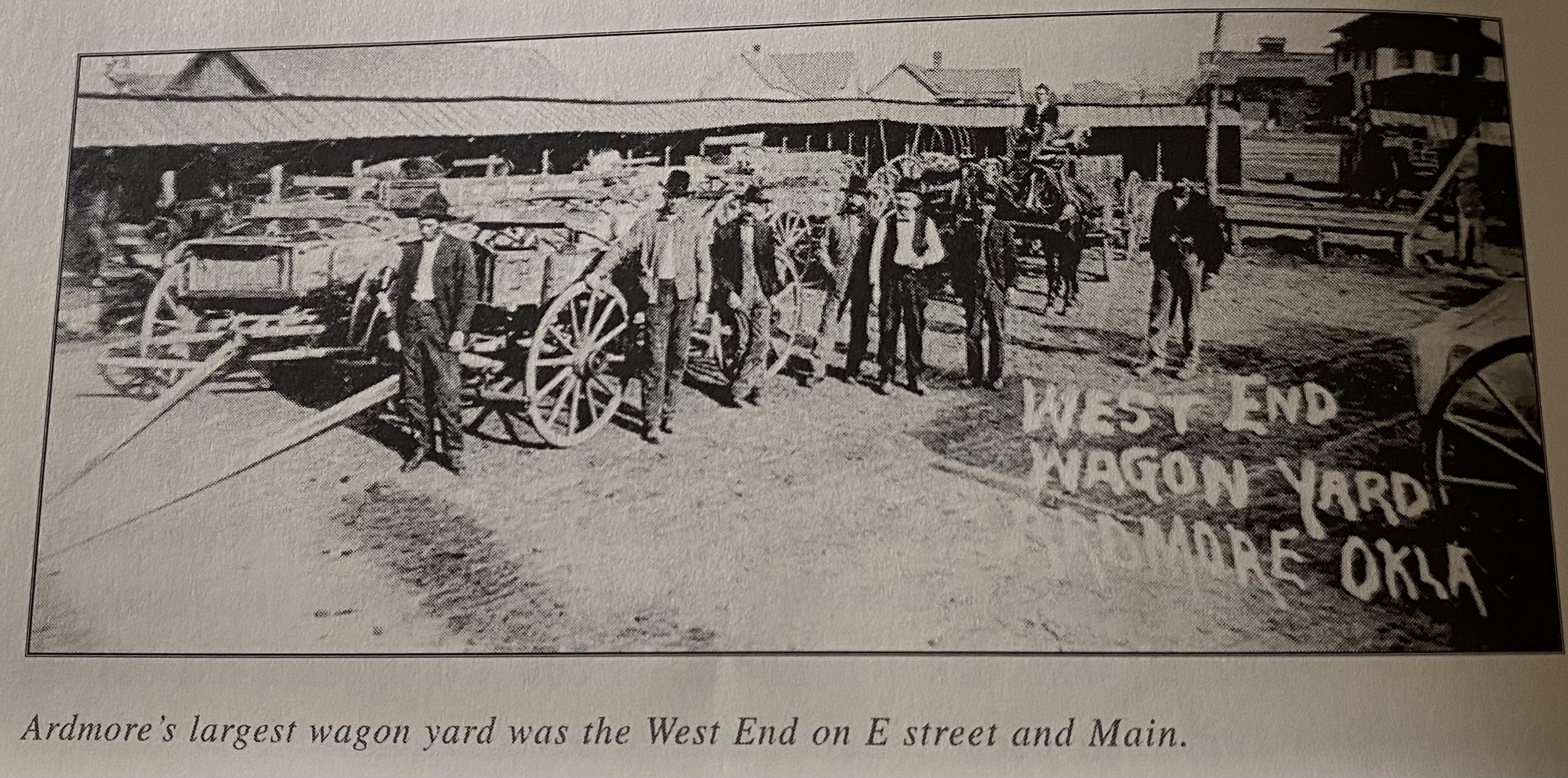
But, wow! I hit the jackpot recently when I opened a book on Ardmore history and found a photo of what I had been looking for all these years, my family’s wagon yard, the largest in town. This photo was taken after E.Z. died and my great-grandmother was leasing it, but there it is. Many have referred to it as the West End Wagon Yard, but the name came from my family, the Wests.
I know this is the one because that is the address where my mother described it and where I remember playing as a child. It’s such a thrill to uncover some real family history when rummaging around so many images and so much information on the internet.
Here is an aerial map of the place today, matching everything my mother told me and I remember.
I’m proud of the pioneering spirit of my family in Ardmore and happy to bring a story to life for my own children and grandchildren. It puts a lot into perspective for me as I keep searching for stories that explain why my family is what it is. It helps me understand personalities in the family as well as what our roles in the country’s history were.
An interesting side note is that at the same time the wagon yard era was coming to a close, my paternal grandfather in Kentucky had graduated as an engineer and was becoming involved in the automotive industry, specifically the aftermarket with parts, which took him to Ohio, then Wichita, Kansas, and eventually to Oklahoma. It seems my family followed the evolution of transportation in one way or another from the late 19th to the early 20th century.
It all makes me feel a part of the story of America as I connect with my ancestors’ stories and begin to feel I know them better. There is so much to learn about the people who are the reason I came to be where and who I am before I am the ancestor story myself.
The Ken Burns series, Muhammed Ali, reminds me of a family story about my cousin and Ali. I had heard this story through the years and had seen photos, but it really came home to me when I traveled to Louisville, Kentucky several years ago to look at some family papers kept in the Filson Historical Society.
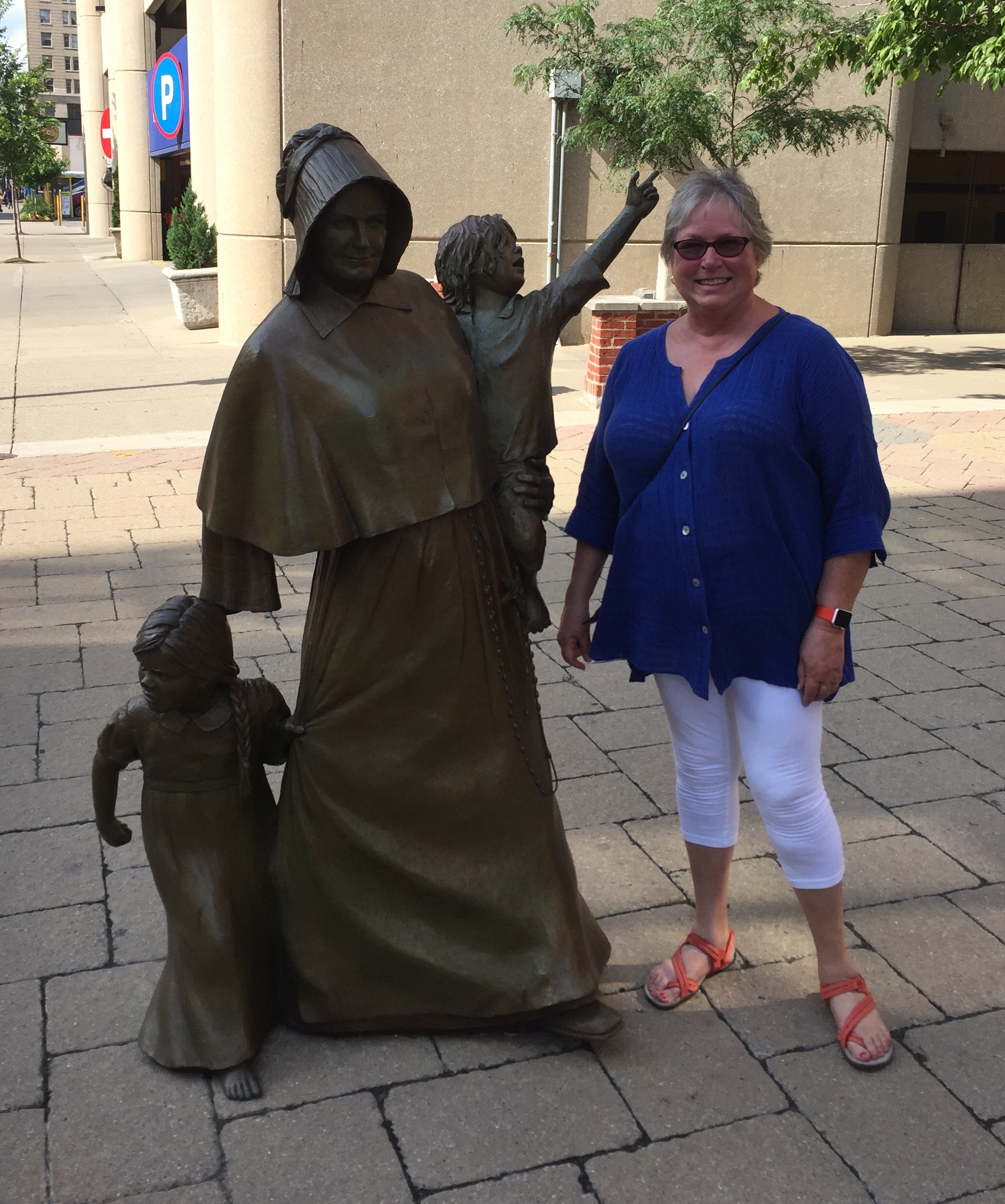
Driving through the streets of Louisville, I began to picture my family traveling there by carriage from Uniontown on the Ohio River to visit family and friends. I loved the elegant old houses that are being restored and the buildings that were standing as they arrived in downtown. While walking around the downtown, I found a statue of Mother Catherine Spalding, known as the first social worker in the area. My grandmother was a Spalding and easily could be related to Mother Catherine, which made me very proud to think about.
My grandmother was raised Catholic but converted to the Episcopal Church when she married my grandfather. We had many Catholic relatives on her side, including many priests and nuns, who we only saw occasionally. The one we did know was my grandmother’s niece, Susie Huff, who became Sister James Ellen as a member of the Sisters of Charity of Nazareth in Louisville, the order founded by Mother Catherine Spalding. Susie was my first cousin, once removed.
Sister James Ellen (I understand she was sometimes called Sister Jimmy Ellen) was known to be a lively woman. She corresponded with my brother for years and I found many letters between them in his papers when he died a few years ago. She was very special to him as evidenced by the personal nature of the letters.
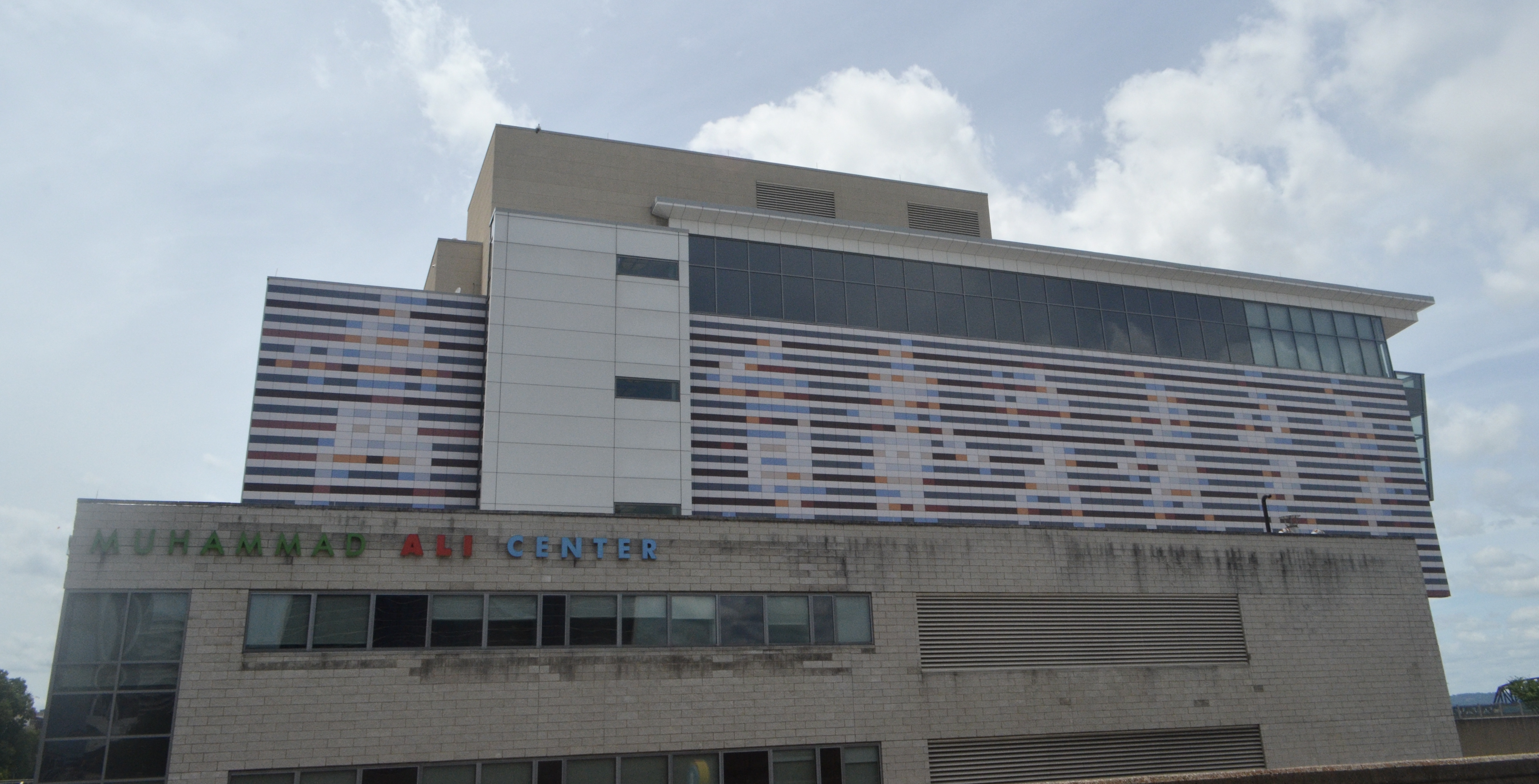
We had heard the story of Sister James Ellen’s friendship with Muhammed Ali, who is such a great figure in this city. I happened to be in Louisville in July, 2016, a month after Ali had passed away. I visited the Muhammed Ali Center, where his fans were still celebrating his life.
I left very touched by the greatness of his life and the effect of his words on the people who were there with me. I purchased a copy of his memoir in the gift shop, where I found that he had mentioned my cousin.
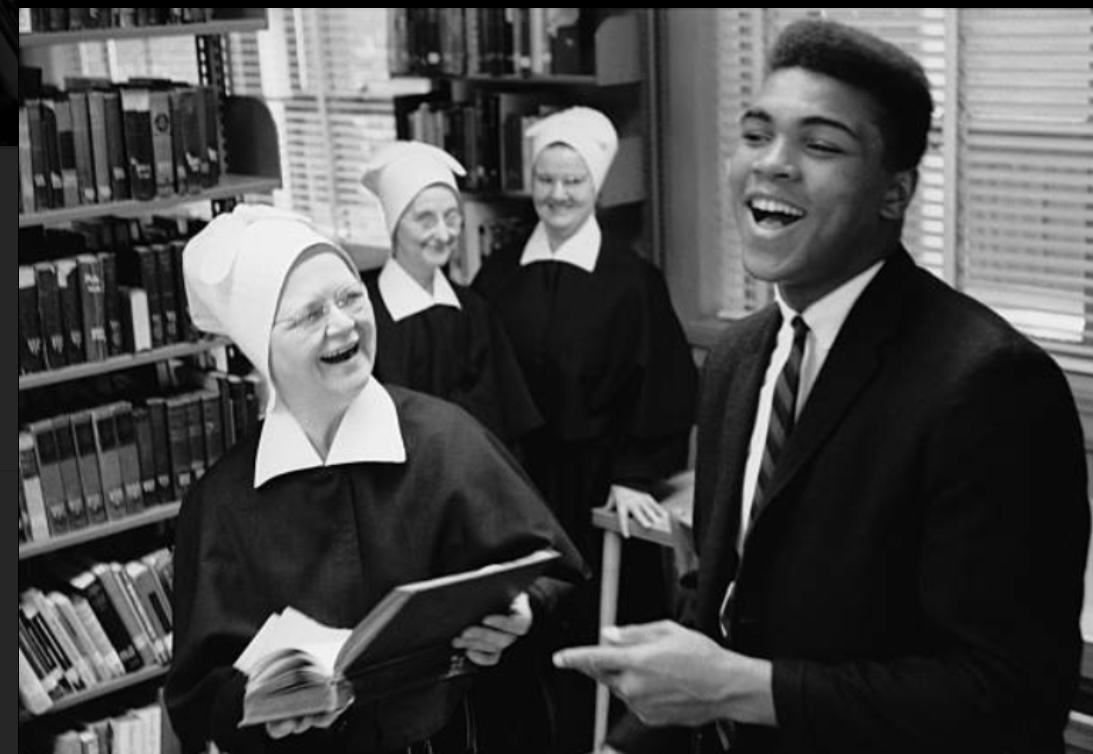
Sister James Ellen first met the young Cassius Clay when he was boxing in the gym across the street from the library at Spalding College where she worked. Here are his words.
I found a story in the newsletter of the Sisters after the death of Sister James Ellen in 2001.
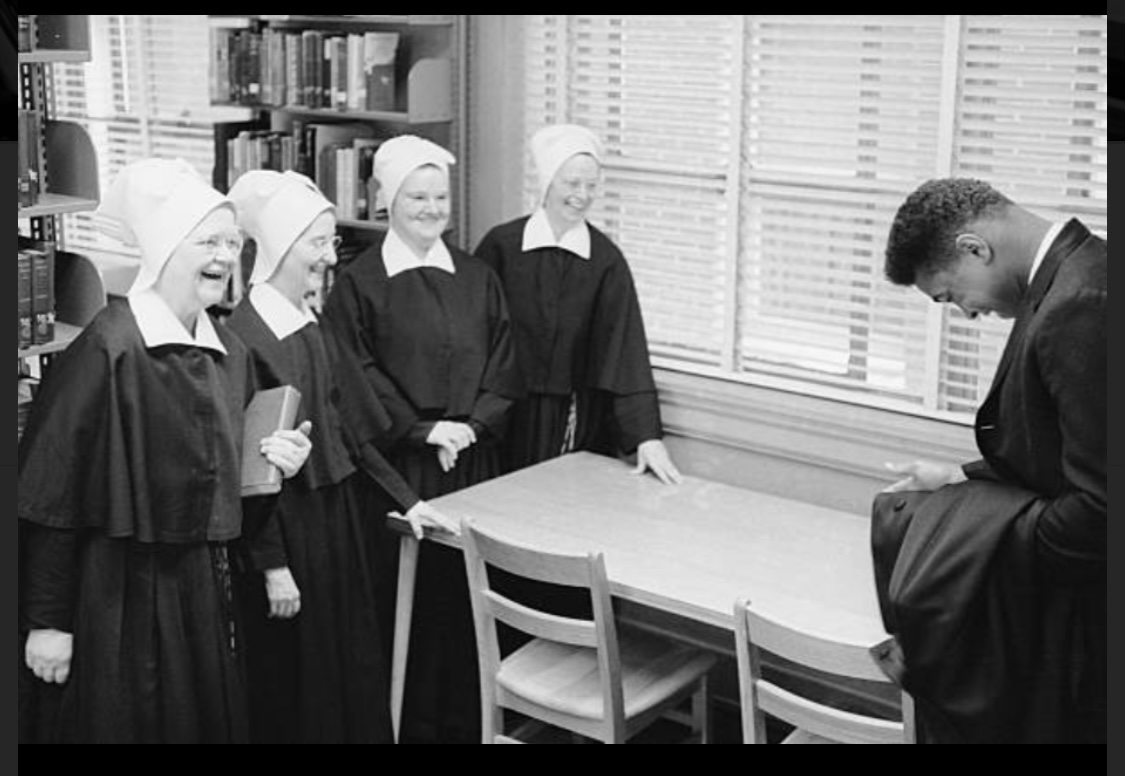
“As a teenager attending Central High School, Ali, and James Ellen Huff, a Sister of Charity of Nazareth, developed a close friendship. Sister James Ellen ran the library at Nazareth College (now Spalding University) across the street from the gym where Ali spent his days boxing. Sister James Ellen hired Ali, who at that time used his birth name of Cassius Clay, to work in the library so he could earn a little money. She said she liked his “zest.” She was known to often give Ali encouragement, frequently share laughs, and even return from dinner with snacks for him before he went to train. Once she found him asleep on a long library table! After the world came to know him, she put a sign over the table that read, “Cassius Slept Here”
Ali and Sister James Ellen are described as kindred souls and when Ali won the gold medal in the Olympics, she was one of the first people to whom he showed his medal. The two would remain lifelong friends exchanging letters, and phone calls, until Sisters’ death in February 2001.”
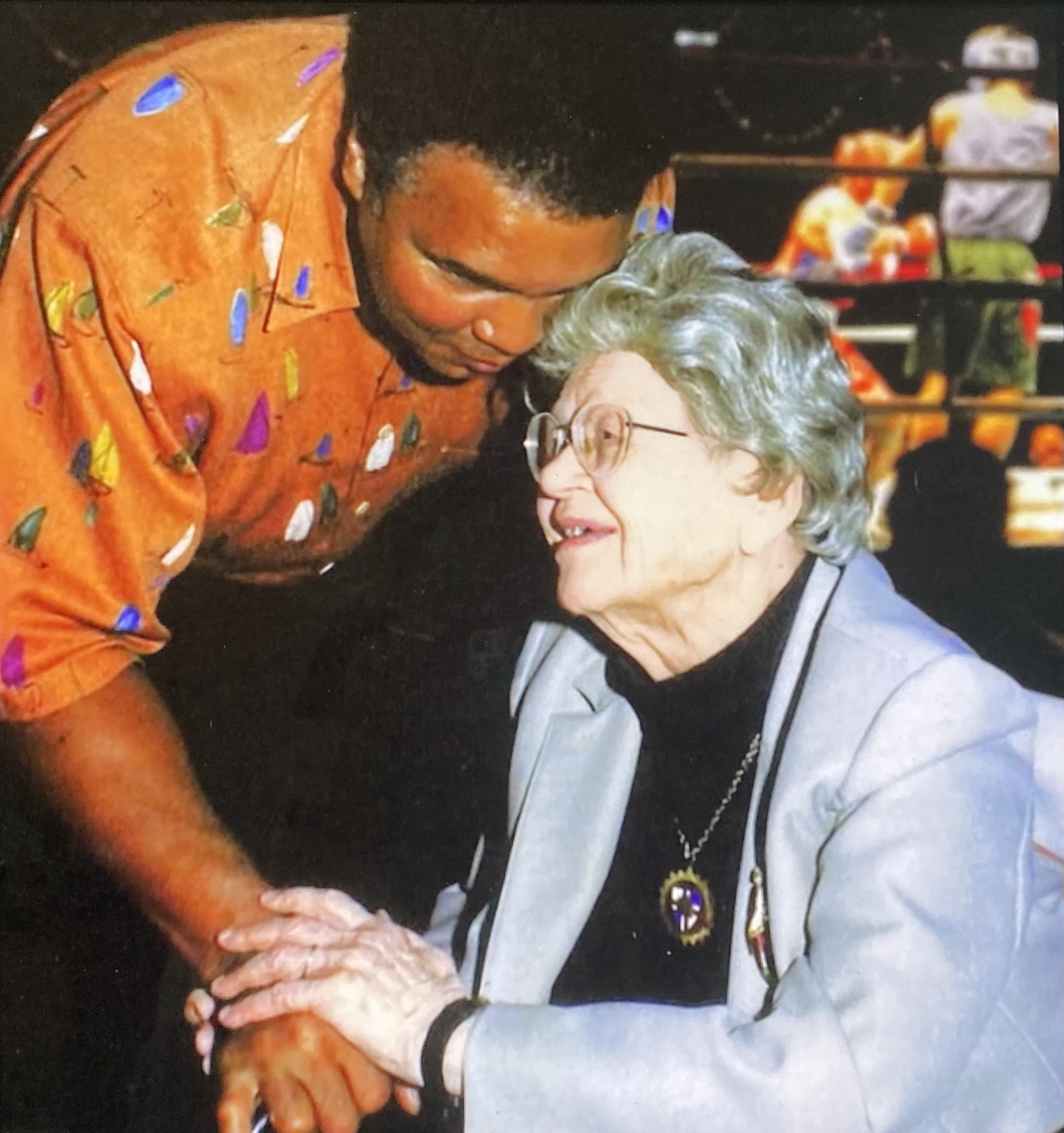
When Ali arrived to show his Olympic gold medal, Sister James Ellen (shown here in the front) sent word to the other sisters to come see their young friend. The absolute delight is shown in all their faces. The photos and story were featured in a story in The Washington Post at the time.
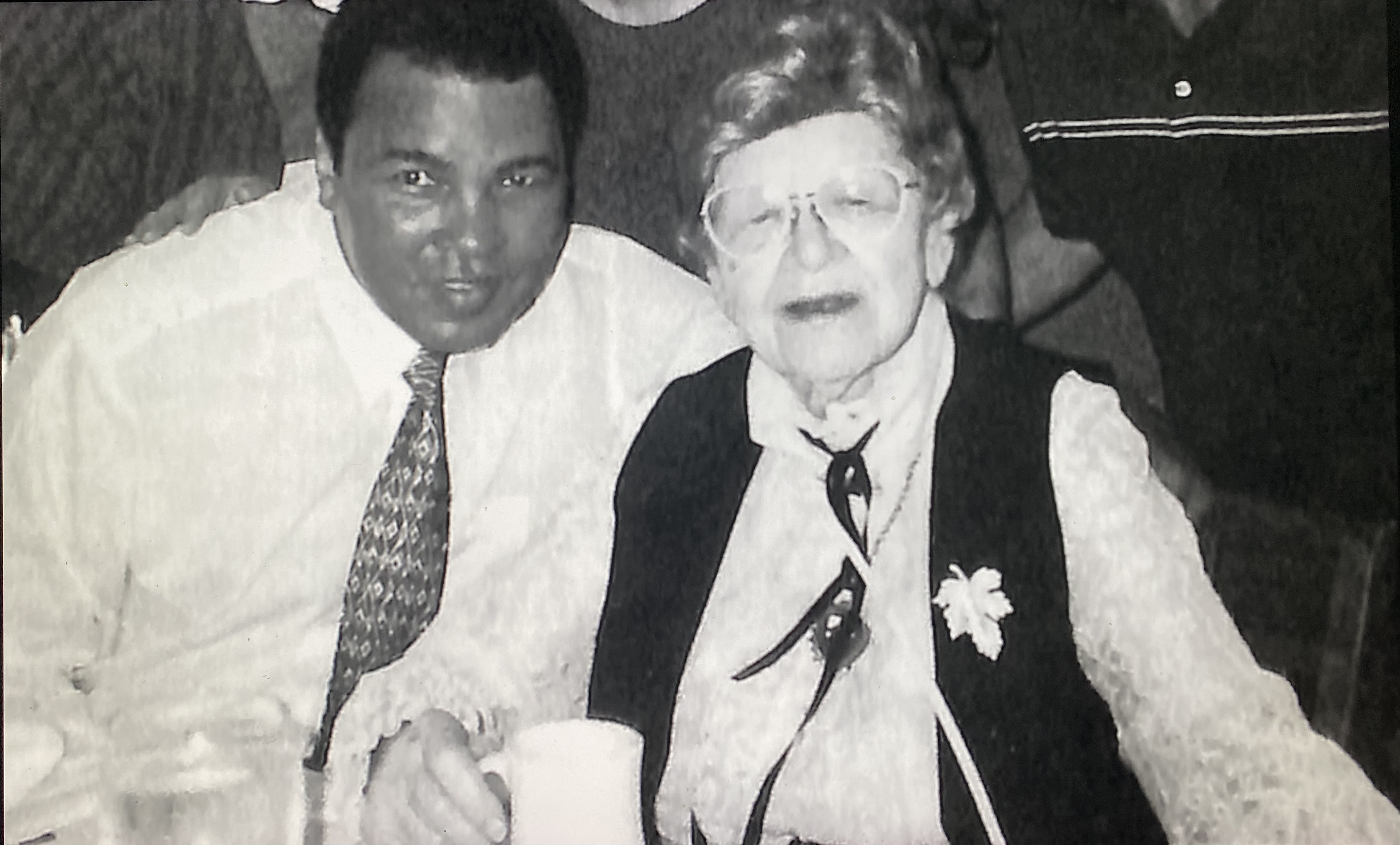
Muhammed Ali and Sister James Ellen remained dear friends until her death and I found these sweet photos of the two of them.
Ali and his wife sent a large bouquet of white roses to Sister James Ellen’s service when she died.
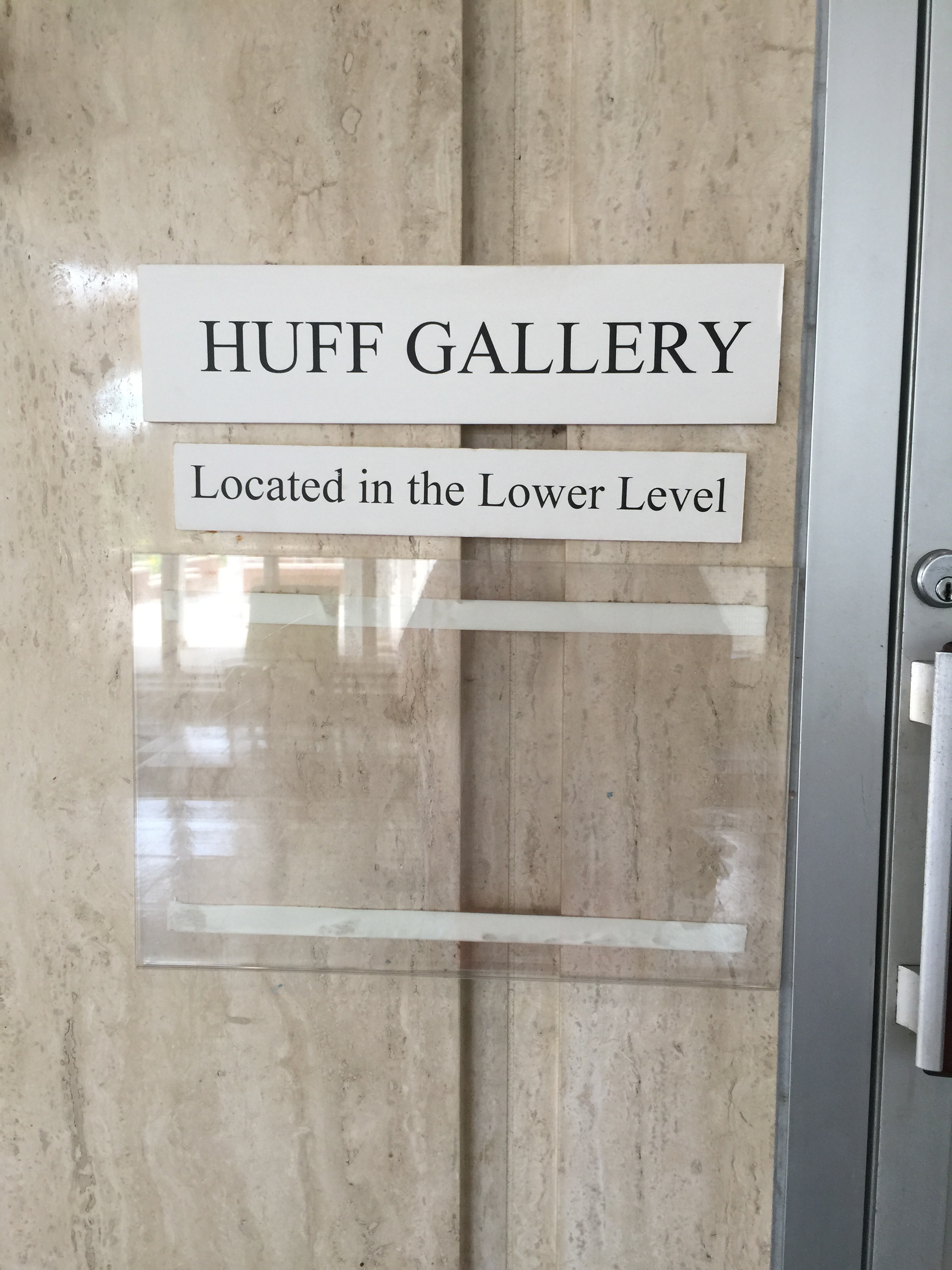
I searched for the site of this friendship and found Spalding University and the library where there is now a Huff Gallery, named for Sister James Ellen. The University has now purchased the building where Ali trained and also has several Muhammed Ali scholarships.
This special story makes my heart happy knowing that these two people from very different worlds formed a lifelong friendship as each had a lasting impact on the world. I love that I can claim even a touch of connection to these two incredible souls.
Lazy summer days are meant for meandering thoughts. Mine came while squinting into the sun, looking for signs of my youngest granddaughter in the vast swimming pool. She’s almost 11, but I automatically check to see where she is. She’s past the age where she delighted in playing with me and is content to be by herself or interacting with other kids, even though it’s 2020 and we’re trying to socially distance even in the water. That leaves me free to remember the years that explode in my mind as I listen to the sounds of happy people in the pool, cooling off on a hot summer day.
I go back over 70 years with this particular pool. Well, it wasn’t this exact pool, but it was this place. We moved to Tulsa when I was about 2 1/2 and my parents immediately joined Tulsa Country Club, the oldest country club in town, having opened in 1908. Daddy was a champion golfer and needed a place to play. He had come back from World War II and married at the age of 32 and rejoined the family business, moving to Tulsa to open a new branch in 1948. At what age they started bringing me to the pool, I have no idea, but we were certainly around the club in one way or another.
My first memories of the pool are of taking swimming lessons. The old pool, opened in 1935, was by the old clubhouse and this was back in the 1950s, my olden days. The pool was a large rectangle with a shallow end and a deep end that had both a low and high diving board. There were dressing rooms at the end of the pool and a grassy area to one side and an area with tables and chairs on the other end. Our swimming lessons were taught by Coach Charvoz, a coach at Central High School, who also managed the pool in the summers. I remember him so well, standing in the pool with a floppy hat to shield him from the sun, demonstrating the different strokes for us. He would stand in front of us and have us swim towards him, stepping back the closer we got until we could make it all the way across the pool. He was an excellent teacher as I can still remember everything he taught me about swimming the backstroke, sidestroke, breaststroke and crawl. I’m still pretty good, although the pool today isn’t as conducive to swimming laps as it was then.
My favorite thing to do for many years was to try and swim the length of the pool in one breath. I don’t know how long the pool was, but I could do it. I wasn’t as much of a fan of the boards, although I could dive off the small one. I’m sure my lifelong fear of heights comes from climbing up the ladder onto the high board and jumping off. It wasn’t a thrill for me – more likely something I did to show I could. Once or twice.
There were so many games we played in the pool, from racing to diving for objects to Marco Polo (why won’t that game go away?). The lifeguards constantly told us not to run around the pool, but we were kids and the pavement was scorching our feet. So many rules back then that have gone away. We were living in the age of polio, so we were constantly reminded to be careful of water. We couldn’t get in the pool for an hour after eating for fear of getting stomach cramps and drowning. This was proven not to be true, but we spent many an hour waiting impatiently for the pool clock to tick to our hour when we could jump back in. We also had to shower before we entered the pool. I still think this is a rule, although few follow it.
Another rule was that the girls had to wear swim caps. This was to keep the hair out of the pool filters, but it was pretty annoying. The guys kept their hair cut in buzz cuts for the summer so they didn’t have to worry. I kept my hair short, but still had to wear that cap. It was no fun squeezing your hair into that piece of rubber, although I guess it did keep it dry. The chin strap was just as irritating as the cap. I still cringe when I think of having to wear those darned things. By the time I was a teenager, it was even more annoying as we were striving to be bathing beauties as we laid in the sun, trying to attract the attention of whatever boys were around.
The sunbathing area was a large patch of lovely grass between the pool area and the clubhouse. To get refreshments, you went to the clubhouse, where there were steps to a window on the side where you could order hamburgers, drinks, ice cream and whatever. Those are the things I remember- cold Grapettes, hamburgers, ice cream bars. We spread our towels on the grass and slathered our bodies with tanning creams, including the all time favorite of baby oil and iodine. Those were the days when all we wanted was a good tan and knew nothing of skin cancers or the dangers of too much sun. We put lemon juice in our hair to bleach it in the sun and worked on getting that coveted beach look of tan skin and sun lightened hair. No wonder so many of us have skin cancers in our old age.
And those summers of my youth melted into the summers when I returned as a young mother. By then, the clubhouse had been moved from the site where it had stood in a wonderful old three story brick building since 1917 to the other side of the golf course into a “modern building,” a move that caused much grumbling among many of the members. The old building burned to the ground in 1986, leaving those of us who were fortunate enough to experience it with only fond memories, which leads me into other memories to be shared another time.
The new pool was a rectangle that flowed into a smaller rectangle that was the diving area. There was a separate wading pool for the little ones. If I spent many hours of my childhood and youth at the old pool, I spent so many more at this one as a parent. My husband and I were able to get a junior membership and my summers as a stay at home mom were marked by the days we spent in the sun, moving from the baby pool to the main pool in what now seems like a flash. There was golf and tennis, but it was mainly the pool. My kids learned to swim there, taking lessons much as I had, and learning strokes that eventually led them onto swim teams in the winter months. They were genuine “pool brats” that I could leave to swim while I ran errands, went to meetings or played golf. They have their own memories of those days, but mine are of sitting with other moms, trying to talk over the constant cries of “Mommy, watch me.” To this day, I can hear those calls and hear the sounds of play that became the background of so many lovely days.
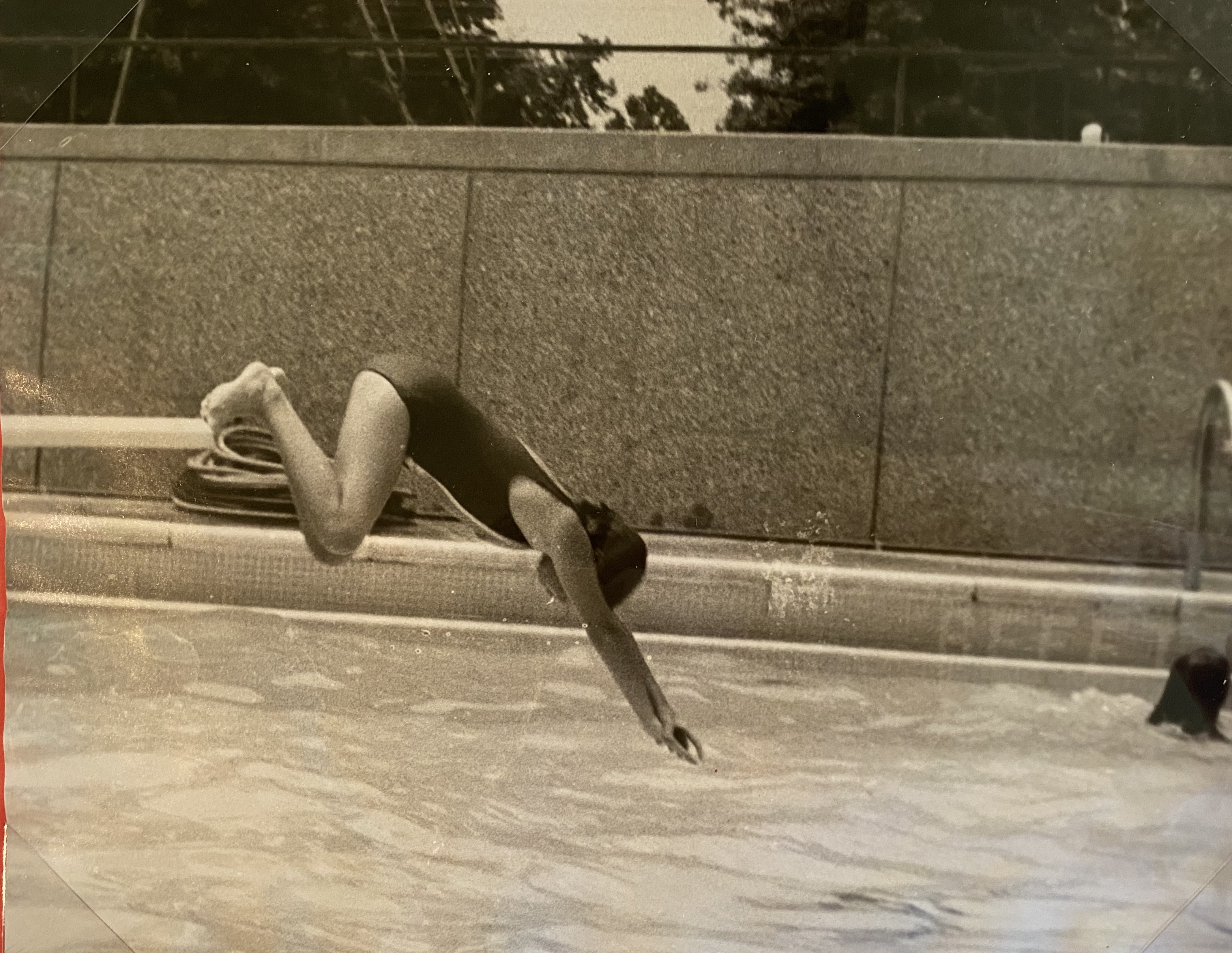
One of our favorite days in the summer has always been the Fourth of July, when there were swim games and races and fireworks. This has been a tradition that continues into the next generation. Here are my two oldest daughters waiting for a race to start:and my youngest daughter catching goldfish in the wading pool. Here is my husband playing with our son in the wading pool:and my middle daughter feeding her brother the wonderful pool water (yikes!)and my oldest daughter diving from the board. Life went on and the kids grew up and I probably didn’t spend as many days poolside until the next generation appeared and we were once again gathering there in the summers. Here are my daughters and the oldest five grandsons at the wading pool:and then there were a couple of more grandkids at the pool.And before I knew it, they were growing up.
And then they were in the races and diving competitions. I will note (with a little bit of a grin) that our family is pretty competitive and we have won a lot of club races through the years.
And then there were improvements at the club and by 2012, the old pool was gone and the new pool was in. This time, it is a spa design with a diving area, a slide, and a beach type area for wading, complete with fountains. My grandkids were bigger
and still doing races in the new pool.By this time, we had lost my son, who was the kid that hung around the pool and knew everyone behind the scenes and everyone knew him by name. We are lucky to have his daughter, who has now grown up at the pool, following her cousins, aunts and father. And me, of course.
My three daughters are now the mothers of grown children, but still like to hang out at the pool together.My grandchildren are growing up, with seven of them in college or beyond. In 2020, it’s just my last granddaughter, turning 11 soon, and me by the pool on this sunny day. Some things are the same. The lifeguards are watching the kids, who are calling to their mothers to see what they can do. Kiddos are asking for snacks, running when they should be walking, doing belly flops off the board, diving for objects, making up fun pool games and making new pool friends. The parents are more diverse and have their electronics with them to read books or check their messages. Now they have their drinks delivered to poolside, where they visit and relax. They look younger all the time to me, as they should.
Sometimes I wonder what my parents would think of the changes around the pool. Not the activities or the pool itself, but the people. From the time I was a child until I was too far into adulthood, the country club was segregated. Now you see a diversity of races in the families, which is nice. It’s more of a slice of our community.
The parents are not as uptight as they used to be and this summer of quarantine, there are more fathers around during the week. I can picture my mother making funny comments about their various tattoos. She wouldn’t have been shocked, but she would have found it as amusing as I do. Since I have so much time to observe, I think about why each tattoo was chosen. Why does this young mother have “Gone Fishing” on her middle right back? What does that woman have a slice of pie on her arm? What was this man thinking when he asked for all those interesting pictures of ships and animals to be inked into his chest? My husband used to amuse me with stories of the tattoos he saw when he was in the Navy back in the sixties. I’m sure he would be rolling his eyes at me. I take it all in when I sit by the pool these days. My mind is full with images of all those decades.
It’s a vault full of memories that flash by with each splash of the water, each squeal of a child, each kid jumping wildly off the board or each girl parading by with her suntanned body glowing with youth and health. It’s just one tiny piece of my life really, but it’s all tied together at this pool in the summer. There are so many places like this for remembering all the good people and things that I have been lucky enough to have in my life. It’s a reminder that I have more good memories than bad ones, more family and friends and love in my life than so many. It’s a good thing to be reminded of on a hot summer day.


















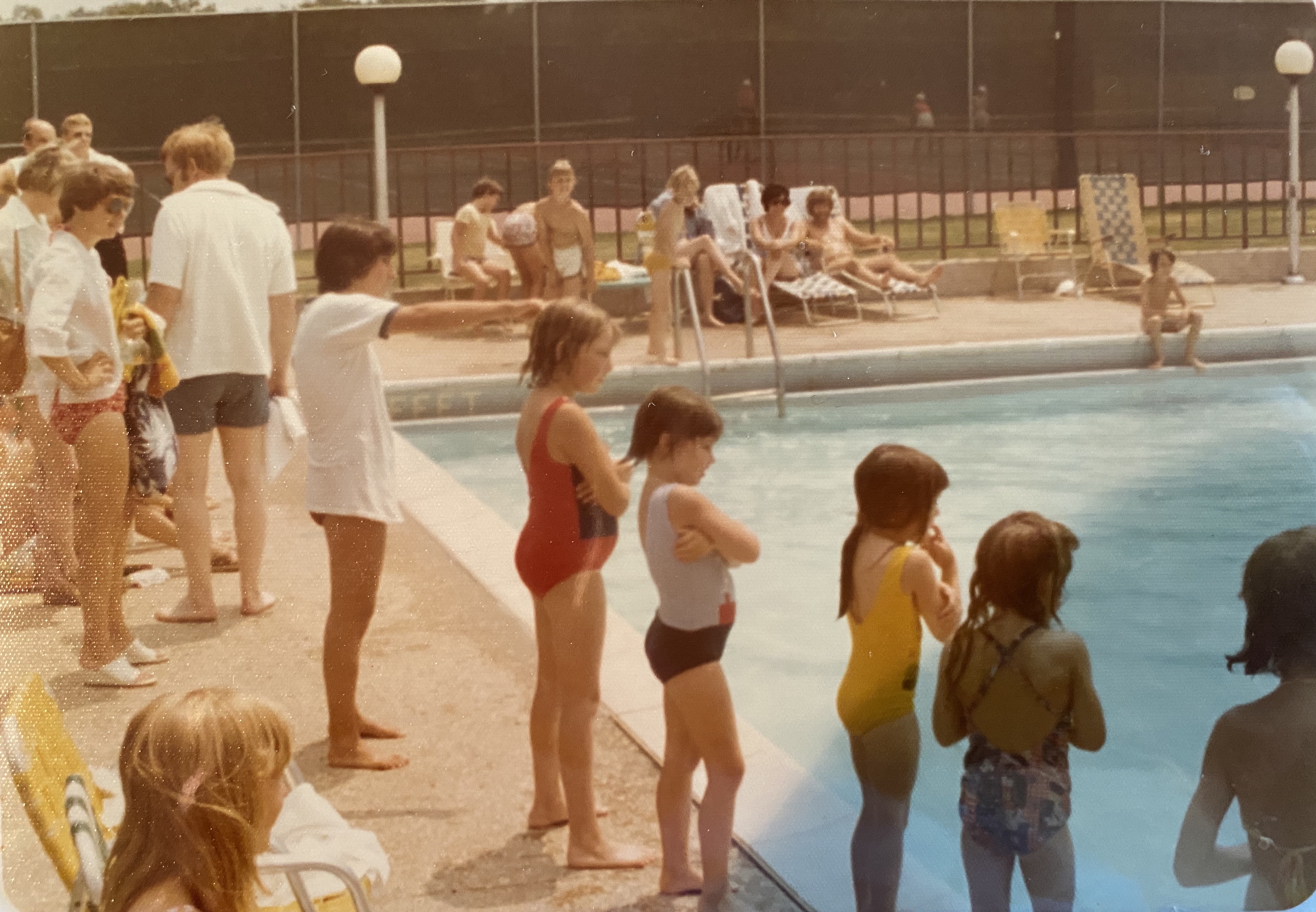 and my youngest daughter catching goldfish in the wading pool.
  Here is my husband playing with our son in the wading pool:
 and my middle daughter feeding her brother the wonderful pool water (yikes!)
 and my oldest daughter diving from the board.
  Life went on and the kids grew up and I probably didn’t spend as many days poolside until the next generation appeared and we were once again gathering there in the summers. Here are my daughters and the oldest five grandsons at the wading pool:
 and then there were a couple of more grandkids at the pool.
 And before I knew it, they were growing up.
 And then there were improvements at the club and by 2012, the old pool was gone and the new pool was in. This time, it is a spa design with a diving area, a slide, and a beach type area for wading, complete with fountains. My grandkids were bigger
 and still doing races in the new pool.
 By this time, we had lost my son, who was the kid that hung around the pool and knew everyone behind the scenes and everyone knew him by name. We are lucky to have his daughter, who has now grown up at the pool, following her cousins, aunts and father. And me, of course.

 My three daughters are now the mothers of grown children, but still like to hang out at the pool together.
 My grandchildren are growing up, with seven of them in college or beyond. In 2020, it’s just my last granddaughter, turning 11 soon, and me by the pool on this sunny day. Some things are the same. The lifeguards are watching the kids, who are calling to their mothers to see what they can do. Kiddos are asking for snacks, running when they should be walking, doing belly flops off the board, diving for objects, making up fun pool games and making new pool friends. The parents are more diverse and have their electronics with them to read books or check their messages. Now they have their drinks delivered to poolside, where they visit and relax. They look younger all the time to me, as they should.
 Confetti Thoughts