
I was born in December, 1945, which makes me 71 now. At this age, I have enough life lived to look back and get perspective on the good old days of my life. I can understand the good, the bad, and the ugly of the times, seeing how it shaped the world and my life and me.
My parents married at the end of the war, my father having served in the Army Air Force as a pilot, a Lt. Colonel returning heavily decorated for his missions over Italy. My mother had worked through the war for officers on the air base in Ardmore, Oklahoma. They met there and married soon after. He was 33 and she was 24. They had both lived through the Great Depression with his family building a business and her widowed mother raising three children in the worst of it. Without too much detail, I understand that this is why they didn’t talk about the past much. Their lives were about the future.
Actually, nobody talked much about anything, at least in front of children. We were sheltered from just about everything to do with the real world, which was nice when your life was pretty great, as mine was. The trouble was that there were other things going on that we didn’t see at all until years later, things we couldn’t begin to understand from our narrow world view.
My family moved from Oklahoma City to Tulsa in 1948 and lived in a nice house with a large yard and the white picket fence.  My father had his branch of the family business and my mother stayed home with me, my brother and, soon, my little sister. She had help in the house, the first Negro (as we knew them), I ever knew. We met others when we went to the country club where my father played golf and we dined, played golf and swam in the summers. More Negro helpers that we knew so well but didn’t really know at all. I don’t remember meeting any other people of different races or even different religions through the 1950s. It was a pretty white life in my little world, even when I went to visit my grandparents in Oklahoma City or my grandmother in Ardmore.
Everybody’s parents seemed nice in the 1950s. We played away from the grownups who were busy talking. In the 1950s, lots of grownups smoked and drank. The men came back from the war as smokers since the government practically gave them cigarettes. Daddy smoked a pipe, cigars, and finally just cigarettes. My mother never did. People drank a lot back then, but we were used to it. Daddy kept a bottle in his desk at the office and came home and had a drink. Everyone did that in those days. Except my mother, who wasn’t a drinker either. She made us clean the ashtrays when we were little so we could see the nicotine which was stuck to the ashtrays as it would stick to our lungs. It was an effective lesson for me at least. We didn’t know about cancer from cigarettes until later and we didn’t really know what an alcoholic was except that some of our parents’ friends seemed to drink a lot more than others and slurred their words. For most of us, drinking was something you would do when you were older to be as cool as our parents were. It was a rite of passage.
In the 1950s, we didn’t know much in my little world about the real world that would come soon enough. We had news on the radio, but what little kid was going to sit and listen to that? By the time we got television, it only came on at about 5:00 and went off the air at 10:00. There were short newscasts, but those weren’t too interesting either. Actually, we got most of our information from newspapers and magazines. In my home, we subscribed to just about everything, so I grew up reading both the morning and evening newspaper and magazines that ranged from my mother’s (Ladies Home Journal, McCall’s), my father’s (Argosy, Field and Stream), my brother’s (Boy’s Life) and the children’s magazines (Highlights). And there were Life, Look, Reader’s Digest, and Saturday Evening Post. I read more and more of them as I grew up, learning much about the world that way. We still didn’t talk much at home about anything in the world. I absorbed by listening and reading.
In 1955, my parents built a beautiful home and we moved to a new neighborhood. We changed from private to public schools so we could meet new friends and the world began to open up. I went from a class of 24 kids I had known forever to a class of 650. I was eleven years old and my world was changing. I was in junior high, thrown into a world of pre-adolescence that I embraced with great excitement. I made my first Jewish friends, I met kids who had grown up in other parts of town. I was exposed to the “facts of life” through raging hormones, changing bodies, and the giggling of girls as we awkwardly learned to dance, talk to boys (we always had but this was different). Everything was emotional, our parents didn’t understand, and we thought we were grown up. We were typical kids, living the American teen life.
I realize now that we learned so much from each other about love, sex, relationships, but our information was scattered. My mother talked to me a little, but I probably didn’t want to hear it from her. How embarrassing! We still didn’t know so much, so very much. One of my dear friends lost her mother and I went to the funeral. I remember it well, but it was hard to absorb. I had no frame of reference for anyone losing a parent. By the time I was in 9th grade, I lost a friend to suicide. I didn’t understand why until 40 years later when I learned she was pregnant. Nobody talked to us about it. And, how sad is it that she thought she had to die rather than face her friends, family and society. Such were the norms in those days when your family’s reputation was everything. Everything. You didn’t say anything that would make anyone look bad. You keep secrets.
In high school, we still kept secrets. If you didn’t, it was gossip and nothing could destroy you more quickly. If you were fast or wild, you got that reputation and I can guarantee that we will still remember you that way today, even if we can at least understand now. There was no perspective when everything was black and white. There was little compassion when you were either right or wrong.
Years later, I learned a lot of the things I didn’t know back then. Gradually through the years, friends have talked about the abuse in their homes, the alcoholism, the secrets. There were fewer divorces because there was really no place for the women to go. Whether you agree or not, a lot of people stayed in marriages that were damaging to everyone stuck there. The abuse of women and children was hidden. What could women do? Where could children go if their mother or father was destroying them at home? We didn’t know anything. I found out later that one of the popular boys used to spend his nights at a relative’s, sneaking home in the morning so that he could be seen leaving for school from his parents’ home so that nobody knew the hell he was living in. We didn’t know.
So many things I’ve learned since those days. I made a new friend when I was in my 50s who is Native American. She grew up across town from me, left on a doorstep and raised by foster families. We didn’t know that was going on and nobody admitted they had Indian blood back then. I live in Oklahoma and didn’t know that friends of mine were Native American. It wasn’t the popular thing to admit because people would look down on you.
By high school, we had lost friends to car wrecks (driving too fast with no seat belts because there were none or driving while drinking) and everything in our world was changing quickly. We danced and listened to music our parents hated and drove around in cars looking for other teens to follow and flirt with. We were the kids you later saw in American Graffiti. Here is the music we were listening to my senior year. 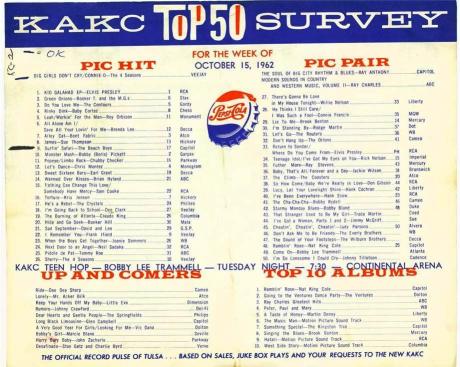 Most of it was fun and silly. Some of it was sexy. We had learned to do the Twist and we were listening to folk music. We had progessed from The Kingston Trio to Peter Paul & Mary. We were on the verge of Joan Baez and Bob Dylan and songs with messages. Our world was about to be rocked.
I graduated from high school in 1963 and left for Oklahoma State University, formerly an agricultural school but known for engineering and business by now. It was the heartland and the university was in the middle of the Oklahoma plains, formerly land rush country. Now I met cowboys, real cowboys, for the first time. My first roommate was from a class of 6 in a small town. I had traveled to Europe for the first time when I was a senior so my world was expanding and now I was learning the other side of my own state, meeting kids who grew up away from the cities I knew. We talked for hours, sitting on beds in the dorms, learning about new people.
In November of that year, President John F. Kennedy was assassinated. I remember the shock and horror. We had never experienced anything like this in our lives. Presidents didn’t get assassinated and here it was being shown over and over on television. We watched the accused assassin shot in front of us. To be on a campus of young people when this happened was the rude awakening we didn’t see coming. Our world was not what we had been led to believe at all. Everything we felt secure about was thrown up in the air and floated down around our confused young selves. Our music changed and the messages got deeper. By spring, we had met The Beatles on Ed Sullivan’s show and the sounds and the beat was driving us. We had rock & roll, folk music, and now the British influence. As those college years went on, we were shaking up our parents’ ideas, questioning everything.
In the 1960s, we faced the Viet Nam war and the boys in my class could suddenly be drafted. The ways to at least postpone it were to be in college or to be married. If you left college, you could be called up immediately. To say this had an impact on us is an understatement. Although many of my friends served since the war dragged on, many were able to avoid it. There were weddings all the time, either because the guy was leaving or to keep him from going.
For girls, college life was restrictive in these days when we were testing our new sense of idealism. On my campus, girls had to wear skirts and couldn’t live off campus until they were 23 unless they were married. We rebelled. As fashion changed in those years with skirts going from mid-calf to mini and micro-mini, the rules eased. We signed petitions for more realistic curfews and questioned why we couldn’t do what the guys could. During my college years, Gloria Steinem visited campus, bringing us the messages of women’s liberation. I listened to her and absorbed so much, wondering how this would fit in my life. The world was changing all around us. There was the sexual revolution and birth control and so much to absorb. Abortion was around and girls got them. Some of my friends were unable to have children afterwards. Do I believe in abortion? It’s a private and personal decision and it should be safe. Abortion will always be an option, but let’s make it safe.
I married my high school sweetheart in December 1966, soon after he was home from the Navy. As he worked on his degree, I taught English as a graduate assistant, and we had our first child, our oldest daughter, while we were in school. I was the oldest mother in the hospital at 22 in this time when birth control was new and everyone was marrying at a younger age.
By 1970, we had moved back to Tulsa, where my husband went to work for my father, we purchased our first home, and had our second daughter. I stayed home with the children, leading a life much like my parents had done. The difference was that I was one of a generation of women who had gone to college and been exposed to all these new ideas. We had birth control and education and degrees and what were we going to do with it? I played bridge and kept the house and did all the things I was supposed to do. I was bored and found volunteer work, which was to sustain me for the next couple of decades as an outlet to use my brain, network with the community, and expose myself to the rest of the world while growing into leadership positions. I worked with women, domestic violence, the arts, a nature center, water conservation, historic preservation, and diversity while working with community leaders, the media, and donors, developing skills and relationships I had used as I entered the work world in the 1980s and 90s.
My other salvation in the early 1970s was a group of women I met who formed a “discussion group.” We met once a week in the Presbyterian church half of us belonged to. The other half were members at the Unitarian Church. We had a sitter for the morning and our goal was to discuss anything but children. We took field trips, discussed books and ideas and used our brains, a welcome relief from our lives with toddlers and babies at home. I still love these women and the special bond we formed. We all went on to have interesting lives while raising our families. We were each other’s salvation for many years. One thing that happened in that group was that an older woman asked us to read a book that was being talked about, The Total Woman. A woman was going to use the church to have a lecture on the book and she was skeptical. I was asked to go to the lecture and report back to the group. The theory of the book was that women should be adoring to their husbands and cater to them so that they will adore you back. That’s simplistic, but one of the ideas was to meet your husband at the door dressed in saran wrap with a drink ready for him. Really. I don’t think that was going to happen in my house where I had three daughters by now. Where were they going to be during this? Anyway, I went to the lecture and took notes and reported back. My main takeaway from this was that it was really demeaning to men and gave them no credit for anything. It was manipulative, to say the least.
By the 1970s, we were talking about everything. We had learned from our own childhoods and were going to raise our children differently. When Our Bodies, Ourselves was published, we read it cover to cover. Who had ever talked about our bodies with us? I had learned everything from women’s magazines and talking to my friends. Doctors didn’t even talk about this stuff with us. We were talking now. And we were raising our children differently, just like we wanted to. By now, I had three girls and a boy and it was just 1975. I wanted them all to grow up with choices, all kinds of choices. They were raised with this…
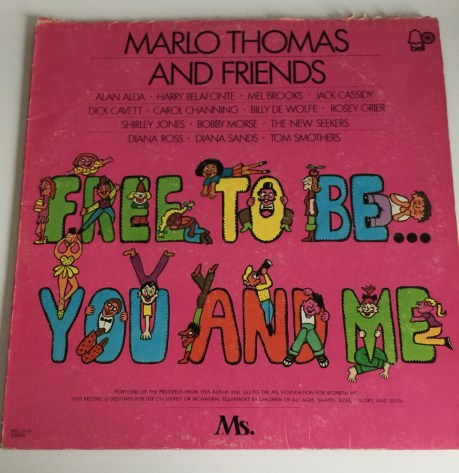 Yes, life was different for my generation. We talked about things and we learned about all our choices. By the time we were in our 30s, lives were changing. A friend lost her husband and all those years she had spent home raising the kids were now a challenge because she was a single mother having to enter the work force when she had lost ten years or so of career advancement. Other friends faced divorce because men now had the freedom to leave their wives for the girlfriends they had found. These women also found that they had to reinvent themselves. Life was not as simple as we thought it would be.
I won’t go on with the details of what I’ve learned, but it does make you reflect. Were things better back when men worked and women stayed home and nobody talked about anything? Were we better living in a world full of such dangerous secrets?
My own children’s generation is a mixed bag. They saw divorce up close and many chose to either wait or not marry. They have so many choices. They don’t have to hide the fact they are gay or lesbian as many of my friends did back in the days when you married as a cover because it was too dangerous to live your life the way you felt. We have more technology, different types of jobs, more ways to raise our children, more ideas to absorb and it all changes quickly. There have been movements to get back to basics, back to the earth, back to priorities.
My sons-in-law participate in their children’s lives as my generation’s men were only beginning to be able to experience. My father’s generation would never have left work for ball games or plays or stayed home to raise the kids while the wife worked. In that way, women’s freedom has freed up men to be better people, better parents.
The diversity of our world has changed so much in my lifetime as we learn to be proud of where we come from, to understand our ancestors, to see that we all want the same things for our children. I see families with parents from mixed races, same sex parents, old and young parents, and I see families who understand that love is love is love. We learn more about other cultures, other countries, other people. What we should be seeing is that we all want homes, food, water, security and education for our children. We’re not that different at all.
In times of fear and anger, I look around me and reassess once again what I want. I want to leave this world a better place than when I arrived. I want my grandchildren and their children to have the beautiful wild places to visit to restore their souls from the fast pace of human life. I want their lives to be rich with experiences and friendships and love. We’ll never be perfect as human beings, but we can progress. Or at least try. That’s what I see when I look way back at my life’s experiences and then turn around and look to the future.
We keep trying our best and doing good things and loving, loving, loving.

 While driving to the election board for early voting, I suddenly found myself crying, once again something I’m not prone to doing while I’m on my way to vote. All these conversations I had with my mother came flooding back to me. Anyone who knew my mother knew how strong she was. I often wondered how in the world I was related to someone who was so much stronger than I ever felt.
 So I drove to the polls with a sudden rush of knowing how all the women in my family would vote today, even the ones who were never allowed to vote. I had a vision of having a discussion with all my ancestors on both sides, male and female, about the candidates in this election. I’m not sure how the men would vote really because they are from a different time and different generations. But, the women would know exactly who and what is going on. I felt that so strongly after my fifteen minute drive, which was an interesting feeling. I certainly hadn’t been thinking about any of them when I started out this morning.
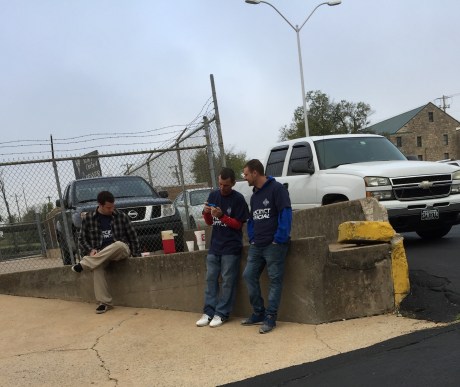
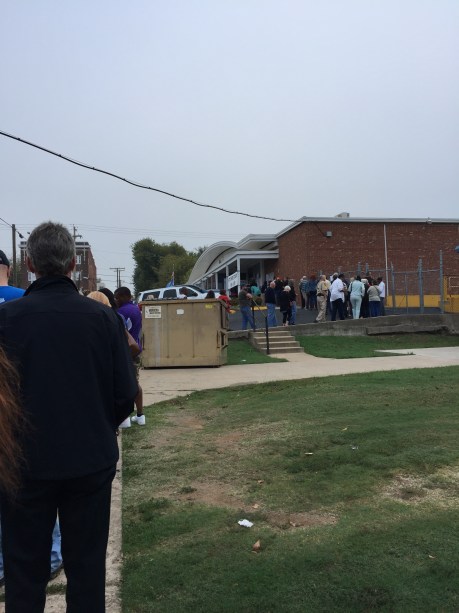 You can see the line wound up and around the dumpster, although not too long. Beside us were the election officials, who were drinking coffee and talking.
 A man with a cane approached the line and they stopped him to show him where he could go so he didn’t have to stand in the longer line. He was most appreciative and they were very polite. Inside, there were sheriffs to tell us how to proceed and they were friendly and helpful and nice. Everyone was smiling, everything moved quickly and, even with a long ballot to hand mark, the whole thing took about 20 minutes. As I left, more elderly people, on walkers, canes and in wheelchairs, were entering through the other door. That was nice to see. They were making the effort to be there.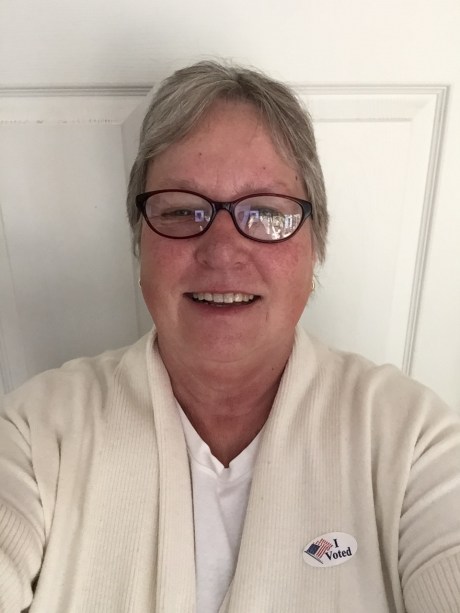
 I’m mostly writing this because I’m depressed and ashamed to have given any encouragement at all for the growth of this ugliness. I’m embarrassed for all the times I laughed at mean-spirited jokes or didn’t speak up when I heard words spoken that made me shudder. I’m ashamed for being so afraid at this time in my life when I should be relaxing and enjoying the fruits of my life – mainly my children and grandchildren.
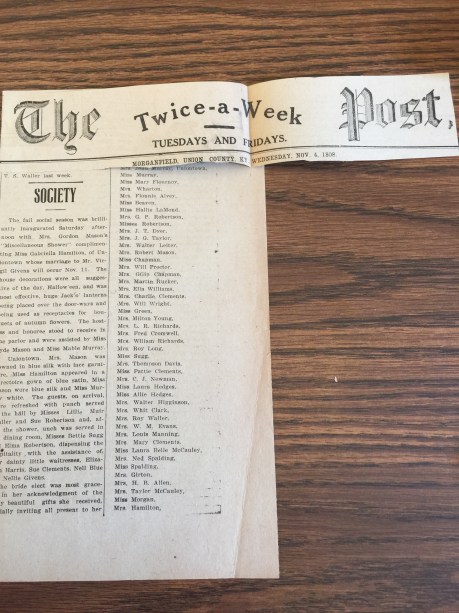 I thought the description of the decorations for this Halloween shower were right up to Pinterest standards today as they used jack o’lanterns filled with flowers placed over the doorways. More details show that the guests were served punch before lunch, assisted by young girls, including the soon to be stepdaughter/niece of the bride.
 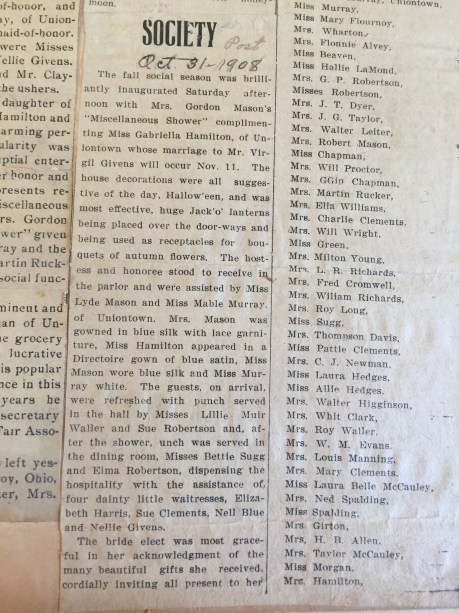 We may not dress in blue satin and silk these days and we don’t really have parlors anymore, but the rest of the details are so very familiar to those of us who have been to many bridal showers in our lifetimes.
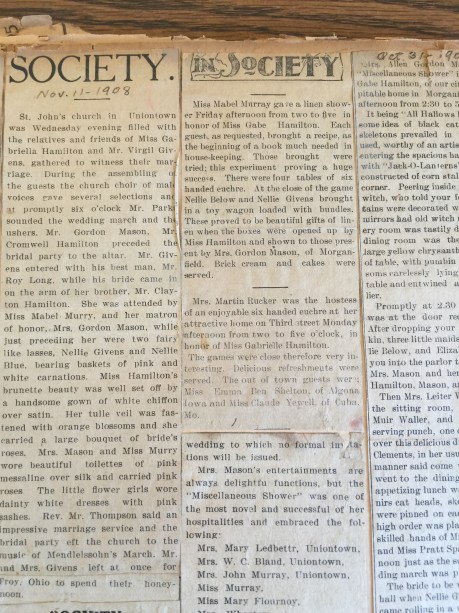 You will notice that six-handed euchre was played at two of the showers. I had to look this up, although I knew it was a card game. Euchre was very popular at this time and was the game that introduced jokers to the deck. I can’t give you many details other than it involves taking tricks, so maybe it’s close to Bridge. I guess the practice of playing cards at bridal showers has gone by the wayside, although I think it sounded like a fun thing to do.
 a
a

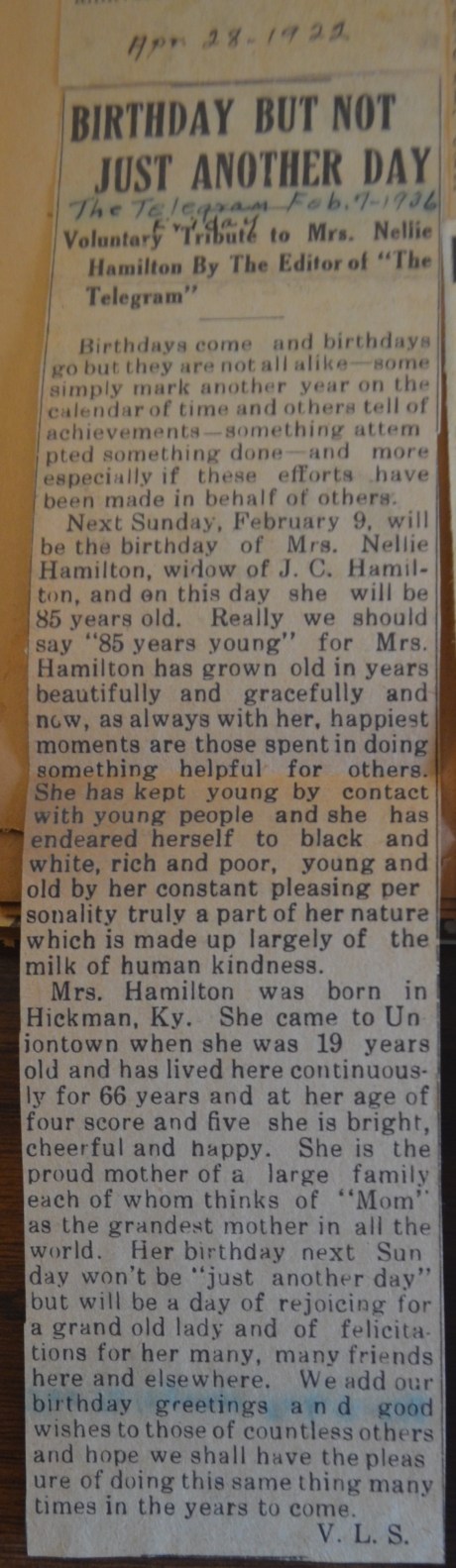 Ella or Nellie Hamilton came to Kentucky from Louisiana (the clipping has that wrong, as she was born in Louisiana and moved to Hickman later) and moved to the town of Uniontown at the age of 19. I’m not sure what brought her there, but I know her father had died years earlier and her mother may have had relatives nearby. At the age of 21, she married my grandfather who was 34 at the time. I think it was fairly common for the men to marry younger women as I’ve seen this with others on my family tree. I’m assuming he was fairly settled by then. They were the first couple married at St. John Episcopal Church in Uniontown. I found a clipping that said he was confirmed as a member along with four of his sons years later and I know he served in leadership roles in the church after that.
 She is holding her youngest baby while one of her daughters holds her youngest. This young mother would soon die and the son-in-law pictured behind the mother and baby would later marry one of the other girls who would raise the children. Hard to keep them all apart in my own family’s saga. My grandfather is the little boy in the grass in the middle, shown with one of the family dogs.
 And this one must be about 1915…
 And here she is on her 50th wedding anniversary in 1922.
 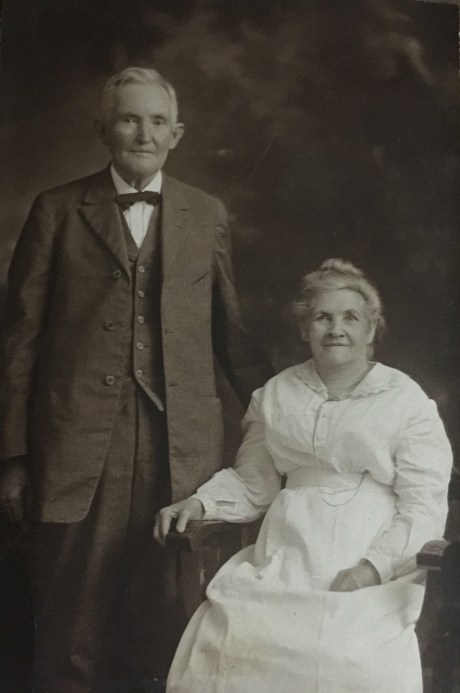 What were those spells, those fussy spells? I mean, why would she have reason to act anything other than her sweet loving self with 8 children running around a huge house…
 …even though she had cooks and others to help with laundry and managing the gardens and the cleaning. I mean, really. Her mother also lived with them, so there was some help with the sewing and teaching the children manners and getting them to school. Life was easier in that she didn’t have to drive them to school since they could pretty much walk anyplace in town and everyone knew them so they were safe in that way.
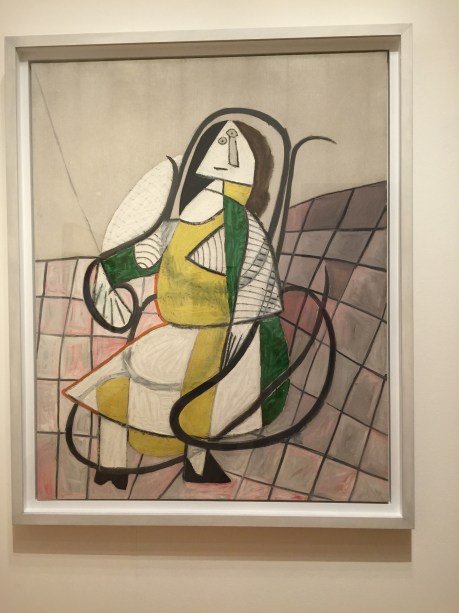
 It wasn’t a large painting at all. When I saw this Picasso, I felt a big smile. Oh you, Picasso, you! “Rocking Chair” was one of my favorites I kept returning to. Maybe I saw my future!
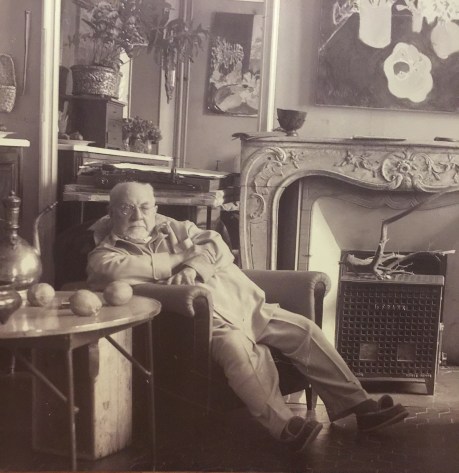
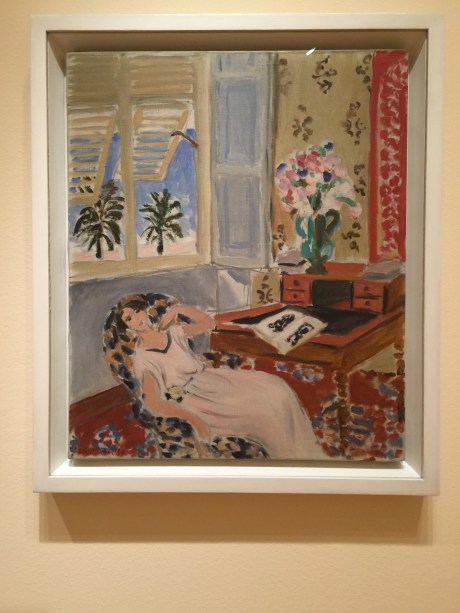
 I won’t spoil the show for you, but it was pretty spectacular for art lovers. To think he spent his last years cutting designs and creating fanciful treats for us to enjoy all these years later. Thank you, Matisse!
 I went downstairs to see the permanent Chihuly exhibition and the rest of the museum, going back through the Matisse show before I finally left. Chihuly brightens my day and brings joy to my heart. Having tried glass blowing, I can only say it takes not only creative talent but an enormous amount of strength to master the manipulation of the hot, heavy glass. His work always makes me go Wow!
 Since I was by myself, I thought I would do some things I’d been wanting to do. Next was the Oklahoma City National Memorial, just blocks away. Did I mention I was born in Oklahoma City and lived there until my family moved to Tulsa when I was 2 1/2, back in 1948. I spent much of my life traveling back to see my grandparents, aunts, uncles and cousins and even spent work time here later on. It is a part of me.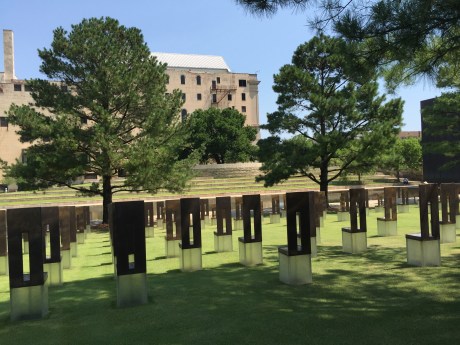
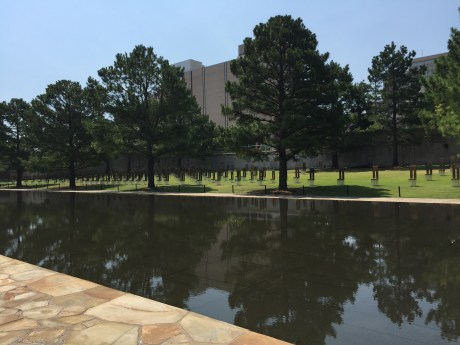 A couple of years ago, I toured the JFK Memorial in Dallas and I felt the same way about this one. I lived through it and it is so painful to walk through each detail again. Both are wonderful walks through our history with details that take you right into the moment if you were here at that time. For those who are younger, these are important ways to understand and learn what happened, bringing it to life. In the OKC memorial, you walk into an exhibit that shows what a normal day it was and then you wait to enter a room that is a copy of the ordinary meeting room where the Water Resources Board was meeting that fateful meeting. They had recorded the meeting and you sit in a closed room listening to a woman start the meeting, giving instructions, greeting the visitors, knowing that you are going to hear an actual recording of the bomb exploding. I was lulled into listening to her as she routinely did her job and then jolted by the sounds of bomb, screams, hysteria and confusion. You then enter the rest of the story. I didn’t spend too much time there as the photos and sounds were so very familiar to me. I stood in the memorial room, looking at the portraits of the victims, hearing their names as they were called as each person’s picture was lit. Powerful stuff to see the miniature memorials of stuffed animals, tokens of memory placed by families. Powerful. I was ready to race back into the 100 degree heat and rest in the memorial outside, standing in the shade of the huge tree that showed us we can make it, even through such atrocities.
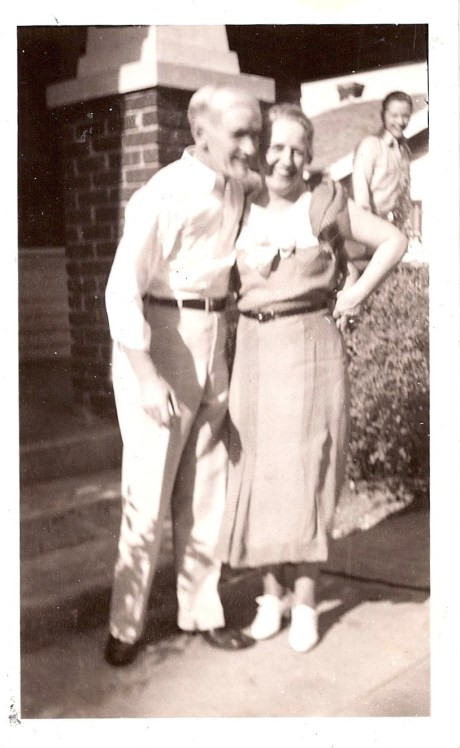 Here they are, relaxing in that wonderful home, much smaller than I remember it when we gathered for dinners and holidays. My grandad had his workshop in the garage in back and the big kids got to eat at the big table in the room behind the kitchen at the back of the house. The smaller children ate at the kid’s table in the kitchen. The beds were so tall that we could crawl under them easily and had endless games of hide ‘n seek. We played on that porch and walked that street for hours.
 Driving around the corner, I saw the movie theatre we used to walk to, now an antiques mall…
 …and parked across the street for a fried chicken lunch. It seemed like the right thing to do and the right area to be in.
 After drinking as much liquid and eating fried chicken and fried okra, I headed further north with the goal of visiting my grandparents’ grave, very far north in a city that sprawls forever. Driving past the more affluent areas where my grandparents and cousins lived later, I finally arrived at the cemetery. I have to tell you that my family isn’t much for visiting graves and I hadn’t been here since my grandmother died in 1977. My parents were both cremated, which I agree with, so here we are. I’ve visited all my grandparents’ graves now along with my great-grandparents, so I’m up to date. There are mixed feelings about graves for me. They are interesting, but I’m obviously not out there all the time. I don’t know if we are losing some history, but I’m about dust to dust too. I’m being cremated myself.
 Wiley Post, the great aviator from Oklahoma who died in the Alaskan plane crash with his friend, Will Rogers.
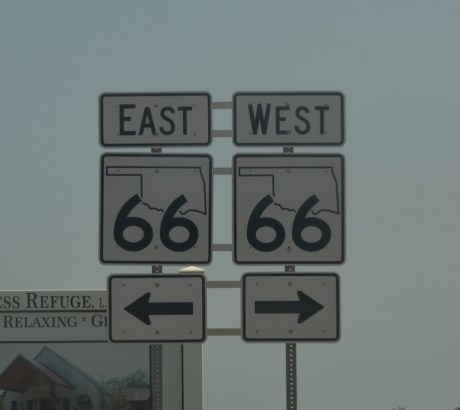 I hadn’t been on this stretch in a few years, so it was a new adventure. There are places with stories like this.
 And then you turn a corner and then modern times hit you as you meet the new Iowa tribe.
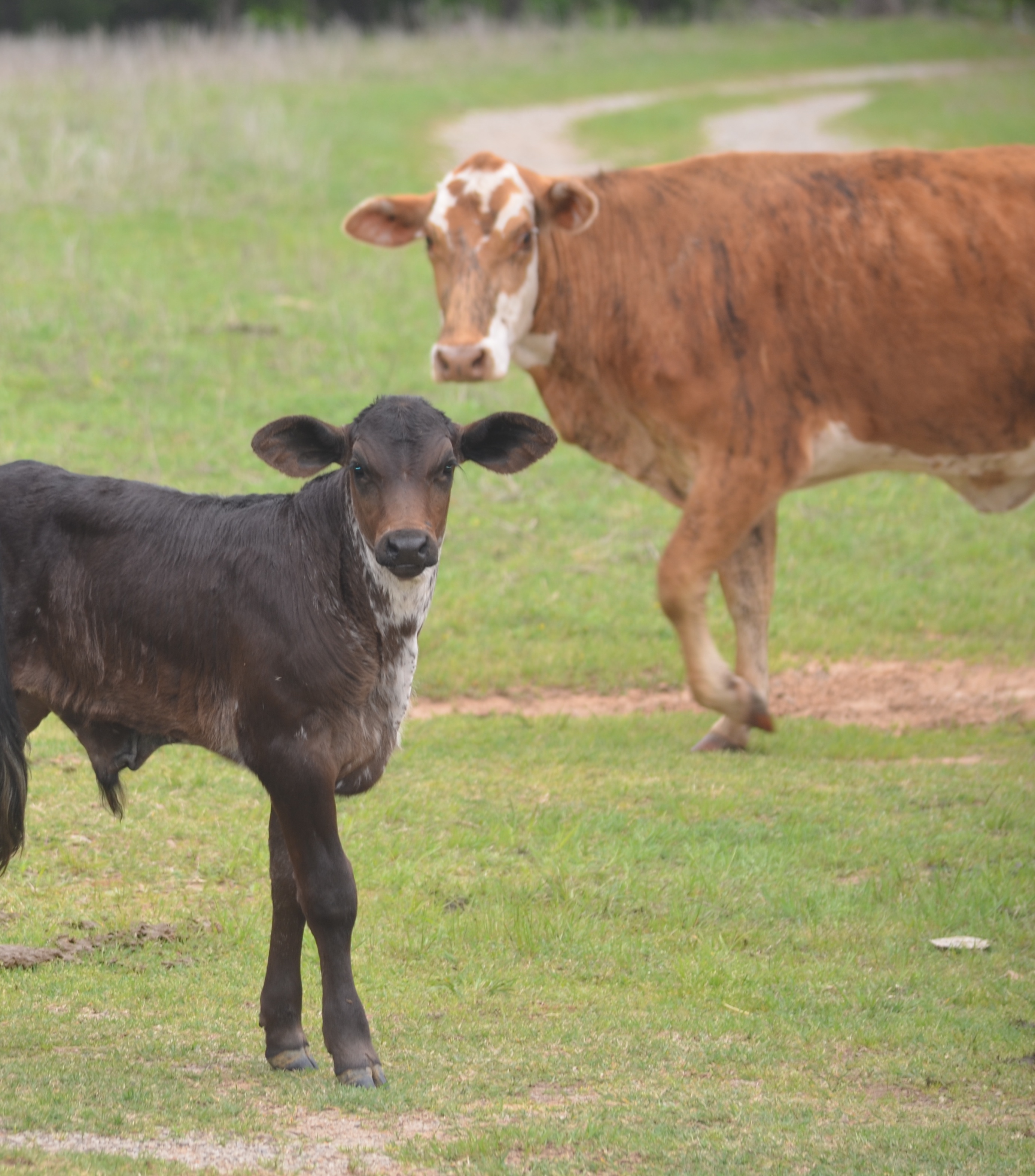
 In the eastern side of Oklahoma, we have brown dirt, regular dirt. About halfway between Tulsa and OKC, you begin to see the red dirt, clay colored dirt. Growing up, we would play in this bright stuff, staining our summer clothes. I guess my mother knew how to get it out because I’m picturing white shorts and tennis shoes with globs of red mud on them. Anyway, that memory came back as I saw this scene with cows and ducks cooling off in the red muddy waters.
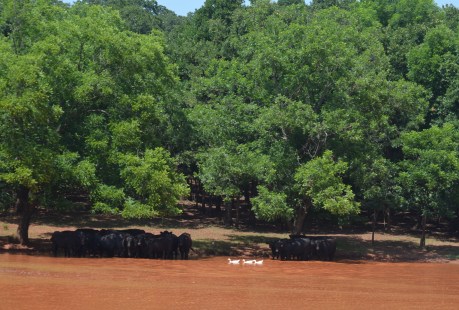 Across the road, there was a farm with green plants pushing up through the red earth.
 I kept turning around and going back to see these things. On the last pass by this field, where I had stopped to take pictures, I had to stop at this sign, conditioned by my mother who never saw a road-side stand she didn’t love.
 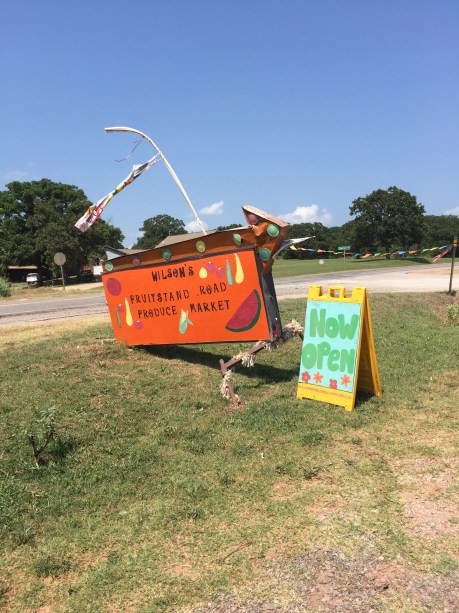 I mean, you have to stop, don’t you? Especially when you can meet Mr. Wilson himself.
 I know he thinks I’m the most ignorant city girl he’s ever seen as I asked him questions about how hard it is to grow crops in that red soil. Of course, he smiled his missing tooth smile and told me it’s no problem if you have water. Of course. And I purchased potatoes and peaches and tomatoes from him, even though I asked and he told me that these weren’t his crops as his aren’t ripe yet. Duh. Of course they aren’t. I know when Oklahoma crops come in. But I wanted to keep his stand going, chickens running around with its cute painted things and all sorts of quirky items on the ground.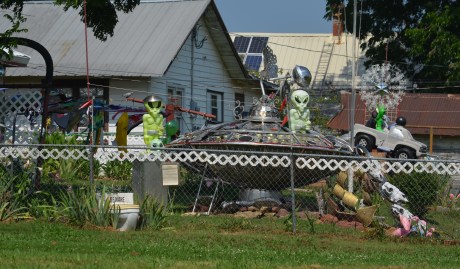
 Following along, I approached Depew and took the truck route through the mostly deserted town. It had its own charm as I drove the main street, thinking of the people who came from all over the country to travel this road.
 Leaving Depew, I crossed the old railroad tracks leading east.
 Now I was passing through other towns that had jumped on the Route 66 bandwagon and restored their main streets with antique shops and restaurants and museums for those who are hitting the off roads again. Occasionally, I saw one of these signs and jumped off the current Route 66 onto the old one.
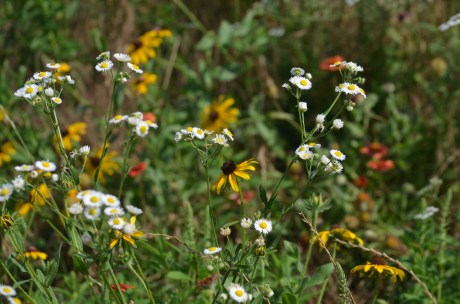
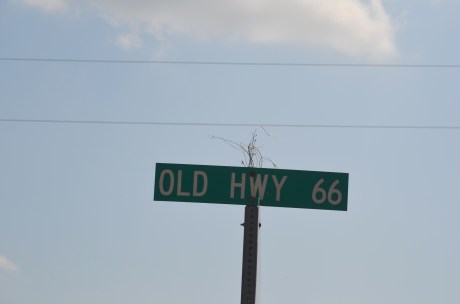 Driving for just a stretch, I would imagine how it must have been with new fangled cars heading across the country on great adventures – without the air conditioning I was enjoying so much! Whew! These old stretches have wildflowers still alive before our stretch of summer heat wilts them all.
 At a house on the old road, I saw this basketball goal where someone had made Old Hwy 66 into a private court.
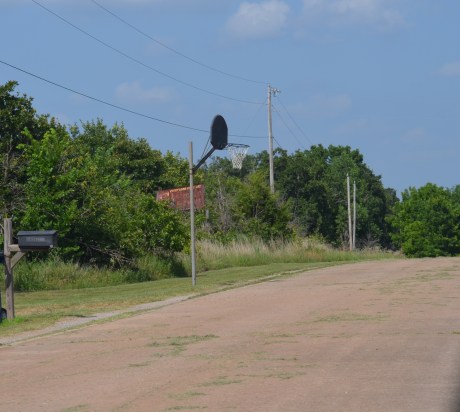 Here’s the old sign you see in the background.
 Turning back from this little touch of the old Mother Road…
 I kept going, stopping and turning around for things like this that caught my eye as I made my way home.
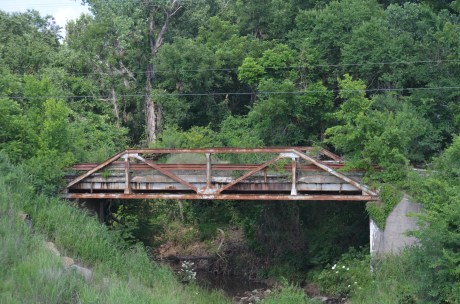 And this. I saw the sign from the road and then turned onto the next street with another one of those Old Hwy 66 signs.
 It was deserted, but must have been a lot of fun at one time.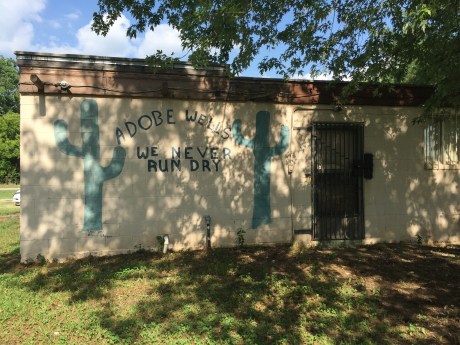
 That was my day on the road alone, not rushing anywhere and stopping to see whatever. Adventures and people I wasn’t expecting made me arrive home hot and happy. I should do this every week, this getting in the car and going somewhere. There’s so much to see out there in ordinary places and I’m old enough to enjoy it and young enough to do it. Thanks for coming with me…













 Confetti Thoughts